Steel Pipe Types, Sizes, Specifications and Selection Guide
Ordering steel pipe by size alone is how projects end up with the right dimensions and the wrong material, and the fix starts with three questions: what load, what environment, what standard.
A steel pipe is a hollow section, and the hollow is the point. The same product is sold as steel tube in some markets and as MS pipe or mild steel pipe in others, but the engineering is identical. Distributing metal away from the centre of the section gives far more strength per kilogram than solid bar, which is where its resistance to bending and torsion comes from.
Get any of those three questions wrong and you either overspend or install a section that cannot carry what it was meant to. This guide covers steel pipe types by shape and manufacturing method, standard sizes and wall thicknesses, the international specifications that govern them, how to calculate weight per metre, and the ordering mistakes that cost most.
What Is a Steel Pipe and How Is It Made?
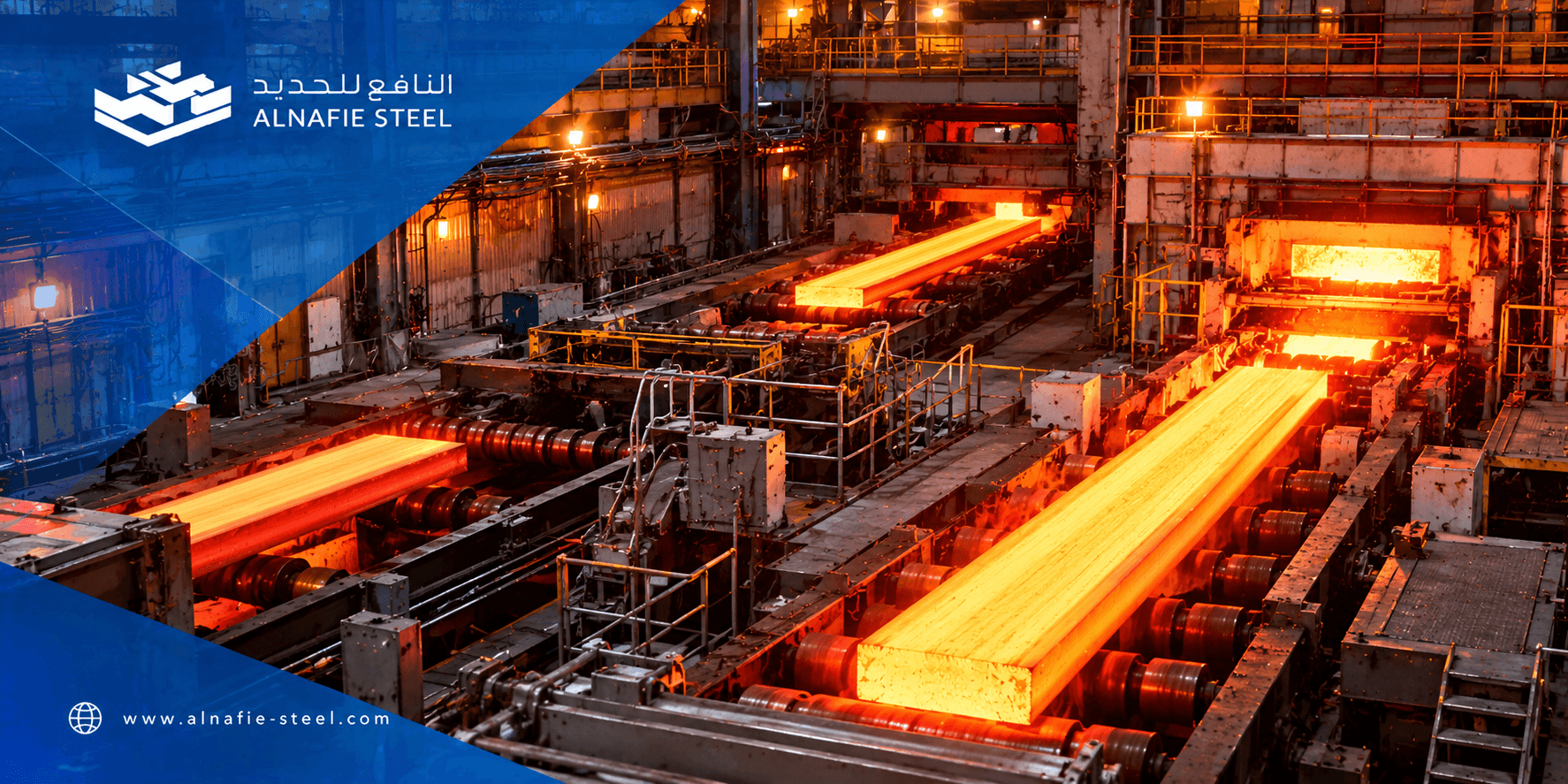
Most structural hollow sections start life as coil or plate — specifically hot rolled plates and coils — which are then formed, welded along the length, and cut to size.
Pipe or Hollow Section? They Are Not the Same
This distinction is a recurring source of confusion in purchase orders, and it is not cosmetic:
- Pipe: sized by nominal diameter (NPS or DN) and wall schedule. Its primary job is carrying fluid.
- Hollow section: sized by actual outside dimensions and wall thickness. Its job is structural. Abbreviated SHS for square, RHS for rectangular, CHS for circular.
- MSH sections: the common trade name in the Gulf market for square and rectangular hollow sections.
Order a “100 mm pipe” when you meant a 100 × 100 mm square hollow section and you will receive something entirely different, because the two measure from different reference points.
Welded or Seamless?
Welded pipe is formed from strip and joined along its length — the economical route that covers most structural and plumbing work, with ERW pipe dominating small and medium diameters. Seamless pipe is pierced from a solid billet, so there is no weld line to become the weak point under high pressure or temperature.
That is the short version. The full comparison — pressure behaviour, wall consistency, cost and where each is specified — is covered in our dedicated guide to ERW and seamless pipes.
Cold-Formed or Hot-Finished?
A second distinction carries equal weight and gets far less attention.
Cold-formed steel tubing is cheaper and dimensionally more precise, but it retains residual stresses at the corners. Hot-finished sections are relieved of those stresses, gain toughness at low temperature, and carry a more generous corner radius.
The corner radius is not a detail. It changes how connections seat and how details are drawn, and it becomes visible on hot-finished sections.
Need help choosing the right Steel Pipe for your project? Call us today.
Al Nafie Steel
Steel trading and import in the Saudi market since 1979
Jeddah • Riyadh • DammamSteel Pipe Types by Shape
This is the classification that matters most in practice, because shape determines how the section behaves under load. Suppliers list the same three profiles as steel tube or as hollow section depending on whether the intended use is structural or fluid-carrying, but the geometry is what governs performance either way.
Square Tube — Square Hollow Section (SHS)
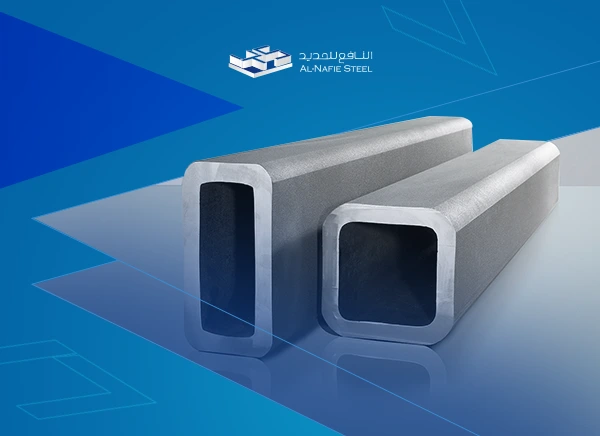
Sold as square tube or square hollow section depending on the supplier, this profile is symmetrical about both axes, so it resists bending equally in every direction. That makes it the logical choice for columns receiving load from more than one direction.
Where it is used:
- Columns in steel structures, canopies and warehouse hangars
- Fences, gates and handrails
- Metal furniture and industrial racking
- Equipment frames and machine bases
Square tube is also the easiest profile to fabricate. Four right-angled corners simplify the work: cuts are straight, joints sit flat, and no profile cutting templates are needed as they are with round sections.
Rectangular Tube — Rectangular Hollow Section (RHS)
A rectangular tube is asymmetrical — its bending resistance is substantially higher about the long side. That makes it the right choice for beams and horizontal members where load arrives from one known direction.
Where it is used:
- Beams and horizontal members in steel structures
- Door, window and façade frames
- Bases and supports in industrial facilities
- Trailer chassis and equipment frames
The condition is orientation. Installing a rectangular section with its long side horizontal instead of vertical wastes most of its bending capacity, and it is a mistake that survives inspection because the size on the delivery note is correct.
Circular Hollow Section (CHS)
A circular hollow section is best in torsion and best in wind, because its curved surface reduces drag coefficient. It is also the only shape genuinely used to carry fluids and gases under pressure, which is why circular hollow section and round steel tube dominate service networks rather than structural frames.
Where it is used:
- Water networks, firefighting systems and gas lines
- Circular columns, towers and scaffolding
- Exposed structures subject to high wind loads
- Visible architectural applications
Quick Comparison
| Criterion | Square (SHS) | Rectangular (RHS) | Circular (CHS) |
|---|---|---|---|
| Strength distribution | Equal both axes | Higher on long side | Equal all directions |
| Best for | Columns | Beams | Torsion and pressure |
| Connection ease | High | High | Needs profile cutting |
| Wind resistance | Moderate | Moderate | Best |
| Carrying fluids | Not suitable | Not suitable | The only option |
GI Pipe, Black Steel Pipe and Finish Options
Finish often determines service life in Gulf conditions more decisively than wall thickness does.
| Finish | Description | Best suited to |
|---|---|---|
| Black steel pipe | No protective coating, natural oxide surface | Interior use, or where painting follows |
| GI pipe (galvanized steel pipe) | Immersed in molten zinc to ASTM A123 | Coastal, humid and exposed environments |
| Pre-galvanized | Galvanized coil formed after coating | Light interior duty |
| Painted / epoxy | Barrier coating over a prepared surface | Per the project coating specification |
GI pipe — galvanized iron pipe — is the standard request for water supply and firefighting lines across the Kingdom, precisely because hot-dip galvanizing coats the bore as well as the outside. Pre-galvanized tube does not offer the same protection at cut ends, which is why the two are not interchangeable despite both being sold as “galvanized”.
Black steel pipe remains the economical choice wherever it will be enclosed, painted, or used indoors away from moisture. Ordering galvanized steel pipe where black would serve is a common and avoidable cost.
For zinc coating behaviour in more depth, see galvanized sheet and coils.
Steel Pipe Sizes, Wall Thickness and Schedule
Steel pipe sizes are not arbitrary. They follow standard series that mills produce, and stockists hold, and stepping outside them means custom production and longer lead times.
Square and Rectangular Steel Tube Sizes
Written as width × height × thickness (mm) — for example 100 × 50 × 3.
| Type | Common sizes (mm) | Common thickness (mm) |
|---|---|---|
| Square SHS | 20×20 to 400×400 (20, 25, 30, 40, 50, 60, 80, 100, 120, 150, 200, 250, 300, 400) | 1.2 – 16 |
| Rectangular RHS | 40×20, 50×25, 60×40, 80×40, 100×50, 120×60, 150×100, 200×100, 250×150, 300×200, 400×200 | 1.2 – 16 |
Standard lengths for cold-formed steel tube under the European specification are 6, 8 and 12 metres, while American sections use foot lengths such as 24, 40 and 48 ft. Available series and thicknesses vary by mill, so match your required size against the stock list before finalising the design.
Round Pipe Sizes — NPS, DN and Schedule
Round pipe is not measured by its outside dimensions directly. It uses a fixed nominal diameter with a wall thickness that changes by schedule number:
| Nominal | Inch | OD (mm) | SCH 40 wall (mm) | SCH 80 wall (mm) |
|---|---|---|---|---|
| DN 25 | 1″ | 33.4 | 3.38 | 4.55 |
| DN 50 | 2″ | 60.3 | 3.91 | 5.54 |
| DN 80 | 3″ | 88.9 | 5.49 | 7.62 |
| DN 100 | 4″ | 114.3 | 6.02 | 8.56 |
| DN 150 | 6″ | 168.3 | 7.11 | 10.97 |
| DN 200 | 8″ | 219.1 | 8.18 | 12.70 |
The essential point: outside diameter stays fixed for a given nominal size no matter how the schedule changes — what changes is wall thickness and bore. This is why the same fittings and flanges suit every schedule at the same diameter, and why pipe schedule 40 and schedule 80 are interchangeable in connection terms but not in pressure rating.
Calculating Steel Pipe Weight per Metre
Weight drives pricing, freight and dead load calculations. Approximate formulas at a steel density of 7.85 g/cm³:
- Square: weight (kg/m) = 0.0314 × thickness × (side − thickness)
- Rectangular: weight (kg/m) = 0.0157 × thickness × (width + height − 2 × thickness)
- Circular: weight (kg/m) = 0.02466 × thickness × (outside diameter − thickness)
Worked examples:
| Section | Calculation | Result |
|---|---|---|
| SHS 50×50×3 | 0.0314 × 3 × 47 | ≈ 4.43 kg/m |
| RHS 100×50×3 | 0.0157 × 3 × 144 | ≈ 6.78 kg/m |
| CHS 60.3 × 3.91 | 0.02466 × 3.91 × 56.39 | ≈ 5.44 kg/m |
These formulas work for any hollow profile. They ignore corner radii, so actual mill-table weights run slightly lower. Use them for quick estimation and the mill table for final quantities.
Not sure which size your design actually needs? Send us the load, the span and the operating environment, and our team will size the section for you — before you commit to a specification. No drawing required to start. Contect us now
Carbon Steel Pipe Standards and Grades
Most structural and general-purpose steel pipe on the Saudi market is carbon steel pipe — plain carbon and carbon-manganese grades, as distinct from alloy or stainless. The specification is what turns “a pipe” into an auditable product. Without it there are no guaranteed yield values and no dimensional tolerances.
| Standard | Scope | Common grades |
|---|---|---|
| ASTM A500 | Cold-formed structural tubing — round, square and rectangular | A, B, C, D |
| ASTM A501 | Hot-formed equivalent of A500 | A, B |
| EN 10219 | Cold-formed welded hollow sections | S235JRH, S275J0H, S355J2H |
| EN 10210 | Hot-finished hollow sections | S235JRH, S355J0H, S355J2H |
| ASTM A53 | Welded and seamless pipe for general and plumbing use | Grade A, Grade B |
| ASTM A106 | Seamless carbon steel pipe for high-temperature service | A, B, C |
| API 5L | Line pipe for oil and gas transmission | B, X42 – X70 |
| ASME B36.10M | Standard wall thickness schedules | SCH 40, SCH 80 and others |
How to Read a Grade
The grade carries its meaning in its name. In the European designation S355J2H: S is structural steel, 355 is the minimum yield stress in MPa, J2 indicates impact testing at −20°C, and H means hollow section.
In the American system, Grade B and Grade C under ASTM A500 are the most requested for structural work, with Grade C preferred where strength requirements are higher.
One practical note on terminology: carbon steel pipe, mild steel pipe and MS pipe usually refer to the same family of low-carbon grades, and the label used tells you nothing about the grade. Only the standard and grade designation does.
American and European standards are not automatic substitutes for one another. Any substitution must go through the design engineer or the purchasing authority.
The Mill Test Certificate
Request the mill certificate with every delivery. A type 3.1 certificate under EN 10204 is issued by an independent inspection function inside the mill, and documents chemical composition, mechanical properties, and the heat number matching the marking printed on the pipe itself.
A missing heat number, or one that does not match the goods received, is a signal to stop and review rather than a paperwork detail.
It also helps to understand how alloy steel elements affect the properties listed on that certificate — particularly the carbon content and its relationship to weldability.
Need help choosing the right Steel Pipe for your project? Call us today.
Al Nafie Steel
Steel trading and import in the Saudi market since 1979
Jeddah • Riyadh • DammamHow to Choose the Right Steel Pipe for Your Project
Six Practical Steps
- Define the function first. A column wants square, a beam wants rectangular, fluid transport wants round.
- Calculate load and span. Load and the distance between supports determine the section modulus required, and therefore the size.
- Choose specification and grade from what the project documents demand, not from what happens to be available.
- Increase thickness before increasing size. Adding wall thickness at the same outside dimension is often cheaper than jumping to a larger section.
- Match the finish to the environment. Coastal or exposed projects earn hot-dip galvanizing from the start.
- Check availability and length. A design built around a rare size means either delivery delay or waste in cutting.
Common Ordering Mistakes
- Ordering by size alone with no specification or grade. A 100×100×4 section can arrive in grades that differ substantially in strength.
- Ignoring permitted thickness tolerance. Negative tolerance can reach 10% of nominal thickness — a real difference in structural calculations.
- Overlooking corner radius, which affects details and connections and is more pronounced on hot-finished sections.
- Assuming black pipe will be painted later. Paint over an unprepared surface offers no real protection.
- Welding galvanized sections without preparation. Zinc must be removed locally, ventilation provided, and protection restored afterwards — see steel welding before starting.
Protecting Steel Pipe from Corrosion in Gulf Conditions
High humidity and airborne salts in coastal areas accelerate corrosion noticeably compared with inland sites. Three rules reduce the problem:
- Choose hot-dip galvanizing for exposed members rather than paint alone.
- Seal or drain the ends of hollow sections. Water trapped inside rusts the section from within, where nobody sees it until it is serious.
- Inspect weld locations periodically — they lose protective coating first.
Steel Pipe Applications in Saudi and Gulf Projects
| Sector | Application | Typical section |
|---|---|---|
| Construction | Columns and beams in steel structures | SHS / RHS |
| Infrastructure | Temporary bridges, supports and towers | CHS / SHS |
| Industry and plants | Equipment frames, machine bases, conveyors | RHS / SHS |
| Oil and gas | Transmission lines and platforms | Seamless CHS |
| Water and firefighting | Supply networks and sprinkler lines | Galvanized CHS |
| Commercial projects | Façades, canopies and car parks | SHS / RHS |
Hollow sections are rarely used alone. A complete steel structure combines them with beams and channels in the primary load-bearing members, equal and unequal angles in bracing and connections, and hot rolled steel grating for platform and walkway flooring. In concrete buildings, hollow sections work alongside reinforcement bar in secondary members, canopies and façades.
Where corrosion resistance beyond galvanizing is required, stainless steel round, flat and angle bars cover the alternative material range.
Already holding a quotation from another supplier? Send it over. We’ll tell you which grade and wall tolerance it is actually based on — so you know whether you’re comparing like with like before you sign anything. With Alnafie Steel Company in Riyadh
Steel Pipe Supply from Alnafie Steel Company
Alnafie Steel is a steel company in Saudi Arabia and one of the leading steel suppliers in Jeddah, Riyadh and Dammam. The company has traded steel and metals since 1979, from its headquarters in Jeddah with principal centres in Riyadh, Dammam and Dubai. Four decades in this market means understanding what contractors and fabricators actually need on the pipeline item, not simply holding a size list.
We import ferrous, non-ferrous and alloy products from selected international manufacturers, with adherence to approved specifications on every supply.
What sets our supply apart on this line:
- A range of sizes and wall thicknesses covering light and heavy structures
- Compliance with international standards, documented in supply paperwork
- Technical support in selecting section and thickness before purchase
- Integration with the rest of your project scope across commercial steel and special steel
- Support services that shorten your preparation steps
Get the Specification Right the First Time
You now know the questions that separate a real order from a guess: which grade, which tolerance, which finish.
Send us your requirement, and we’ll answer directly — section, grade, wall thickness, finish and price on a single line. If you’d rather send a drawing, we’ll size the sections and flag what’s missing before it reaches site.
Four decades supplying Saudi industry. One conversation to get the specification right.
Need Any Steel Advice For Your Project? Talk to Us Today
We serve project sites across Saudi Arabia.
Al Nafie Steel
Steel trading and import in the Saudi market since 1979
Jeddah • Riyadh • DammamFrequently Asked Questions
What is the difference between square and rectangular hollow sections?
The square section is symmetrical and resists bending equally in both directions, which suits columns. The rectangular section is stronger about its long side, which suits beams and horizontal members — provided it is installed in the correct orientation.
What steel pipe sizes are available?
Square sections typically run from 20×20 mm to 400×400 mm and rectangular from 40×20 mm to 400×200 mm, with common thicknesses between 1.2 and 16 mm. Round pipe is measured by nominal diameter from DN 15 upwards with standard wall schedules. Actual availability varies by mill and stock.
How do I calculate steel pipe weight per metre?
Square: 0.0314 × thickness × (side − thickness). Rectangular: 0.0157 × thickness × (width + height − 2 × thickness). Circular: 0.02466 × thickness × (outside diameter − thickness). Results are approximate because they ignore corner radii.
Which is better, ERW pipe or seamless pipe?
ERW pipe is more economical and covers most structural and general plumbing work. Seamless is preferred for high pressure and temperature and for oil and gas lines, where a weld seam represents a potential weak point.
What is the difference between GI pipe and black steel pipe?
GI pipe is hot-dip galvanized, with zinc coating inside and out, and is standard for water and firefighting lines. Black steel pipe has no coating and suits enclosed, interior or subsequently painted applications at lower cost.
What does schedule 40 mean?
It is a standard wall designation that fixes wall thickness at a given nominal diameter. A higher schedule number means a thicker wall and higher pressure capacity, while the outside diameter stays unchanged.
Which standard should I specify for structural work?
Usually ASTM A500 on projects with American references, and EN 10219 or EN 10210 on projects with European references. The governing document is always the project specification.
Is galvanized steel pipe always necessary?
No. Galvanizing is a justified investment in coastal, humid and exposed conditions, while painted black pipe is sufficient for protected interior use.
What is the standard length of structural pipe?
6, 8 and 12 metres under metric specifications, and foot lengths such as 24, 40 and 48 ft under American ones. Match length to design details to reduce cutting waste.