The wrong steel grating specification means a floor that flexes underfoot or a shipment sent back from site, and the fix starts with three numbers: load, span, and deflection limit.
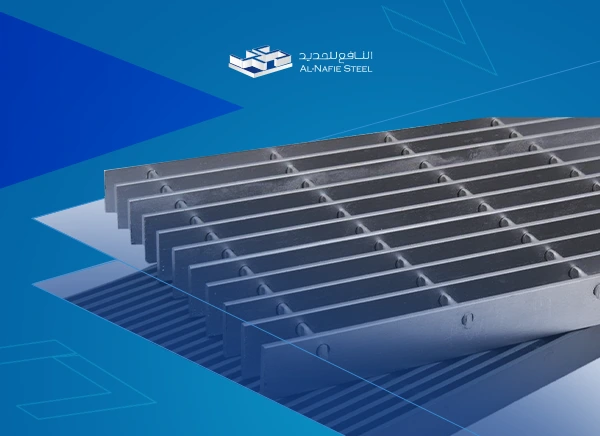
Those three numbers determine your bearing bar size. Everything else shape, finish, product name comes after them. Grating itself is an open floor panel built from parallel flat steel bars locked together by cross bars, so it carries heavy loads at a fraction of the weight of solid plate while letting water and air pass through.
Before any technical detail, one point needs settling: the same name covers four different products in this market. This guide separates them first, then goes deep on steel grating types, sizes, standards and the factors that actually drive price.
In this article, our team at Alnafie Steel Company in Riyadh, Jeddah, and Dammam explain steel grating types, sizes, and your guide for projects
Four Different Products Share One Name
In the Saudi and Gulf market, buyers use overlapping terms for products that have nothing in common beyond the word “mesh” or “grating”. Mixing them up in a purchase order costs time and return freight.
| Product | Construction | Sold as | Used for |
|---|---|---|---|
| Steel grating (bar grating) | Welded or press-locked flat bars | Panels, by the square metre | Industrial floors, platforms, walkways |
| Galvanized wire mesh | Welded or woven wire | Rolls (e.g. 2 m × 15 m) | Fencing, plaster mesh, window guards |
| Reinforcement mesh | Perpendicular ribbed bars | Sheets or rolls, by wire diameter | Concrete slabs and reinforcement |
| Expanded metal | Slit and stretched sheet | Sheets | Guarding, ventilation, façades |
How each is ordered in practice:
- Steel grating: by specification and panel size — for example “30×5 galvanized serrated grating” — with quantity in square metres.
- Wire mesh: ordered as a roll by width and length, or by aperture shape, or as window mesh where the purpose is guarding openings.
- Reinforcement mesh: ordered by wire diameter — 6 mm or 8 mm — together with the aperture size.
- Expanded metal: by sheet thickness and aperture shape.
Two questions settle it:
- Will people walk on it or will it carry load? Then you need grating — the subject of this guide.
- Are you ordering it by the roll, or specifying it in millimetres of wire diameter? Then you need wire mesh or reinforcement mesh, not grating.
The practical distinction: grating is a structural element with a calculated load, span and deflection. Wire mesh is a fencing product that carries no foot traffic, and reinforcement mesh works inside concrete rather than on top of it. From here on, everything in this guide refers to steel grating.
Steel Grating vs Wire Mesh — Which Do You Actually Need?
More enquiries are lost to this confusion than to any specification detail. Wire mesh and steel grating are both open metal products, and both get called “mesh” on site, but they belong to entirely different structural categories.
| Steel grating | Wire mesh | |
|---|---|---|
| Raw material | Flat bars, 3–9 mm thick | Drawn wire, typically 1–8 mm |
| Assembly | Resistance welded or press-locked | Spot welded or woven |
| Supplied as | Rigid panels, 1000 × 6000 mm | Rolls, e.g. 2 m × 15 m |
| Priced by | Square metre, driven by kg/m² | Roll, or by wire diameter |
| Load capacity | Structural — carries people and equipment | None — carries its own weight only |
| Governing standard | ANSI/NAAMM MBG 531 / BS 4592 | Fencing and mesh standards |
| Typical use | Platforms, walkways, drainage covers | Fencing, plaster reinforcement, guarding |
The Test That Settles It
Will anything stand on it? If yes, only steel grating qualifies, and wire mesh is ruled out regardless of wire diameter or aperture size. A welded wire panel is not a walking surface, and no thickness of wire converts it into one.
This matters commercially as well as technically. Wire mesh is ordered by the roll and priced per roll; grating is ordered by specification and priced by weight. A quotation request phrased in wire mesh terms — “how much for a roll?” — cannot be answered by a grating supplier, and the enquiry usually stalls there.
Where Wire Mesh Is the Right Answer
Wire mesh remains the correct product for perimeter fencing, plaster and render reinforcement, window and opening guards, and animal enclosures. None of these involves foot traffic or imposed load, which is precisely why the lighter, cheaper product suits them.
If your requirement falls into that group, steel grating specifications will not help you, and the rest of this guide is aimed elsewhere.
What Is Hot Rolled Steel Grating?
Hot rolled steel grating is grating built from hot-rolled flat bars, assembled into panels by pressing or welding. It is the most widely used type in industrial facilities because it combines structural steel strength with reasonable manufacturing cost.
A Necessary Clarification on the Name
Many buyers assume the panel itself goes through a rolling process. It does not. Hot rolling applies to the raw material only — the flat bars cut from hot rolled plates and coils. Panel assembly happens cold, by pressing or electric welding.
This is not a semantic point. The bar’s grade determines yield strength, weldability and galvanising behaviour, and it is what belongs in the purchase order — typically ASTM A36, Q235B or S235JR.
Panel Components
| Component | Description | Function |
|---|---|---|
| Bearing bar | Vertical flat bar running across the span | Carries the entire load |
| Cross bar | Twisted rod or bar perpendicular to the bearing bars | Fixes spacing and distributes load |
| Banding | Flat strip closing the panel edges | Prevents bars loosening where cut |
| Clips | Fasteners securing the panel to the support | Prevent sliding and uplift |
Practical rule: bearing bars must always run parallel to the span. Installing a panel rotated 90° from the correct orientation cancels its design capacity entirely — the most common installation error on site.
Steel Grating Types by Manufacturing Method
The way bars are joined is what separates the main steel grating types, and it drives both price and load capacity.
Electro-Forged Welded Grating
Cross bars are resistance-welded onto the bearing bars under high pressure. The joint becomes part of the metal itself, producing a panel that resists dynamic loads and vibration.
This is the standard choice for industrial and oil-and-gas facilities. For the joint characteristics involved, see our page on steel welding.
Press-Locked Grating
Bearing bars are punched, then cross bars are pressed mechanically into the openings without welding. The result is a cleaner, flatter surface, which suits exposed architectural applications and ventilation façades.
The trade-off: lower dynamic load capacity than welded grating at the same size.
Heavy Duty Grating
Deeper, thicker bearing bars designed for wheel loads and equipment traffic rather than foot traffic. It falls under a separate standard from pedestrian grating — a distinction frequently missed at purchase.
Plain or Serrated Surface?
Plain grating gives acceptable slip resistance in dry conditions. Serrated grating has the top edge of each bearing bar notched to increase friction.
Specify serrated for: oil and grease areas, surfaces exposed to water or sand, stair treads, and sloped platforms. The price difference is small against the cost of a single slip incident.
Quick Comparison
| Criterion | Welded | Press-locked | Heavy duty |
|---|---|---|---|
| Joint strength | Highest | Moderate | Highest |
| Dynamic loads | Excellent | Limited | Excellent |
| Appearance | Industrial | Clean and flat | Industrial |
| Best for | Plants, oil and gas | Façades, architecture | Vehicle traffic |
Steel Grating Sizes and Standard Specifications
Steel grating sizes follow standard series set by international specifications. Going outside them means custom manufacturing and longer lead times.
Bar Sizes and Spacing
| Element | Common range | Most requested |
|---|---|---|
| Bearing bar size | 20×3 to 100×9 mm | 25×3 · 25×5 · 30×5 · 40×5 |
| Bearing bar pitch | 12.5 – 100 mm | 30 · 40 · 60 mm |
| Cross bar pitch | 18.5 – 101.6 mm | 50 · 100 mm |
| Twisted rod diameter | — | 6 or 8 mm |
| Standard panel size | — | 1000 × 6000 mm |
How Grating Designation Is Read
The common designation 30 × 100 means 30 mm between bearing bars and 100 mm between cross bars. The bar size itself is written separately — 30×5 meaning 30 mm deep and 5 mm thick.
Confusing the two is a recurring source of ordering errors. Always write steel grating sizes in full: bearing bar 30×5, pitch 30×100, serrated, galvanized.
International Standards
| Standard | Scope |
|---|---|
| ANSI/NAAMM MBG 531 | Standard pedestrian grating, bars up to roughly 5 mm |
| ANSI/NAAMM MBG 532 | Heavy duty grating for vehicle loads, bars 6 to 12 mm |
| BS 4592 | British standard for industrial flooring and stair treads |
| EN 1433 | Drainage channels and their covers |
| AS 1657 | Australian standard for platforms, walkways and ladders |
| ASTM A36 / S235JR / Q235B | Structural bar grades |
| ASTM A123 · EN ISO 1461 | Hot-dip galvanising |
The distinction that matters most: MBG 531 covers pedestrian traffic; MBG 532 covers vehicle loads. Using a pedestrian specification where equipment passes is not a saving — it is a design error.
Need help choosing the right steel grating for your project? Call us today.
Al Nafie Steel
Steel trading and import in the Saudi market since 1979
Jeddah • Riyadh • DammamLoad, Span and Deflection
A grating panel can carry its load without failing and still be rejected at handover for exceeding the permitted deflection. A panel that “bounces” underfoot may be structurally safe but operationally unacceptable.
Specify three items together in your enquiry: distributed load in kN/m², concentrated point load, and maximum span. For vehicle loads, classes such as AASHTO HS-20 and HS-25 apply.
Load tables are issued by the manufacturer against the governing standard — request them before fixing your size rather than relying on general estimates.
Galvanized Steel Grating and Corrosion Protection
Grating combines two properties that accelerate rust: a large surface area relative to its weight, and constant exposure to water and humidity. This is why galvanized steel grating is specified on the overwhelming majority of Saudi and Gulf projects, coastal ones in particular.
Hot-Dip Galvanising and Its Specification
Hot-dip galvanising coats the panel on every surface, including the internal faces between bars — coverage that paint cannot match.
A critical point: writing “galvanized” on its own gives you nothing measurable. The specification (ASTM A123 or EN ISO 1461) and the coating weight in grams per square metre must both be stated. Without them, coating thickness is contractually undefined and any thickness can be delivered.
For zinc coating behaviour in more depth, see galvanized sheet and coils.
Rules That Extend Service Life
- Cut before galvanising, not after. Any later cut exposes bare steel where corrosion starts.
- Repair field cuts immediately with zinc-rich paint.
- Inspect contact points with the supporting structure — friction strips protection there first.
When to Go Beyond Galvanized Steel
In aggressive chemical environments or food and pharmaceutical applications, stainless becomes the logical choice despite the cost difference. Grade details are covered on our stainless steel sheet and plates page.
Where abrasion rather than corrosion is the problem, wear resistance plates may suit better than grating.
Floor Grating Applications in Industrial Projects
As a floor grating solution, steel grating appears across almost every heavy-industry sector in the Kingdom and the wider Gulf. What makes grate flooring the default choice in these environments is the combination of three properties no solid surface offers at once: load capacity, drainage, and a fraction of the dead weight.
Floor grating also simplifies maintenance access. Steel grating panels lift out individually, so services beneath a platform stay reachable without cutting or demolition — a practical advantage that grate flooring holds over poured or welded surfaces.
| Sector | Application | Typical specification |
|---|---|---|
| Plants and warehouses | Floors and operating platforms | Welded, galvanized, serrated |
| Oil, gas and petrochemicals | Walkways, platforms, stairs | Welded galvanized serrated, to MBG 531 |
| Infrastructure | Drainage channel covers | Heavy duty, to EN 1433 |
| Power and water stations | Equipment room flooring | Welded galvanized |
| Ports and marine facilities | Quays and walkways | Galvanized, high coating weight |
| Commercial projects | Ventilation façades and canopies | Press-locked, flat finish |
Stair Treads and Accessories
A grating stair tread is not simply a cut panel. It needs an anti-slip nosing on the leading edge and punched end plates for fixing. Ordering “grating panels” instead of “stair treads” means goods arriving that need modification on site.
Fixing accessories are covered in their own section below, because they are where most grating orders go wrong.
What Grating Works Alongside
Grating is rarely installed on its own. A complete industrial platform needs beams and channels for the primary structure, equal and unequal angles for support frames, and square and rectangular hollow sections for handrails and posts.
Where a closed surface is needed to stop tools or material falling through, chequered plates replace grating. The choice comes down to one question: do you need drainage and ventilation, or do you need to prevent things falling?
Grating Clamps and Fixing Accessories
Grating clamps are the smallest line item in a steel grating package, and the one most often dropped from the order. That omission is a safety failure, not a saving: an unsecured panel lifts under load, slides sideways under lateral force, and becomes a trip hazard at the joint.
What Grating Clamps Do
A clamp works as a two-part saddle. The upper piece seats over a bearing bar, the lower piece grips the supporting beam flange, and a bolt draws the two together. The panel is then locked against uplift and lateral movement without any welding on site — which matters on galvanized grating, where welding would destroy the coating locally.
Choosing and Counting Them
| Consideration | Guidance |
|---|---|
| Quantity | Plan on four clamps per panel as a working minimum, increased for vehicle traffic or vibration |
| Material | Match the panel — galvanized clamps on galvanized grating, stainless on stainless |
| Bearing bar depth | Clamp size must suit the bar depth; a clamp for a 25 mm bar will not seat on a 40 mm bar |
| Flange thickness | The lower saddle must fit the supporting steel |
Two further accessories complete any steel grating order: banding to close cut edges so bars cannot loosen, and anti-slip nosing on stair treads. Both are separate items that must appear on the purchase order — neither is included by default.
What Determines Steel Grating Price?
Price cannot be compared between suppliers unless the specification is identical. Two panels can look the same and differ substantially in weight and value.
The governing factors:
- Weight in kilograms per square metre — the primary driver. Bar depth, thickness and spacing determine the mass of metal, and steel is priced by weight.
- Manufacturing method — welded is usually more economical than press-locked at the same size.
- Finish — plain black is cheapest, galvanising adds the zinc cost, stainless is a different price category entirely.
- Surface — serrated adds a manufacturing step.
- Cutting and fabrication — openings, angles and banding are separate line items.
- Quantity and lead time — standard sizes from stock cost less than custom production.
Estimating Cost Before You Request a Quote
Grating is priced by weight, not by area, and you can estimate the weight per square metre yourself:
Weight (kg/m²) ≈ (1000 ÷ bearing bar pitch) × depth × thickness × 0.00785 + cross bar weight
| Specification | Bearing bar calculation | + cross bars | Approximate total |
|---|---|---|---|
| 25×3 · 30 mm pitch | (1000÷30) × 25 × 3 × 0.00785 | ≈ 3 | ≈ 23 kg/m² |
| 30×5 · 30 mm pitch | (1000÷30) × 30 × 5 × 0.00785 | ≈ 3 | ≈ 42 kg/m² |
| 40×5 · 40 mm pitch | (1000÷40) × 40 × 5 × 0.00785 | ≈ 3 | ≈ 42 kg/m² |
Note the result: the first and second specifications differ by roughly double the weight, yet both are “a square metre of grating”. Anyone comparing the two on area alone thinks they have found a price saving, when they are comparing different products.
These figures are approximate — they ignore banding, serration and manufacturing tolerances — but they are enough to expose the gap between two quotes. Ask every supplier for three numbers together: bar specification, weight in kg/m², and price. Then compare.
Common Ordering Mistakes
- Comparing per square metre without the weight. Always request kg/m² alongside the price.
- Omitting span direction from the drawing, so panels arrive at the right size in the wrong orientation.
- Forgetting banding on cut panels, leaving bars loose at the edge.
- Specifying “galvanized” with no standard or coating weight — covered above.
- Dropping clips from the order to save a small line item, then buying them later at a higher cost.
- Using a pedestrian specification where vehicles pass.
Steel Grating Supply from Alnafie Steel
Alnafie Steel is a steel company in Saudi Arabia and one of the top steel companies in Riyadh, Jeddah and Dammam. It has traded steel and metals since 1979, from its headquarters in Jeddah with principal centres in Riyadh, Dammam and Dubai. Four decades in this market means understanding what contractors and fabricators actually need on the grating line item, not simply holding a size list.
We import ferrous, non-ferrous and alloy products from selected international manufacturers, with adherence to approved specifications on every supply.
What sets our supply apart on this line:
- A range of sizes and finishes covering light and heavy applications
- Specification and grade documented in supply paperwork
- Technical support in fixing bar size and pitch before purchase
- Integration with the rest of your project scope across commercial steel and special steel
- Support services that shorten your preparation steps
Need steel grating to a specific size and specification? Talk to the Alnafie Steel team. Request a quotation now and finish your project.
Need Any Steel Advice For Your Project? Talk to Us Today
We serve project sites across Saudi Arabia.
Al Nafie Steel
Steel trading and import in the Saudi market since 1979
Jeddah • Riyadh • DammamFrequently Asked Questions
What is the difference between steel grating, wire mesh and reinforcement mesh?
Steel grating is a panel of flat bars sold by the square metre that carries foot traffic and load. Wire mesh is made from thin wire, sold in rolls for fencing and plastering. Reinforcement mesh is perpendicular ribbed bars specified by wire diameter and works inside concrete. The three share a category name and nothing else.
Is 6 mm or 8 mm mesh a type of steel grating?
No. That figure refers to the wire diameter of reinforcement mesh, not a grating size. Grating is specified by bearing bar depth, thickness and pitch — for example 30×5 at 30 mm pitch — not by a single wire diameter.
What are the main steel grating types?
Three by manufacturing method: electro-forged welded, which is the industrial standard; press-locked, for architectural applications; and heavy duty, for vehicle loads. Surface classification adds a fourth distinction: plain or serrated.
What is the standard grating panel size?
The most widely traded panel is 1000 × 6000 mm, with bearing bars from 20×3 to 100×9 mm and common pitches of 30 or 40 mm. Actual availability depends on the mill and current stock.
What does the 30×100 designation mean?
30 mm between bearing bars and 100 mm between cross bars. It is separate from the bar size itself, written as 30×5.
How do I compare steel grating price between suppliers?
Ask for the weight in kilograms per square metre alongside every quotation. Without it you may be comparing a light panel against a substantially heavier one and mistaking the difference for a saving.
Is galvanized steel grating always necessary?
In industrial, exposed and coastal environments, yes — grating is highly exposed to moisture. In protected dry interiors, painted black grating may be sufficient.
Do I need grating clamps on every panel?
Yes. Plan on four grating clamps per panel as a working minimum, more where vehicles pass or vibration is present. Without them the panel lifts under load or shifts sideways, and grate flooring left unsecured is a recognised trip hazard at panel joints.
What is the difference between MBG 531 and MBG 532?
The first covers standard grating for pedestrian traffic with bars up to roughly 5 mm; the second covers heavy duty grating for vehicle loads with bars from 6 to 12 mm.
When should I choose grating over chequered plate?
Grating when you need drainage, ventilation and reduced weight. Chequered plate when you need a closed surface that prevents tools or material from falling through.