A Welding Steel joint can look flawless to the naked eye and still tear open a few months into service. The welder wasn’t careless. The machine wasn’t faulty. The failure was set in motion weeks earlier, the moment the purchase order was signed.
This is not a rare scenario. Across project sites in the Kingdom, from steel hangars in Riyadh’s industrial cities to pipeline runs in Jubail and Yanbu, most joint failures trace back to a metal that was never suited to the process applied to it. The difference between a structure that lasts decades and one that gets called back for repair after a single season starts with one question: which steel did you buy, and do you actually know its chemical composition?
This guide is written for site engineers, metal fabrication workshop owners, and procurement managers. It won’t stop at explaining equipment — it connects the properties of the metal itself to the process and parameters it demands.
What Is Welding Steel and How Does the Process Work?
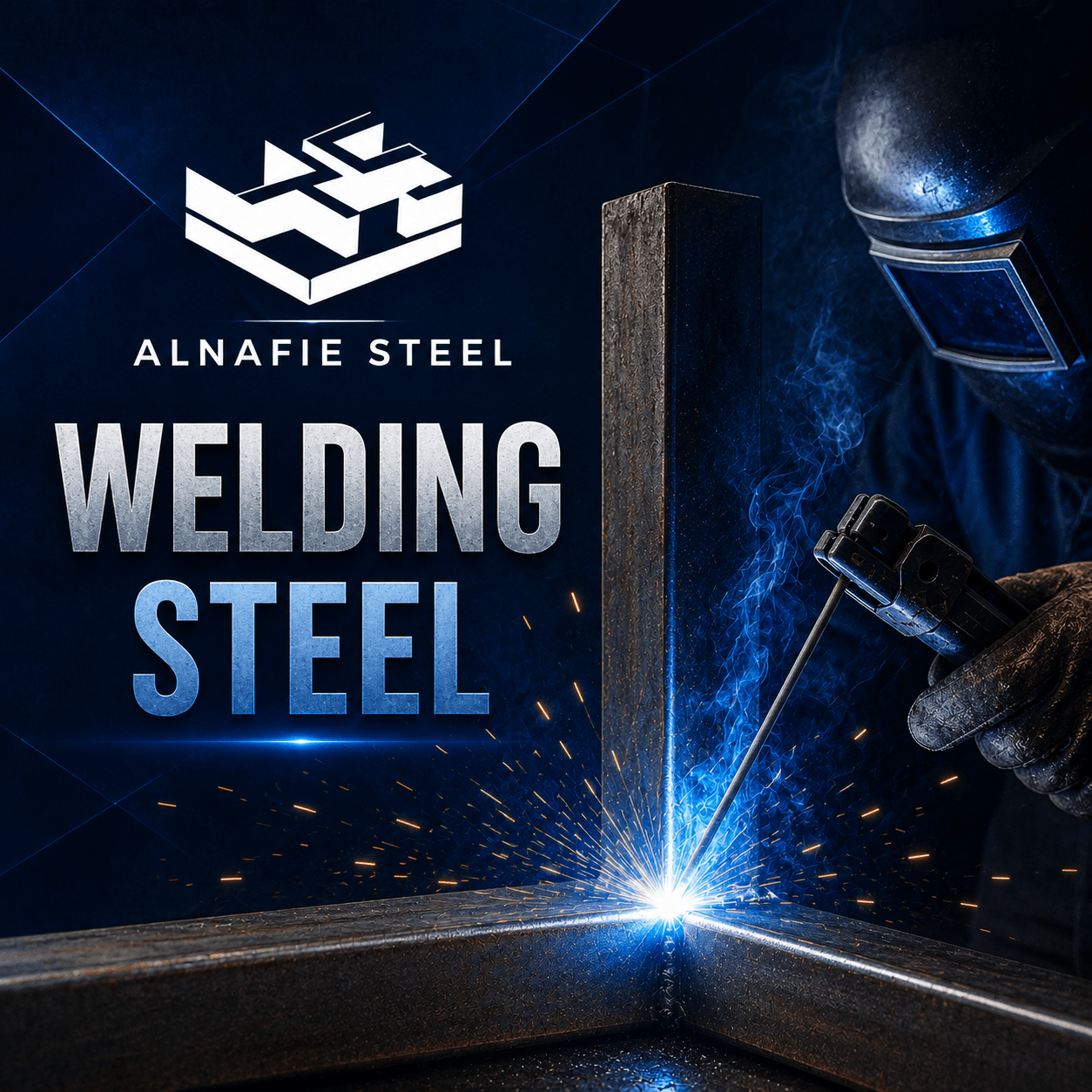
Welding Steel joins two or more metal pieces by melting their edges at high temperature until they fuse into a single piece on cooling, with filler metal added in most processes to fill the gap and strengthen the joint.
The fundamental difference between this and riveting or bolting is that the resulting joint becomes part of the parent metal rather than depending on an intermediate component. That gives it higher strength and lower weight, but it also means any flaw inside it cannot simply be unfastened and repaired.
In practice, the process produces three distinct thermal zones, and the quality of the entire job is determined across them.
The Welding Steel is the region that actually melted and re-solidified.
The heat-affected zone (HAZ) never melted, but got hot enough for its microstructure to change. This is the weakest region and the one most prone to failure.
The parent metal is unchanged in composition.
Understanding these three zones is what later explains why one steel cracks and another does not under identical conditions.
Types of Welding Steel and the Methods Most Used in Saudi Arabia
Welding Steel processes differ in their heat source and in how they shield the molten pool from oxygen and nitrogen in the surrounding air. These are the ones most widely used across the Saudi market.
Shielded Metal Arc Welding (SMAW / Stick)
The most common choice on open sites because it needs no external shielding gas — the coating around the electrode decomposes under heat and generates its own protective gas. It suits structural work and thicker steel, and it tolerates the wind and dust conditions typical of Saudi worksites. The trade-off is a slower pace and a slag layer that must be chipped away between passes.
MIG / MAG Welding
A continuously fed wire with shielding gas. Considerably faster and cleaner, delivering high productivity inside enclosed fabrication workshops. Wind disperses the shielding gas, however, which makes it less reliable outdoors unless screening is provided.
TIG Welding
A non-consumable tungsten electrode shielded by argon. It delivers the highest precision and cleanliness, making it the practical choice for stainless steel, aluminium, and thin sections — particularly in food and pharmaceutical applications that require a smooth, inclusion-free joint. Its only real drawback is that it is the slowest and most expensive option.
Submerged Arc Welding (SAW)
The arc region is buried beneath a layer of flux powder. Very high productivity and deep penetration, though it is confined to flat positions and automated production lines — this is the process behind ERW and seamless pipes and built-up beam sections.
The practical rule for selection: position and thickness determine the process, while the metal type determines the filler and the parameters.
Weldability: Why Not All Steel Welds the Same Way
Weldability is how readily a metal can produce a sound joint free of cracking. In steel, the dominant factor governing it is the carbon and alloying element content.
Carbon raises hardness and strength, but it also makes the metal more prone to abrupt hardening on rapid cooling, forming a brittle phase called martensite in the heat-affected zone. This is the direct cause of most cold cracking.
To measure this tendency in practice, engineers use the carbon equivalent (CE), a formula that condenses the effect of carbon and the other elements into a single number:
CE = C + Mn/6 + (Cr + Mo + V)/5 + (Ni + Cu)/15
The commonly accepted engineering reading follows three bands.
At a carbon equivalent below 0.40, weldability is good, and the metal generally needs no preheating.
Between 0.40 and 0.60, weldability becomes moderate, and preheating is usually required.
Above 0.60, the work becomes difficult, and both preheating and controlled cooling become mandatory.
This is where the Mill Test Certificate supplied with the delivery earns its importance: it is the only reliable source for the chemical composition from which this value is calculated. Buying without a certificate means welding a metal of unknown composition and gambling on the outcome. For a deeper look at how alloying elements behave, see our guide to alloy steel and its types.
Need help choosing the right Welding Steel for your project? Call us today.
Al Nafie Steel
Steel trading and import in the Saudi market since 1979
Jeddah • Riyadh • DammamWelding Different Types of Steel
Carbon and Structural Steel
The easiest to work with, handled by conventional processes without complication as long as carbon content stays low. The structural grades available in commercial steel are designed with calculated carbon levels precisely so weldability stays good. Above 25 mm thickness, preheating becomes necessary to slow the cooling rate.
Stainless Welding Steel
Austenitic grades (304 and 316) weld well but impose three constraints: use of a low-carbon filler such as 308L or 316L, controlled heat input to avoid chromium carbide precipitation in the 425–815°C range which strips the metal of its corrosion resistance, and argon back-purging on pipe work. Its higher thermal expansion also makes it more prone to distortion. See stainless steel sheets and plates and stainless steel round, flat and angle bars.
Welding Galvanized Steel
The most important occupational safety rule sits here: the zinc layer vaporises below the melting point of steel, and the resulting zinc oxide fumes cause what is known as metal fume fever. The zinc coating must therefore be removed from the joint area before starting work, work must be done with ventilation or local extraction, and the area must be re-protected with a zinc-rich paint afterwards — otherwise the weld line itself becomes the starting point for steel rust. Product details are on galvanized sheet and coils.
Wear Resistance Plates
These plates draw their hardness from precise heat treatment, and excess heat during welding damages that structure and reduces abrasion resistance in the region around the joint. Heat input limits and preheat temperatures specified by the manufacturer for each grade and thickness must therefore be observed. See wear resistance plates.
Cast Iron and Non-Ferrous Metals
Cast iron is highly brittle and requires preheating, very slow cooling, and a nickel-based filler — details are covered in cast iron types and uses. Aluminium and copper and brass both require removal of the surface oxide layer and alternating current in TIG.
Welding Steel Sections and Products
Execution varies with the shape of the section, not only the type of metal.
Plates and sheet. Thickness is the governing variable. Thin sheet distorts quickly, so it is handled with stitch welding and passes alternated between opposite sides to balance the stresses. Thicker hot rolled plates and coils, by contrast, need V-shaped edge preparation and multiple passes.
Pipes and hollow sections. These force the welder through continuously changing circumferential positions, and any internal flaw is difficult to detect visually. Welding thin-walled steel pipes demands precise current control to avoid excess penetration. On square and rectangular MSH sections, the joint should never be terminated at a corner, since corners are stress concentration points.
Angles and beams. The backbone of steel structures and hangars. When joining steel angles to heavier sections, the pass sequence is the decisive factor in controlling overall distortion of the frame. See equal and unequal angles and beams and channels.
Weldable Steel Grades and What to Specify at Purchase
Weldable steel is not a separate product you order from a catalogue. It is a property band — a range of chemical compositions that tolerate rapid heating and cooling without cracking. A grade sits inside that band or outside it, and nothing done in the workshop moves it.
This is the practical consequence of the carbon equivalent explained above. Once the metal arrives on site, its composition is fixed. Preheating and low-hydrogen electrodes can compensate for a difficult grade, but they add cost, time and risk to every single joint. Specifying weldable steel at the purchase stage removes that burden entirely.
The Weldability Ladder
| Grade family | Typical weldability | What it demands |
|---|---|---|
| Low-carbon structural (S235JR, S275, ASTM A36, Q235B) | Good | Conventional processes, no preheat under 25 mm |
| Higher-strength structural (S355J2 and similar) | Good to moderate | Preheat becomes thickness-dependent |
| Medium-carbon grades | Moderate | Preheat generally required |
| Alloy and quenched-and-tempered grades | Difficult | Mandatory preheat and controlled cooling |
| Austenitic stainless (304, 316) | Good, by a different mechanism | Low-carbon filler, controlled heat input, back-purging |
| Cast iron | Poor | Dedicated procedure, nickel filler, very slow cooling |
Treat this table as a starting orientation, not a substitute for the certificate. Two deliveries carrying the same grade designation can differ enough in composition to land on opposite sides of the 0.40 threshold — which is why the Mill Test Certificate, not the grade name, is the authority.
Weldable Steel Is a Purchasing Decision
The most expensive welding problems are not solved with a better machine. They are avoided by refusing delivery of a metal that was never suited to the process.
Four items belong in every purchase order where welded steel is the end product:
- Grade and the standard it is certified to — not simply “structural steel”
- Mill Test Certificate, type 3.1, with the full chemical composition
- Thickness, because it changes the preheat requirement independently of composition
- The intended process, so the supplier can flag a mismatch before shipping
A supplier who cannot produce the certificate cannot tell you whether the metal is weldable. At that point you are not buying steel — you are buying an assumption.
Where the Choice Shows Up
In welded steel structures, the consequences appear at the joints long before they appear anywhere else. A hangar frame, a pipe rack, a platform — each concentrates stress at the welds, and each is inspected there first.
Welded steel fabricated from a properly specified grade behaves predictably: consistent penetration, no cold cracking weeks later, no callback for repair after the first season. The same fabricator, working the same procedure on an unverified grade, produces joints that pass visual inspection and fail in service.
The difference was decided at purchase.
Corrosion and Steel Rust in the Heat Affected Zone
The weld line is the chemically weakest point in any structure. Heat alters the microstructure and creates electrochemical differences between the weld metal and the parent metal, forming a miniature galvanic corrosion cell from which steel rust begins.
In coastal regions of the Kingdom — Jeddah, Dammam and Jubail — the effect is amplified by humidity and airborne salts, as atmospheric chlorides penetrate the protective layer and initiate pitting corrosion even in stainless steel.
Four practical protective measures apply: remove slag and oxidation residue completely as soon as work finishes, chemically clean stainless with passivation paste to rebuild the chromium oxide layer, reapply protective coating to areas where galvanizing was removed, and avoid crevices and pockets in the joint design because they trap moisture.
Common Defects in Welding Steel and Their Causes
Welding steel introduces defects through three routes: surface condition, thermal control, and the composition of the metal itself. The six below account for most joint failures on site.
Porosity arises from moisture or oils on the surface, or from inadequate gas shielding. The remedy is cleaning the edges, drying electrodes, and screening against wind.
Cold cracking occurs when a high carbon equivalent combines with hydrogen and rapid cooling. It is addressed through preheating and low-hydrogen electrodes.
Hot cracking is usually caused by elevated sulphur content in the parent metal, and is avoided by selecting a low-sulphur grade and adjusting joint geometry.
Lack of fusion results from low heat input or excessive travel speed, corrected by adjusting current and redesigning the edge angle.
Undercut appears with excessive current or an incorrect torch angle, and is resolved by reducing current and correcting the work angle.
Distortion stems from unbalanced thermal stress, and is controlled through jig fixturing and pass sequencing. This is why welding steel sections of differing thickness demands a planned pass sequence rather than an improvised one.
Note that four of these six defects originate in the metal or its preparation, not in the welder or the machine. This means most of the risk in welding steel is settled before the arc is ever struck — at the purchasing decision.
How Alnafie Steel Supports Welding and Fabrication Work
Alnafie Steel is a steel company in Saudi Arabia and one of the top steel companies in Riyadh, Dammam, and Jeddah. It has traded steel and metals since 1979, from its headquarters in Jeddah with principal centres in Riyadh, Dammam, and Dubai. decades of experience in supplying steel suited to different welding processes, grades, and project requirements. This helps contractors and fabricators choose the right material for strong, reliable, and long-lasting welded joints.
Supply with Mill Test Certificates documenting chemical composition and mechanical properties — the basis for calculating carbon equivalent and determining whether preheating is required.
Compliance with international standards, covering European, American and Japanese specifications for imported grades.
Free technical consultation to select the grade suited to the operating conditions before purchase.
Explore the full range through our services page, or contact us for a quotation or technical consultation on your project.
Need Any Steel Advice For Your Project? Talk to Us Today
We serve project sites across Saudi Arabia.
Al Nafie Steel
Steel trading and import in the Saudi market since 1979
Jeddah • Riyadh • DammamFrequently Asked Questions
What is the best type of welding Steel?
With Welding Steel, there is no single best type, only the most suitable one for each case. Shielded metal arc welding (SMAW) works best for structural work on open sites, MIG for fast production inside workshops, and TIG for stainless steel and thin sections requiring high precision.
Can galvanized steel be welded directly?
It is not advisable. The zinc layer must be removed from the joint area first, because vaporising zinc produces toxic fumes and causes porosity in the weld. After finishing, the area is re-protected with zinc-rich paint to prevent rust.
Why does steel crack after welding?
The most common cause is a high carbon equivalent combined with rapid cooling, which produces a brittle martensitic structure. It is addressed by preheating the metal, using low-hydrogen electrodes, and slowing the cooling rate after completion.
What is the difference between welding stainless steel and carbon steel?
Stainless requires a low-carbon filler such as 308L or 316L, lower heat input to avoid losing its corrosion resistance, and argon purging on pipe work. Its higher thermal expansion also makes it more prone to distortion than carbon steel.
When is preheating necessary?
When the carbon equivalent of the metal exceeds roughly 0.40, when thickness goes above 25 mm, or when working in low ambient temperatures. The purpose is to slow cooling and prevent cold cracking.
How do I know if steel is weldable before buying it?
Through the Mill Test Certificate supplied with the delivery, which shows the carbon, manganese and alloying element percentages from which the carbon equivalent is calculated. Metal without a certificate means unknown composition and an unguaranteed result.