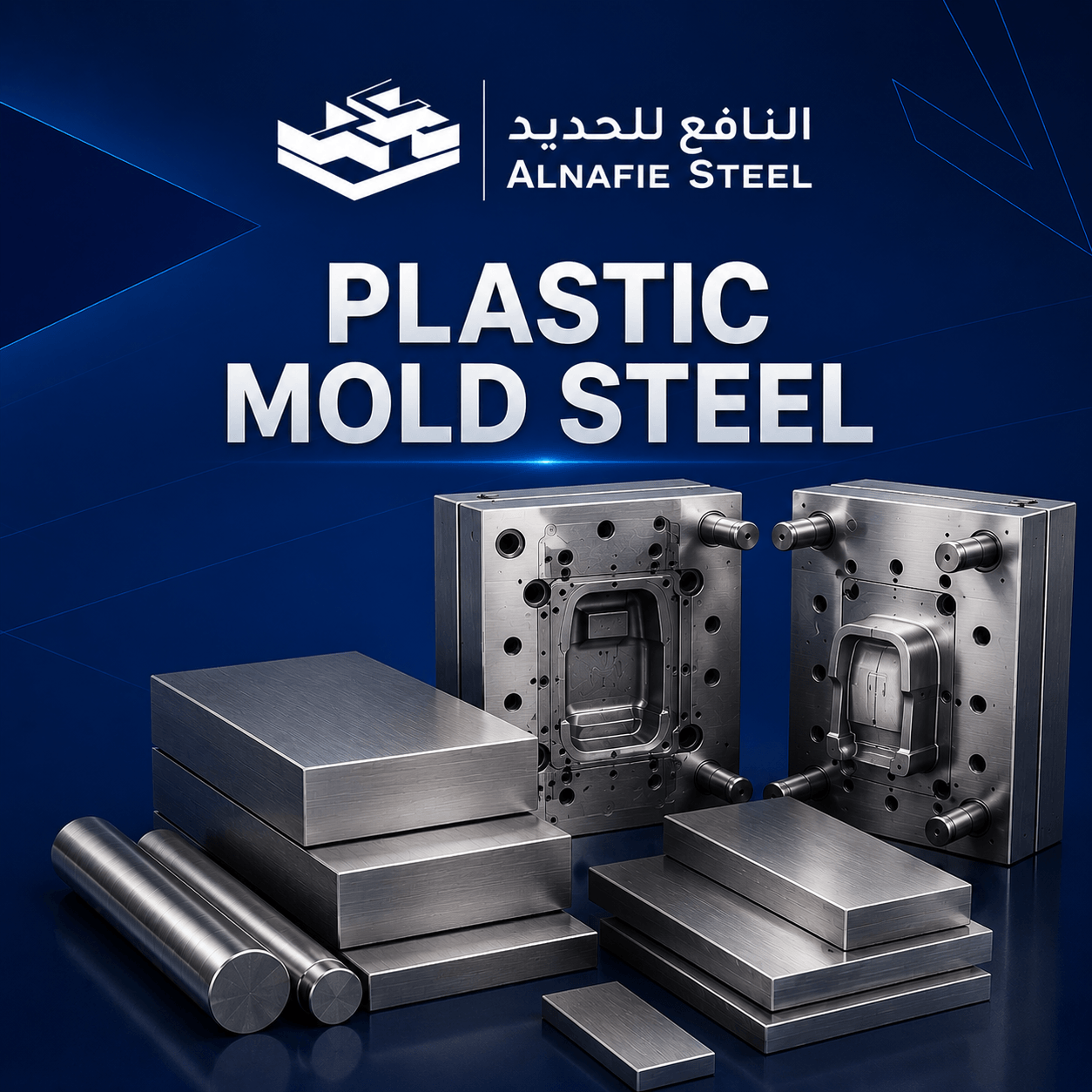
Plastic mold steel is the material that decides how long an injection tool will last, how good the molded surface looks, and how much the whole project finally costs. In an injection molding plant, efficiency is measured by the number of cycles a mold runs before it loses its surface finish or its dimensional accuracy, and that number is set by the steel long before the first cut is made.
Most engineers and buyers still start with the cavity layout and the cooling design, then leave the steel decision to the end. Plastic mold steel absorbs repeated injection pressure, thermal cycling, and constant friction against molten polymer, so the wrong grade leads to one of two results. Either you pay for performance the tool never needed, or the mold fails early and stops the entire line.
This guide explains what plastic mold steel is, which engineering properties actually matter, and how the grades most used in the Saudi market (2312, 2738, 2316, 2083 and EFS Supra) compare, with a practical method for matching a grade to an application.
What Is Plastic Mold Steel?
Plastic mold steel is a specialised branch of tool steel, known internationally as mold steel, developed specifically for injection, compression and blow molding tooling. It does not belong with the commercial steel used in general structural work, nor with grey cast iron used for heavy bases and frames. It belongs to the special steel family, produced through controlled metallurgical routes to achieve four objectives at once: high internal cleanliness, a uniform microstructure through the full section, a precise balance between hardness and toughness, and predictable response to heat treatment, nitriding and polishing.
These materials are supplied in two basic conditions:
- Pre-hardened: delivered already hardened and tempered at a working hardness (typically 280–325 HB), so the block is machined directly with no subsequent heat treatment — eliminating distortion and dimensional movement.
- Annealed: delivered soft for easier machining, then hardened and tempered after machining to reach high hardness, usually between 48 and 54 HRC.
Procurement engineers should also note that a single grade appears under several designations: the European DIN/EN system (1.2312), the American AISI system (P20 steel), plus each mill’s proprietary trade name. Understanding this cross-reference prevents the most common errors in purchase orders and price comparisons.
Why Plastic Mold Steel Determines Tool Quality
In a single injection cycle, the cavity sees pressure that can exceed 1,000 bar, a melt flow between 180 °C and 320 °C, rapid cooling, and mechanical stress at clamping and ejection. This sequence repeats hundreds of thousands — often millions — of times, which makes material performance decisive across four axes:
Tool life. Wear resistance and hardness stability directly govern how many cycles pass before erosion appears at parting lines and gates, or the cavity surface degrades.
Product quality. The surface of a molded part is a direct reflection of the cavity surface. Only steel with high internal cleanliness reaches a stable mirror polish — non-negotiable for transparent and optical parts.
Dimensional stability. Steel with a homogeneous microstructure resists residual stress and distortion after machining or heat treatment, keeping part dimensions inside tolerance.
Cycle time and cost. Thermal conductivity influences cooling rate and therefore hourly output.
The economic point matters most: raw material is only a limited share of total tool cost compared with design, machining and assembly — yet it governs most of the operational risk that follows.
Key Properties of Plastic Mold Steel
When evaluating any Plastic mold steel grade, these properties must be read together rather than in isolation, because improving one usually costs something on another:
- Hardness: measured in Brinell (HB) for pre-hardened material or Rockwell (HRC) after hardening. The target is not maximum hardness but hardness appropriate to the polymer and cycle count, distributed uniformly through the block thickness.
- Toughness: resistance to cracking at sharp corners and thin sections. High hardness without adequate toughness produces a brittle tool.
- Wear resistance: essential for glass-fibre-reinforced or mineral-filled polymers, where the filler acts as an abrasive medium inside the cavity — the same logic behind wear-resistant plates in heavy equipment.
- Corrosion resistance: required for polymers such as PVC and PET that can release acidic gases, and in humid coastal environments or where tools are stored between production runs.
- Polishability: governed by steel cleanliness and inclusion content. Electro-slag remelted (ESR) material reaches polish levels conventional production cannot.
- Machinability: determines milling and EDM hours and cutting-tool consumption — a decisive factor when scheduling mold manufacturing in-house.
- Heat treatment response: dimensional stability during hardening and tempering, and suitability for nitriding or surface coatings that raise surface hardness without affecting the core.
- Weldability: important for cavity repair or later design changes, and adversely affected by sulphur content.
Types of Plastic Mold Steel
The following plastic mold steel grades differ in their alloying content, explained further in our guide to alloy steel, and in their supply condition:
2312 (P20) — Grade One
Definition: 1.2312 — commercially, a sulphur-enhanced development of P20 steel — is a pre-hardened mold steel on a chromium-manganese-molybdenum base, supplied at 280–325 HB. Sulphur is added in a controlled proportion to improve machinability.
Main advantages: the best machinability among pre-hardened mold grades, cutting milling time and tool consumption; uniform hardness through the section; immediate readiness for machining with no heat treatment and therefore no distortion; and lower cost than corrosion-resistant grades.
Applications: mold frames, plates and holders, parts with moderate surface requirements, blow molding tools, and large tools running medium production volumes.
When to prefer it: where speed and cost lead and the part needs no mirror polish or fine texture. Avoid it where the tool will require repair welding or a high-grade finish, since sulphur shows as micro-defects on polished surfaces and impairs weldability.
2738 (P20+Ni) — Grade Two
Definition: 1.2738 shares the same base as 2312 but adds nickel (around 1%) with no free sulphur. It is supplied pre-hardened at 280–325 HB, and also in a higher-hardness version (2738 HH) at 340–380 HB.
Main advantages: nickel provides deep hardenability, keeping hardness uniform even in thick blocks over 400 mm — precisely where 2312 falls short. It also offers better polishability, reasonable repair weldability, and the option of nitriding or hard chrome plating to raise surface hardness.
Applications: large and medium high-output tools, automotive bumpers and interior parts, appliance housings, crates and containers, and molds needing a glossy or textured surface.
When to prefer it: it is the reference grade and the most widely used plastic mold steel worldwide for medium-to-high volume injection tooling with non-abrasive, non-corrosive polymers — particularly on large tools.
2316 — Grade Three
Definition: 1.2316 is a corrosion-resistant mold steel containing around 16% chromium, normally supplied pre-hardened at 280–325 HB (roughly 30–34 HRC), and suitable for nitriding to reach high surface hardness.
Main advantages: high resistance to rust and chemical attack, protecting both the cavity and internal cooling channels from corrosion that restricts flow and extends cycle time; good polishability; and good dimensional stability, since it is machined in the as-supplied condition.
Applications: PVC, PET and POM molding, fluorine-bearing polymers or compounds with flame retardants that release acidic species on heating, and tooling for medical, pharmaceutical and food applications.
When to prefer it: where the polymer is chemically aggressive, where the plant operates in a humid coastal environment such as Jeddah or Jubail, or where tools sit in storage between production campaigns.
2083 — Grade Four
Definition: 1.2083 is a martensitic stainless mold steel with about 13% chromium (broadly equivalent to AISI 420), supplied annealed at around 230 HB and hardened after machining to 50–54 HRC. ESR versions with higher cleanliness are available for optical work.
Main advantages: it combines the highest level of corrosion resistance with high final hardness, giving excellent mechanical wear resistance and long tool life, together with outstanding polishability up to mirror finish.
Applications: optical lenses and transparent parts in polycarbonate and acrylic, medical devices and consumables, cosmetics packaging, and PVC products.
When to prefer it: where two conditions coincide — a high-quality mirror finish and corrosion resistance — at large production volumes. Post-machining heat treatment and the limited dimensional movement it brings must be accounted for at the design stage.
EFS Supra
Definition: EFS Supra is not a separate chemical grade but a cleanliness and production level: a 5% chromium, 1% molybdenum hot-work steel (grade 1.2344 / H13) produced through the EFS route and then electro-slag remelted, giving internal homogeneity and microstructural cleanliness far above conventional production. It is supplied annealed (around 229 HB max) and hardened to a working hardness of up to roughly 54 HRC.
Main advantages: a fine, uniform carbide distribution with no clustering at grain boundaries, which extends tool life and supports a polish level sufficient even for translucent parts; excellent wear and thermal-fatigue resistance; and high suitability for nitriding and PVD/CVD coatings.
Applications: inserts, cores, gates and injection entries; tools exposed to high injection pressure and thin walls; glass-fibre-reinforced compounds; rubber molds and die casting.
When to prefer it: in the most demanding plastic mold steel applications — very high cycle counts, abrasive fillers, or small components carrying concentrated thermal and mechanical stress inside the tool.
Plastic Mold Steel Grades Compared
| Grade | Hardness | Wear resistance | Polishability | Machinability | Main applications |
|---|---|---|---|---|---|
| 2312 (P20+S) | 280–325 HB (as supplied) | Moderate | Limited | Excellent | Frames and plates, parts with moderate finish needs |
| 2738 (P20+Ni) | 280–325 HB (as supplied) | Moderate to good | Good | Good | Large tools, automotive, appliances, high output |
| 2316 | 280–325 HB (as supplied) | Good + high corrosion resistance | Good to very good | Good | PVC and PET, medical, food, humid environments |
| 2083 | 50–54 HRC (after hardening) | High + high corrosion resistance | Excellent (mirror) | Moderate (heat treatment needed) | Lenses, transparent parts, medical, cosmetics |
| EFS Supra (1.2344) | Up to 54 HRC (after hardening) | Excellent + thermal fatigue resistance | Excellent | Moderate (heat treatment needed) | Inserts and cores, reinforced compounds, high pressure |
Working from a defined specification or a finished tool drawing? You can request a quotation for a specific grade, and our technical team will confirm the supply condition and hardness range with you before the order is placed.
How to Choose the Right Plastic Mold Steel
Choosing plastic mold steel: No grade is best in absolute terms; one grade is best suited to a specific operating system. Work through these six criteria in order:
1. Polymer type. This is the entry point. Chemically aggressive polymers (PVC, PET, flame-retardant compounds) call for 2316 or 2083. Glass-fibre-reinforced compounds call for high wear resistance such as EFS Supra or nitrided cavities. Standard polymers like PP, PE and ABS are served more economically by 2738.
2. Required surface finish. Matte or textured parts are well served by 2312 and 2738. Mirror surfaces and transparent parts demand high-cleanliness material such as 2083 or remelted grades.
3. Expected cycle count. Up to around 100,000 cycles, pre-hardened material is sufficient. At hundreds of thousands or millions, investing in a hardened grade or surface nitriding becomes economically justified.
4. Tool size and section thickness. In thick blocks, the nickel in 2738 is what keeps hardness uniform to the core — a fundamental difference from 2312.
5. In-house manufacturing route. Does the workshop have reliable heat treatment furnaces? If not, pre-hardened material is safer because it removes distortion risk altogether — a practical consideration for mold making inside the Kingdom.
6. Operating and storage environment. High humidity and cooling circuits running untreated water push toward corrosion-resistant grades even when the polymer itself is neutral.
Finally, calculate cost per cycle over tool life rather than price per kilogram. The price gap between two grades usually disappears against the cost of a single unplanned stoppage.
Plastic Mold Steel Applications Across Industries
Mold steel is used in every sector that relies on engineering polymers, in single-cavity and multi-cavity tooling alike, with priorities shifting from one sector to the next:
- Automotive: large tools for bumpers, instrument panels and interior trim, with emphasis on hardness uniformity in massive blocks and dimensional stability — hence the dominance of 2738 with EFS Supra inserts in high-stress zones.
- Medical devices: syringes, tubing and sterilisation containers, where full corrosion resistance and a pore-free surface are required, favouring 2316 and 2083.
- Packaging: containers, closures and preforms produced at very high cycle counts, which favours hardened, wear-resistant grades to reduce maintenance downtime.
- Food industry: food-contact containers and utensils requiring a cleanable, corrosion-resistant surface, where 2316 is the default choice.
- Electronics: device housings and connectors with thin walls and tight tolerances, often in reinforced compounds, calling for high cleanliness and hardness.
- Household products: plastic utensils, furniture and toys, where 2312 and 2738 give the best balance of cost and performance.
Across all of these, injection tooling shares one truth: performance never exceeds the limits of the steel it was cut from.
Why Source Plastic Mold Steel from Alnafie Steel?
Alnafie Steel has traded and supplied steel in the Kingdom of Saudi Arabia since 1979, headquartered in Jeddah with coverage across the Kingdom and the GCC, importing to European, American and Japanese specifications. That accumulated experience translates into direct value for mold shops and injection molding plants:
- Material quality: supply from approved European and international sources, with Mill Test Certificates documenting chemical composition and mechanical properties for every consignment, so your quality department can verify before machining starts.
- Range of grades: a broad span of mold steel and tool steel grades — from pre-hardened 2312 and 2738 to corrosion-resistant 2316 and 2083 and high-cleanliness EFS Supra — in sizes, plates and blocks matched to different tool dimensions, backed by cutting and preparation services that reduce waste and workshop set-up time.
- Specification compliance: accurate conformity to DIN/EN and AISI numbering systems and to the requested supply condition (pre-hardened or annealed), with precision on the hardness ranges stated in the purchase order.
- Support for Saudi industry: technical consultation on grade selection before purchase, and local stock that shortens lead time against direct import — decisive for molding plants that cannot absorb line stoppages, and consistent with the Kingdom’s Vision 2030 drive to localise industrial supply chains.
Selecting plastic mold steel is an engineering and an economic decision at the same time. The right grade follows from polymer type, required surface finish, expected cycle count and tool size — not from price alone. 2312 serves speed and economy, 2738 is the broadest balanced choice, 2316 protects against chemical attack and rust, 2083 opens the door to mirror polishing, and EFS Supra withstands the most extreme loads.
In every case, tool quality begins with the material certificate, not with the milling machine.
Alnafie Steel Experience
Alnafie Steel is a steel company in Saudi Arabia and one of the top steel companies in Riyadh, Dammam, and Jeddah. It has traded steel and metals since 1979, from its headquarters in Jeddah with principal centres in Riyadh, Dammam and Dubai. Four decades in this market means understanding what contractors and fabricators actually need to choose the Right Plastic Mold Steel.
Contact the Alnafie Steel team today for free technical consultation on the right grade for your application, and a quotation for plastic mold steel in the sizes you need — and let your next tool run longer and produce better.
Frequently Asked Questions
Can ordinary stainless steel such as 304 or 316 be used for injection molds?
No. 304 and 316 are austenitic and cannot be hardened by heat treatment; their hardness stays around 200 HB, so cavities erode quickly and never hold a stable polish. Where corrosion resistance is needed, martensitic mold grades such as 2316 or 2083 are the correct answer.
What is the difference between plastic mold steel and die casting mold steel?
Plastic tooling runs at 180–320 °C, so hardness, polishability and corrosion resistance lead. Die casting tools contact molten metal above 650 °C, so thermal fatigue and heat-checking resistance dominate instead — which is why hot-work grades such as 1.2343 and 1.2344 prevail there.
Does a mold need stress relieving after rough machining?
Yes, and it is strongly advised on large or complex tools. Removing the surface layer releases residual stress locked in the block, which can cause dimensional drift. It is normally carried out at 500–550 °C for pre-hardened grades, with slow heating and cooling, before finish machining.
How do I verify that delivered material matches the specification?
Request an EN 10204 type 3.1 mill test certificate covering chemical analysis, hardness and heat number, and confirm the heat number stamped on the block matches the certificate. A verification hardness test at two points at a minimum is advisable before machining begins.