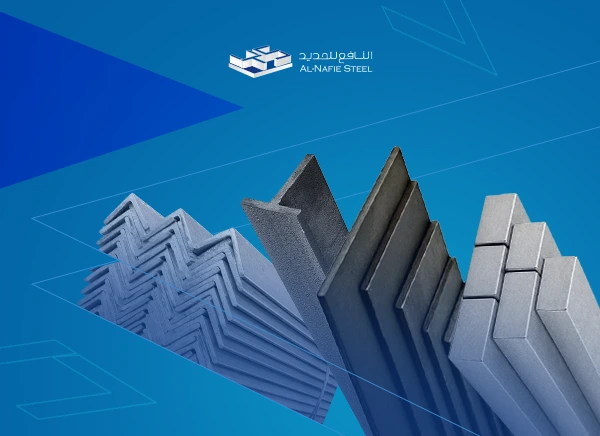
Al Nafie Steel supplies a broad range of steel sections for industrial and construction projects, covering equal and unequal angles, flat bar, T-bar and square bar, produced to accurate dimensions and consistent quality for customers across Saudi Arabia and the Gulf.
These products are the working backbone of fabrication, metal structures and infrastructure. They carry load, hold frames square and give assemblies their stiffness, and because they cut, weld and bolt easily they remain the default choice in construction, industry and engineering alike.
This guide covers each of these steel sections in detail: what it is, where it is used, the standard sizes it comes in, verified weight tables you can price from, and how to pick the right size for the job.
What Are Steel Sections?
Steel sections are steel products rolled with a constant cross-section along their entire length. Most are hot rolled, then supplied in standard lengths that are cut and fabricated to suit the project. The market also calls them structural steel sections, steel profiles or simply sections, and they are the starting point for almost every piece of metalwork.
In the Saudi market, they divide into families by the shape of the cross-section:
| Family | Examples | Typical use |
|---|---|---|
| Angle sections | Equal and unequal angles | Bracing, frames, metal structures |
| Flat and solid sections | Flat bar, square bar, T-bar | Fabrication, blacksmithing, connections |
| Heavy structural sections | Beams and channels (IPE, HEA, UPN) | Load-bearing frames, industrial buildings |
| Hollow sections | Square and rectangular MSH | Light columns, steel structures |
| Reinforcing bar | Reinforcement bar | Inside reinforced concrete |
The steel sections covered in this guide, angles, flat bar, T-bar and square bar, belong to the first two families. They are the most widely used in fabrication and metalwork because they cut, weld and assemble easily, and they come in small sizes that suit a workshop as readily as the large sizes that suit a major project.
Why Steel Sections Matter in Modern Projects
Industrial and construction projects lean heavily on steel sections because of the load capacity they deliver for their weight and the design freedom they allow. They appear in metal structures, production lines, industrial equipment, commercial facilities and heavy engineering works.
The range of shapes and sizes is what makes them flexible. The same family serves a small workshop bracket and a full industrial frame, with only the size changing.
The main advantages behind that:
- High strength and load-bearing capacity
- Easy fabrication and welding
- Good resistance to mechanical stress
- Wide range of dimensions and thicknesses
- Suitable for both industrial and structural applications
- Straightforward to install and assemble
Equal and Unequal Angles
Steel angles split into two main types, equal and unequal, and they are among the most used steel sections in metal structures and industrial supports. They deliver strong stability and effective bracing across a wide range of engineering applications. Internationally, they are known as angle bar, angle iron or the L-shaped section, and they are produced to standards, the best known being the European EN 10056-1.
Equal Angles
Equal angles are steel sections with two legs of the same length, used where load needs to be distributed evenly and support capacity has to be high.
Applications of equal angles
- Fabricating metal structures
- Bracing and support work
- Building steel towers
- Manufacturing industrial equipment
- Fixing and assembly work
Key features
- Balanced load distribution
- Easy to weld and form
- Excellent load capacity
- Suitable for both heavy and light duty
Unequal Angles
Unequal angles have legs of different lengths, which gives extra flexibility in certain specialised engineering applications.
Applications of unequal angles
- Complex structural projects
- Frames that need uneven load distribution
- Specialised metal fabrication
- Non-standard bracing work
Key features
- Greater design flexibility
- Adapts to special applications
- Strength and stability in metal structures
- Suits a range of industrial projects
Equal vs Unequal Angles: What Actually Changes
The difference between these two steel sections goes beyond the shape of the cross-section. It reaches into how the section behaves under load and how it has to be fixed. The table below sets out the practical comparison:
| Point of comparison | Equal angle | Unequal angle |
|---|---|---|
| Legs | Two equal legs (such as 50×50) | Two different legs (such as 60×40) |
| Load distribution | Symmetrical in both directions | Stronger along the longer leg |
| Typical use | Frames, general bracing, towers | Places needing strength in one direction |
| Fixing | Flexible, the angle can face either way | Requires a specific orientation |
| Market availability | Much wider and easier to source | Less available, longer lead time |
| Cost | Usually lower, produced in volume | Relatively higher |
The practical rule when choosing between them: if the load is symmetrical or its direction is undefined, the equal angle is simpler and cheaper. If the load runs clearly in one direction, or the space forces one leg to be longer than the other, the unequal angle delivers the same efficiency at a lower weight.
Either way, these steel sections are assembled with bolts or by welding, and the assembly method feeds back into thickness selection, because welded joints need enough thickness to take the heat without distorting.
Steel Angle Sizes and Weight Chart
Equal and unequal angles come in a wide range of dimensions, and the question the market asks most often is the size and its matching weight, because these steel sections are priced and supplied by weight rather than by length.
How to Read an Angle Size
An angle size is written as three numbers: first leg × second leg × thickness, all in millimetres. So 50×50×5 means two legs of 50 mm each with a 5 mm wall, written in engineering notation as L 50×50×5.
Two points are worth keeping in mind when reading a size:
- Thickness is the decisive variable in weight. A 50×50×6 angle is around 18% heavier than a 50×50×5 despite having the same legs, and that feeds straight into cost, since steel sections are sold by the tonne.
- The root radius at the inside corner adds material that a simple calculation does not see, which is why the actual weight in standard tables runs slightly above the hand-calculated figure.
Equal Angle Weight Chart
The values below are taken from the EN 10056-1 tables for equal angles:
| Size (mm) | Weight (kg/m) | Weight per 6 m (kg) |
|---|---|---|
| 30×30×3 | 1.36 | 8.2 |
| 40×40×4 | 2.42 | 14.5 |
| 50×50×5 | 3.77 | 22.6 |
| 60×60×6 | 5.42 | 32.5 |
| 70×70×7 | 7.38 | 44.3 |
| 80×80×8 | 9.63 | 57.8 |
| 100×100×10 | 15.00 | 90.0 |
| 120×120×12 | 21.60 | 129.6 |
| 150×150×15 | 33.80 | 202.8 |
For a quick calculation on site, this approximate formula works:
Weight per metre (kg) = thickness × (sum of both legs − thickness) × 0.00785
We checked it against the EN 10056-1 table above and found it returns a figure 0.6% to 1.4% below the standard, because it ignores the root radius. That makes it excellent for quick estimating, while final take-off and pricing should rest on the standard table or on actual weight at delivery. To turn weights into an estimated cost, see the current steel price per ton.
Unequal Angle Sizes
These are written the same way, with two different legs. The sizes traded most in the market:
40×25 · 50×30 · 60×40 · 65×50 · 75×50 · 80×40 · 100×65 · 100×75 · 125×75 · 150×90 · 150×100 · 200×100
Each size comes in several thicknesses, and the same formula applies, adding the two different legs together. Because availability of these steel sections is narrower, confirm the size and thickness with the supplier before locking them into a final design.
Need equal or unequal angles at a specific size and thickness? Call us today.
Steel Flat Bar and Its Many Uses
Flat bar is one of the most widely used steel sections in engineering and fabrication, with a simple, practical shape that suits a long list of applications. It carries several trade names in the Saudi and Gulf market: many enquiries arrive as mild steel flat bar, flat strip or simply flat bar, and all of them point to the same solid rectangular section.
Where Flat Bar Is Used
Flat bar goes into:
- Manufacturing doors and metal gates
- Welding and assembly work
- Fabricating bases and frames
- Industrial equipment
- General maintenance and fabrication
Key Features of Flat Bar
- Easy to cut and shape
- Suited to welding and assembly
- Good mechanical strength
- Available in many sizes and thicknesses
- Broad use across industrial projects
Flat Bar Sizes and Weight Chart
Flat bar is described as width × thickness in millimetres. Its weight is calculated exactly, with no root radius to allow for:
Weight per metre (kg) = width × thickness × 0.00785
| Size (mm) | Weight (kg/m) | Weight per 6 m (kg) |
|---|---|---|
| 20×3 | 0.47 | 2.8 |
| 25×3 | 0.59 | 3.5 |
| 30×3 | 0.71 | 4.2 |
| 40×4 | 1.26 | 7.5 |
| 40×5 | 1.57 | 9.4 |
| 50×5 | 1.96 | 11.8 |
| 50×6 | 2.35 | 14.1 |
| 60×6 | 2.83 | 17.0 |
| 60×8 | 3.77 | 22.6 |
| 80×8 | 5.02 | 30.1 |
| 100×10 | 7.85 | 47.1 |
Unlike angle steel sections, flat bar carries no root radius, so the calculated weight and the table weight agree exactly.
Flat bar is also available in a corrosion-resistant form within the stainless steel round, flat and angle bars range, for applications that demand high corrosion resistance.
T-Bar Sections in Engineering Applications
Among the solid steel sections, the T-bar takes its name from its T-shaped profile, which suits applications needing extra support or a particular way of carrying load inside metal structures.
Applications of T-Bar
- Heavy metal structures
- Bracing systems
- Fabricating steel platforms
- Industrial and engineering projects
- Production lines and equipment
Key Features of T-Bar
- A profile that delivers added support
- Handles a range of loads
- Integrates easily with other steel sections
- Good resistance to stress
A T-bar is described by three dimensions: flange width, web depth and thickness. One of its best-known practical uses is forming the frames and supports that carry chequered plate on platform floors and steel stairs.
It also serves as the perimeter frame carrying hot rolled steel grating panels in industrial walkways and operating platforms, where it gives a level edge for the panels to sit on and be fixed to.
Square Bar and Its Role in Fabrication
Square bar is the heaviest of the solid steel sections covered in this guide, used across a wide spread of industrial and structural applications, valued for its load capacity and how easily it machines in fabrication work.
Applications of Square Bar
- Manufacturing gates and fencing
- Metal structures
- Blacksmithing and fabrication
- Industrial equipment
- Engineering projects of all kinds
Key Features of Square Bar
- High hardness
- Easy to machine and form
- Accurate dimensions
- Suited to heavy-duty applications
Square Bar Weight Chart
Square bar is fully solid, which is what separates it from hollow steel sections of the same outside size, and its weight is calculated exactly from its side: side² × 0.00785
| Size (mm) | Weight (kg/m) | Weight per 6 m (kg) |
|---|---|---|
| 10×10 | 0.78 | 4.7 |
| 12×12 | 1.13 | 6.8 |
| 14×14 | 1.54 | 9.2 |
| 16×16 | 2.01 | 12.1 |
| 20×20 | 3.14 | 18.8 |
| 25×25 | 4.91 | 29.4 |
| 30×30 | 7.06 | 42.4 |
| 40×40 | 12.56 | 75.4 |
| 50×50 | 19.62 | 117.8 |
An important warning: do not confuse solid square bar with hollow square tube. A 50×50 square bar weighs around 19.6 kg/m, while a 50×50 square tube at 3 mm wall weighs a fraction of that because it is hollow inside. The difference in weight, and therefore in price, is very large, and it is a recurring error in purchase orders.
Need angles, flat bar, T-bar or square bar cut to your list? Send us your sizes today.
How to Cut Steel Sections: Tools and Methods
Once the right section is chosen, the next step is cutting it to size. Steel cutting methods differ widely in speed, edge quality, cost and the type of steel sections each one suits.
Picking the wrong method does not only slow the work down. It can leave a distorted edge that needs preparation before welding, or a heat-affected zone that changes the metal’s properties right where the cut was made.
Steel Cutting Methods Compared
- Abrasive chop saw (cut-off saw): the most common tool in small workshops for its speed and low cost, and it suits angles, flat bar and light solid bar. It leaves a rough edge with burr that needs cleaning, and generates sparks and high heat at the cut point.
- Band saw: gives the cleanest square cut with the least heat effect, and it is the preferred option for structural steel sections when squareness matters. Slower than the abrasive saw and a more expensive machine.
- Hydraulic shear: cuts cold with no sparks or heat, and is widely used with rebar and solid bar. Very fast, but limited to certain sizes and it can slightly deform the cut section.
- Plasma cutting: suits plate and medium to thick sections and is very fast, working on any electrically conductive metal including stainless and aluminium. It leaves a heat-affected zone and dross that needs cleaning.
- Oxy-fuel cutting: handles heavy thicknesses at a relatively low equipment cost, but carries one important technical limit: it does not work on stainless steel or aluminium, because the process relies on oxidising iron, which does not happen the same way in those metals.
- Laser cutting: the highest accuracy and cleanest edge, suited to work needing fine detail and precise holes, but the most expensive and better matched to plate than to thick sections.
- Waterjet cutting: generates no heat at all, so there is no heat-affected zone and no change in the metal’s properties, and it handles almost any material. Slow and costly, used when accuracy is critical or any heat effect must be avoided.
Cutting Methods Side by Side
| Method | Edge quality | Heat effect | Best for | Cost |
|---|---|---|---|---|
| Abrasive chop saw | Low | High, localised | Angles, flat bar, small workshops | Very low |
| Band saw | High | Low | Structural sections, square cuts | Medium |
| Hydraulic shear | Medium | None | Solid bar and rebar | Medium |
| Plasma | Medium | Medium | Plate and medium thickness | Medium |
| Oxy-fuel | Medium | High | Heavy thickness (carbon steel only) | Low |
| Laser | Very high | Low | Fine detail and plate | High |
| Waterjet | Very high | None | Maximum accuracy, any material | Very high |
How to Choose the Right Cutting Method
Three factors settle the choice. Section thickness rules out the methods that cannot reach it. The edge quality required decides whether the cut can be welded directly or needs preparation. The quantity decides whether investing in a faster machine has an economic case.
There are two technical points many people overlook:
- Galvanised sections: any cut made after galvanising exposes bare steel at the edge and creates a starting point for rust, which is why cutting must be completed before galvanising rather than after.
- Stainless steel: never use cutting discs or brushes that have been used on carbon steel, because embedded iron particles stick to the surface and rust later, making the stainless itself look rusted.
Buy a Cutting Machine or Order Cut to Size?
Buying a cutting machine makes sense when cutting is daily, repetitive work at varying sizes inside a fixed workshop. On projects that need defined quantities at sizes known in advance, ordering steel sections cut to size from the supplier is usually cheaper and more accurate, because it saves the equipment and labour cost, reduces the waste that comes from a bad cut, and shortens execution time on site.
That is why Al Nafie Steel provides cutting and processing services to the sizes you specify, so the sections arrive on site ready to install.
How to Choose the Right Steel Section for Your Project
Choosing between steel sections is not a matter of preference. It follows from four questions asked in order:
- What type of load is it? If the load is bending in one direction, sections with greater depth (T-bar and unequal angles) are more efficient. If it is tying or bracing in two directions, the equal angle fits better. If it is simple tension, or the purpose is covering and connecting, flat bar is enough.
- What weight is allowed? Solid square bar is far heavier than open steel sections at the same strength, so using it where solid stiffness is not needed raises cost without benefit.
- What is the operating environment? Exposure to humidity or industrial atmospheres calls for a surface treatment or a corrosion-resistant material.
- What can the workshop handle? Some large sizes need cutting, bending and welding capacity that not every workshop has.
All of these sections sit within the wider commercial steel range, which lets a project source more than one section type from a single supplier.
In every case, the size specified on the structural drawing or the fabrication drawings is the binding reference. It is not swapped for another size, even at a similar weight, without going back to the designer.
How to Order Steel Sections from a Supplier
To avoid the common errors in purchase orders, a section request is defined by four elements, none of them optional:
- Section type: equal or unequal angle, flat bar, T-bar, or solid square bar.
- The full size in millimetres: leg × leg × thickness for angles, width × thickness for flat bar.
- Length required: the standard 6 m length in most cases, or a cut length at a specified size.
- Quantity by weight or by piece: noting that pricing is by weight, so the tables above are the reference for converting lengths into tonnes.
Corrosion Protection for Steel Sections
Carbon steel sections rust on exposure to moisture and oxygen, which gradually reduces the section thickness and weakens its load capacity. The risk is higher in angles and T-bar specifically, because the inside corners trap dust and moisture, so they are given particular attention during preparation.
Protection methods step up with the severity of exposure:
| Exposure level | Suitable solution |
|---|---|
| Dry interior | Primer plus a finish coat |
| Moderate exterior | Surface preparation (grinding or blasting) then a full paint system |
| High humidity or near the coast | Hot dip galvanizing to form a barrier and cathodic zinc layer |
| Harsh chemical or industrial atmospheres | Corrosion-resistant materials such as wear resistant plates or specialised protection systems |
One practical rule matters here: if a section is to be galvanised after fabrication, all cutting, drilling and welding must be finished before galvanising, not after, because any later cut or weld exposes the steel and creates a starting point for rust.
Quality and Supply at Al Nafie Steel
At Al Nafie Steel we supply structural steel sections built to international quality standards, with a range of sizes and thicknesses to match different project requirements.
What we provide:
- Products conforming to international specifications
- A range of sizes and section types
- High quality in manufacture and finish
- Flexible supply solutions for projects
- Technical support in selecting the right material
These steel sections sit within a wider product range that also includes plates and coils, pipes and heavy structural sections, together with processing services matched to each project’s requirements.
Long Experience in the Steel Sector
Al Nafie Steel carries experience reaching back to 1979 in steel and metals, which has made it one of the established names supplying integrated steel solutions inside Saudi Arabia. That experience has gone into meeting the needs of industrial and construction projects with reliable quality and consistent delivery, from single-size orders of steel sections to full project supply. You can read more about the company and the markets it serves.
Need Steel Sections Cut to Size for Your Project? Talk to Us Today
Angles, flat bar, T-bar, and square bar supplied to your cutting list, serving project sites across every region of Saudi Arabia.
Frequently Asked Questions About Steel Sections
How do I calculate the weight of a steel angle?
An angle’s weight is calculated from its thickness and both legs using the approximate formula: thickness × (sum of both legs − thickness) × 0.00785 = weight in kilograms per metre. A 50×50×5 angle weighs about 3.77 kg/m according to the EN 10056-1 table, which is roughly 22.6 kg for a 6 metre length. The formula returns a figure about 1% below the standard table because it ignores the inside root radius.
What is the best way to cut steel angle and flat bar?
No single method suits every case, and the choice depends on thickness, the edge quality required and the quantity. In small workshops an abrasive chop saw is enough for light angles and flat bar, being fast and cheap, though it leaves a rough edge that needs cleaning. Where squareness matters or the cut will be welded directly, a band saw gives a cleaner edge and less heat effect. For large quantities at sizes known in advance, ordering steel sections cut to size from the supplier works out cheaper than buying and running the machine.
Is flat bar the same as flat strip and mild steel flat?
There is no difference. All three are trade names for the same product: the solid rectangular steel section known internationally as flat bar. “Flat bar” is the technical name, while “flat strip” and “mild steel flat” are common market terms in Saudi Arabia and the Gulf. When ordering from a supplier, state width × thickness in millimetres to remove any confusion over naming.
Which is stronger: angle, T-bar or square bar?
There is no absolute answer, because each of these steel sections resists a different type of stress. Solid square bar is the hardest but also the heaviest and most expensive at the same strength. T-bar gives depth that resists bending efficiently in one direction. The angle provides bracing in two directions at far lower weight. The right choice starts from the type of load and its direction, not from which section is “strongest” in general.
Which sizes are most available in the Saudi market?
The most traded are equal angles from 30×30×3 up to 100×100×10, flat bar from 20×3 up to 100×10, and square bar from 10×10 up to 40×40, most commonly in standard 6 metre lengths. Larger sizes and unequal angles are less available and need confirming with the supplier before being adopted in a design.
Complete Solutions for Industrial and Construction Projects
Al Nafie Steel continues to support industrial and engineering sectors by supplying equal and unequal angles, flat bar, T-bar and square bar at high quality and dependable performance. Our specialist team works to deliver the solutions that help clients execute their projects with efficiency, durability and long service life.
As a steel supplier in Saudi Arabia with branches covering Riyadh, Dammam and other regions of the Kingdom, you can request a quotation specifying the sizes, thicknesses and quantities of the steel sections your project needs.