Rebar is the backbone of every concrete structure. Concrete carries compression well but is weak in tension, so steel bars take the tensile stresses that concrete cannot. Choosing the wrong type of rebar rarely shows up on day one — it shows up years later as cracking, spalling, and repair bills. Al Nafie Steel has supplied reinforcing steel to Saudi projects since 1979, and this guide covers what actually drives that choice.
Below we work through the main types of rebar, how they are classified by grade and yield strength, how coatings protect them from corrosion, the standard sizes and weights, and a practical method for selecting the right bar for your project.
Types of Rebar
Several types of rebar are used in construction, and each one earns its place through a specific combination of strength, ductility and corrosion behaviour.
Mild steel rebar is soft and easy to bend, which suits applications that need forming flexibility, but it offers lower tensile strength than modern deformed bars. High-strength rebar sits at the opposite end: it withstands much higher stresses, which makes it the standard choice for bridges, towers and heavily loaded foundations, and it is supplied in several grades according to its yield strength.
Some types of rebar are made for specific environments. Stainless steel rebar suits coastal and marine structures thanks to its inherent corrosion resistance. Seismic-grade rebar is produced with high ductility and controlled chemistry so it can absorb repeated deformation without failing suddenly — at a noticeably higher cost.
Alongside the bars themselves are the supporting elements: tie wire for binding bars at intersections, and cold twisted deformed (CTD) bars, which offer moderate strength and still appear in some structural applications. Welded wire mesh and expanded metal mesh are used to reinforce floors, slabs-on-grade and concrete surfaces. Mesh does not provide the tensile capacity of individual bars — its real job is distributing shrinkage cracks, not carrying primary loads.
Carbon steel rebar — the plain deformed bar most projects use — is by far the most common type, because it balances adequate strength against economical cost. Its weakness is corrosion if the concrete cover is thin or the concrete is permeable. GFRP rebar (glass fibre reinforced polymer) is light and completely immune to rust, which suits certain specialised projects, but it behaves very differently from steel: it lacks comparable ductility and requires design to its own equations, so its use stays limited in heavily loaded elements.
Need help choosing the right rebar type and grade for your project? Call us today.
Rebar Grades and Yield Strength
Classifying types of rebar by rebar grades, mechanical properties and yield strength is the basis for every structural drawing and standard works from. A designer does not specify a bar by trade name — they specify it by laboratory-measured properties.
Yield Strength
Yield strength is the stress at which the bar begins to deform plastically — deformation it will not recover from — and it is the value the engineer builds every calculation on.
Under the American standard ASTM A615, rebar grades are defined by minimum yield strength: Grade 60 corresponds to 420 MPa, and Grade 80 to 550 MPa. The British standard BS 4449 uses a different logic, classifying bars at a characteristic yield strength of 500 MPa (B500A, B500B and B500C) with different ductility classes between them.
This is why comparing “Grade 60” directly against “B500B” is inaccurate: each standard uses its own test method and acceptance limits. Always work from the standard named in the project specification.
Ultimate Tensile Strength
This is the maximum stress the bar withstands before fracture, and it is always higher than the yield strength. Standards pay close attention to the tensile-to-yield ratio because it indicates the safety reserve available after yielding begins — a decisive ratio in structures exposed to dynamic or seismic loading.
Ductility and Elongation
Ductility is the bar’s ability to stretch and deform before it breaks, usually measured as elongation at fracture or total elongation at maximum force. It matters because a concrete element must warn of failure through visible deformation rather than collapsing without notice. This is exactly why building codes require higher ductility classes in seismic regions.
Weldability and Formability
Weldability is not determined by yield strength — it is determined by chemical composition, specifically the carbon equivalent (CE) value. This is why standards such as ASTM A706 exist for low-alloy bars with controlled chemistry, which are the correct choice when a design calls for welding or tight-radius bending.
ASTM A615 bars, by contrast, are not chemistry-controlled for welding purposes. They should not be welded except under an approved procedure and after verifying the carbon equivalent.
How Grade Relates to Mechanical Properties
A higher grade means a higher yield strength, which allows the steel quantity to be reduced or bar congestion eased in densely reinforced sections. But higher grades are typically less ductile and more sensitive to bending and forming. A higher grade is therefore not “better” in absolute terms — the appropriate grade is whatever the structural designer specifies under the governing code.
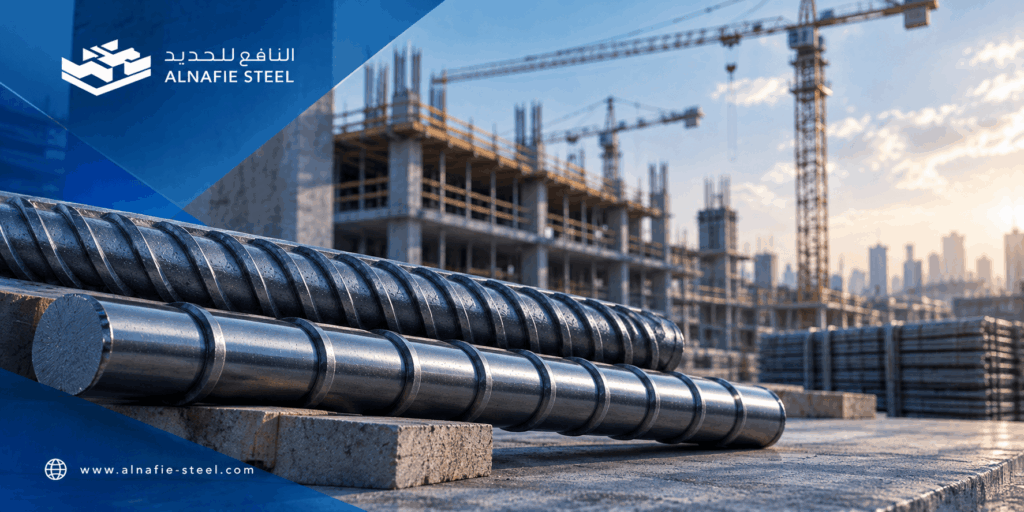
Rebar Coatings and Corrosion Protection
After mechanical properties, the second way of classifying types of rebar is by surface treatment and protection, and it addresses one specific problem: corrosion of steel inside concrete.
Sound concrete provides a highly alkaline environment that forms a thin passive layer protecting the bar. That protection breaks down when chlorides penetrate the concrete or when carbonation lowers its alkalinity. Rust then begins, expands in volume, and cracks and spalls the concrete cover.
Black Rebar
Uncoated deformed bar is the most widely used and most economical option, and the standard grade supplied across most projects. Its protection depends entirely on concrete quality and cover thickness, which makes it appropriate for interior work and non-aggressive environments.
Epoxy Coated Rebar
The bar is covered with a bonded epoxy layer that isolates the steel from moisture and chlorides. Coating thickness is governed by standards such as ASTM A775, typically measured in hundreds of micrometres. It requires careful handling because any scratch weakens protection locally, and it needs suitable tying and storage practices.
Galvanized Rebar
A zinc layer is applied that acts as both a barrier and a sacrificial (cathodic) protection, the same logic used in galvanized steel generally. Galvanizing tolerates handling damage better than epoxy, but costs more than black bar.
Stainless Steel Rebar
Bars made from stainless steel carry inherent corrosion resistance from their alloy composition. They deliver the highest performance and carry the highest cost, which is why their use is usually reserved for critical elements or structures with very long design lives.
When Is Corrosion Protection Necessary?
Protection becomes more important the more a structure is exposed to chlorides, humidity and wet-dry cycling: coastal and marine structures, tanks and treatment plants, industrial facilities with chemical atmospheres, and elements in contact with soil or saline groundwater. These are the conditions under which the protected types of rebar above stop being an upgrade and start being a requirement.
On the other hand, special protection may not be economically justified in an interior residential building with adequate cover and low-permeability concrete. Surface protection complements good design rather than replacing it. Concrete quality and cover thickness remain the first line of defence, and the same principle governs the selection of wear and corrosion-resistant plates in industrial applications.
Best Types of Rebar and Their Applications
Selecting the right bar is fundamental to the strength and durability of concrete structures. Al Nafie Steel supplies a range of types of rebar matched to different project requirements and environmental conditions:
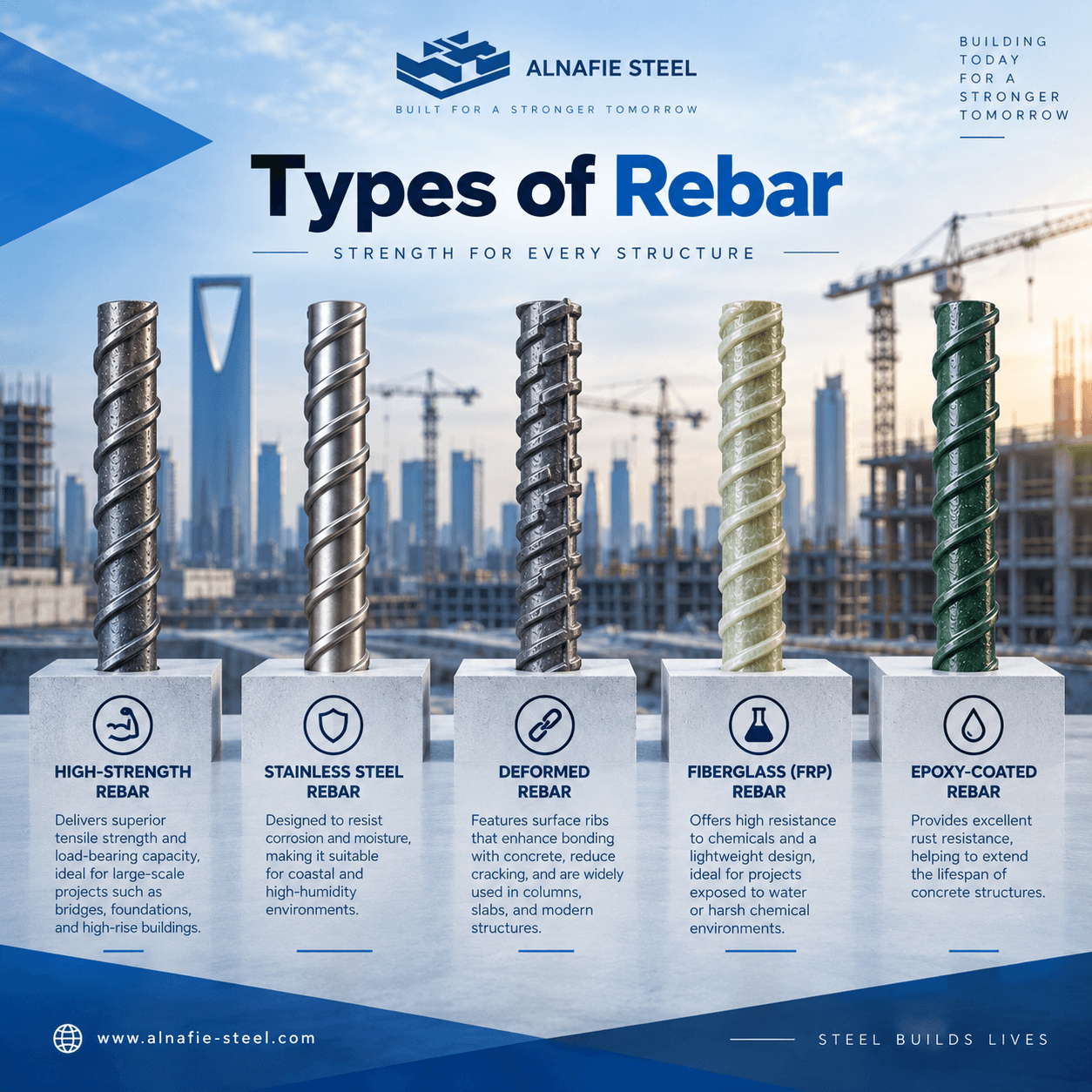
- High-strength rebar — high tensile strength and load capacity, making it ideal for large projects such as bridges, foundations and high-rise buildings.
- Stainless steel rebar — built to resist corrosion and moisture, suiting projects near coastlines and in humid regions.
- Deformed rebar — surface ribs increase bond with the concrete, reducing cracking; used in columns, slabs and modern structures.
- GFRP rebar — high chemical resistance and light weight, ideal for projects with repeated exposure to water or chemicals.
- Epoxy coated rebar — outstanding rust resistance, helping extend the service life of structural elements.
Rebar in Construction: What It Does in Each Element
The role of rebar in construction rests on one simple principle: concrete is strong in compression and very weak in tension, so steel bars carry the tensile stresses. The two work as a single material thanks to the bond between them and their closely matched coefficients of thermal expansion. What the reinforcement actually does changes with the structural element:
- Foundations — reinforcement usually sits in the lower zone to resist bending moments generated by soil reaction, alongside punching shear reinforcement beneath columns.
- Columns — longitudinal bars share vertical loads with the concrete, while stirrups (ties) confine the concrete and prevent buckling of the longitudinal bars. Ties are decisive for column performance under lateral loads.
- Beams — bottom bars concentrate at mid-span to resist tension from positive moment, top bars at supports resist negative moment, and stirrups resist shear. The same logic applies when designing steel beams and channels in structural steelwork.
- Slabs and roofs — reinforcement is distributed one-way or two-way depending on the slab system, with additional steel to resist shrinkage and temperature movement.
- Concrete walls — vertical and horizontal reinforcement mats resist lateral loads and soil or water pressure in retaining walls and tanks.
- Bridges and industrial structures — these demand high-strength bars and precise detailing, with particular attention to durability given direct weather exposure and repeated loading.
- Infrastructure projects — tunnels, stations and drainage networks are among the applications most vulnerable to corrosion, because they remain in permanent contact with soil and water.
Rebar Sizes and Diameters
Rebar sizes are defined by bar diameter in millimetres — the figure that appears in the bar schedules on structural drawings.
What Does Nominal Diameter Mean?
A deformed bar is not a smooth cylinder; it is covered in ribs that increase bond with the concrete. That is why the concept of nominal diameter is used: the diameter of a plain round bar having the same mass per metre. The actual diameter measured across the ribs is slightly larger.
This distinction matters in practice, because every structural calculation and weight table is built on the nominal diameter — not on what a caliper reads across the deformations.
Note on units: Saudi and Gulf projects specify rebar in metric millimetres (8, 10, 12 mm and so on). US projects use imperial bar numbers (#3 to #18), where the number represents eighths of an inch. Confusing the two systems is a common source of procurement errors on international projects.
Common Rebar Sizes in Projects
Across all types of rebar, bars are typically available from 8 mm to 40 mm, which is the range Al Nafie Steel supplies in lengths up to 12 metres. Applications are distributed roughly as follows:
- Small diameters (8–10 mm): stirrups, shrinkage reinforcement and welded mesh.
- Medium diameters (12–16 mm): slabs, light beams and walls.
- Large diameters (18–25 mm): columns, main beams and foundations.
- Largest diameters (28–40 mm): heavy foundations, densely loaded columns and bridges.
How Is Bar Size Selected?
Bar size is not chosen arbitrarily. It follows from the steel area the design requires, divided across a number of bars in a way that satisfies code limits on bar spacing, concrete cover and development length. A designer may prefer more small bars to improve crack distribution, or fewer large bars to reduce congestion and make concrete placement easier.
For that reason, substituting one bar size for another on site — even when the total steel area is close — is an engineering decision that should not be taken without referring back to the designer.
Need rebar cut and bent to your bar bending schedule? Send us your BBS today.
Rebar Weight Chart
The weight per metre of a bar is derived from the density of steel and its cross-sectional area, which reduces to the well-known approximate formula:
Weight per metre (kg/m) = (bar diameter in mm)² ÷ 162
The rebar weight chart below covers the common diameters used across all types of rebar, with the approximate weight of a standard 12-metre bar:
| Bar Diameter (mm) | Approx. Weight per Metre (kg) | Approx. Weight per 12 m Bar (kg) |
|---|---|---|
| 8 | 0.395 | 4.74 |
| 10 | 0.617 | 7.41 |
| 12 | 0.889 | 10.67 |
| 14 | 1.210 | 14.52 |
| 16 | 1.580 | 18.96 |
| 18 | 2.000 | 24.00 |
| 20 | 2.469 | 29.63 |
| 22 | 2.988 | 35.85 |
| 25 | 3.858 | 46.30 |
| 28 | 4.840 | 58.07 |
| 32 | 6.321 | 75.85 |
| 40 | 9.877 | 118.52 |
Important note: these are approximate theoretical values. Actual bar weight can differ slightly from the chart depending on the mass tolerance permitted by the governing standard, on rib geometry and height, and on manufacturing variation. Standards therefore set tolerance limits on weight for each diameter, and the measured weight at delivery — not the theoretical calculation alone — is what governs acceptance. To convert these weights into project cost, see the current steel price per ton.
Difference Between Rebar Types {#comparison}
The difference between types of rebar becomes clear when they are compared on structural performance, corrosion resistance and cost — not on definitions alone. The table below compares the most widely traded types:
| Type of Rebar | Key Characteristics | Corrosion Resistance | Applications | Main Advantages | Main Limitations |
|---|---|---|---|---|---|
| Deformed (black) rebar | Ribs increase bond with concrete | Low; depends on concrete cover | General use in columns, beams and slabs | Most available, economical and easy to install | Rusts where cover is thin or chlorides are present |
| High-strength rebar | Higher yield strength (Grade 60, Grade 80) | Low unless treated | Bridges, towers and heavy foundations | Reduces steel quantity and bar congestion | Lower ductility, more sensitive to bending and welding |
| Epoxy coated rebar | Bonded insulating layer | High while the coating stays intact | Coastal structures and salt-exposed decks | Effective protection at lower cost than stainless | Scratches weaken protection; needs careful handling |
| Galvanized rebar | Zinc barrier plus cathodic protection | High | Humid environments and exposed elements | Tolerates handling damage better than epoxy | Costs more than black bar; limited availability |
| Stainless steel rebar | Inherent corrosion resistance from alloying | Highest | Critical elements and long-life structures | Longest service life, lowest maintenance | Highest cost by a wide margin |
| GFRP rebar | Non-metallic, lightweight | Never rusts | Chemical environments and special applications | Lightweight and complete chemical resistance | Different structural behaviour, limited ductility |
Reading the table across rather than down is what makes it useful: the same project can call for two different types of rebar in different elements — plain deformed bar in interior columns and epoxy coated bar in an exposed roof slab on the same building.
Best Types of Rebar for Projects in Saudi Arabia
No single bar can be called the best in every situation. Talking about the best types of rebar for projects in Saudi Arabia is really a question of matching the bar to the conditions it will live in.
The factors that govern the decision include the nature of the project and its structural design, the magnitude of loads, the surrounding environment and its exposure to humidity, salts and chlorides, and the site location. Code and standard requirements such as the Saudi Building Code for Concrete Structures (SBC 304) and SASO specifications sit alongside budget and target design life.
Given the range of environments across the Kingdom, the picture reads roughly like this:
- Coastal regions on the Red Sea and Arabian Gulf: high-chloride environments with humidity and wet-dry cycling. Here, exploring corrosion protection options (epoxy, galvanized, or stainless for critical elements) becomes both engineering-justified and economically sound, alongside improving concrete quality and increasing cover thickness.
- Hot desert regions: the dominant challenge is execution rather than corrosion. Heat affects concrete curing and can cause shrinkage cracks that later open a path for moisture, which makes site discipline as important as bar type.
- Industrial zones: exposure to fumes, chemicals, and treated water usually calls for protected or corrosion-resistant types in exposed elements.
- Infrastructure projects: tunnels, bridges and water networks carry long design lives and high maintenance costs, making early investment in durability a sound economic decision.
- Residential and commercial buildings: under normal conditions away from the coast, conventional deformed bars at the grade specified on the drawings remain the practical and most cost-balanced choice.
How to Choose the Right Types of Rebar
The selection process can be reduced to a sequence of practical steps:
- Start from the drawings and specification. Grade, diameter, and standard are set by the structural designer. They are not a site-level variable.
- Assess the environment. Establish the level of chloride and moisture exposure before discussing any surface treatment.
- Review execution requirements. Does the design call for welding or tight-radius bends? If so, chemical composition and weldability become a requirement rather than a feature.
- Balance cost against design life. The price difference on protected bars should be weighed against repair and maintenance cost over the structure’s life, not against the price per ton alone.
- Verify conformity documents. Request the Mill Test Certificate and tensile and bend test results, and confirm that the markings rolled onto the bars match the required standard.
- Work with a reliable supplier. Consistent supply and proper handling and storage have a real effect on the quality of the steel that reaches the site.
As a steel supplier in Jeddah with branches covering Riyadh, Dammam, and other regions of the Kingdom, Al Nafie Steel supplies all types of rebar from 8 mm to 40 mm, along with cutting, bending, and stirrup fabrication to your bar bending schedule — part of a wider range of commercial steel products and processing services available across Saudi Arabia.
Choosing the Right types of rebar for Your Project? Talk to Us Today
Our team is ready to support your project from start to finish, serving project sites across every region of Saudi Arabia.
Frequently Asked Questions
What is the difference between Grade 60 and Grade 80 rebar?
The fundamental difference is yield strength. Under ASTM A615, Grade 60 means the bar’s minimum yield strength is 420 MPa, while Grade 80 means 550 MPa. A Grade 80 bar therefore withstands higher stress before it begins to deform permanently.
The practical effect is that the higher grade allows the steel quantity to be reduced, or the number of bars cut in densely reinforced sections — useful in columns and heavy foundations. In return, higher grades are usually less ductile and more sensitive to bending and forming, so the higher grade is not “better” in absolute terms.
The governing rule: grade is a design decision, not an execution choice. The required grade is written on the structural drawings and must not be substituted on site, because capacity, development length and bond calculations were all built on it.
Can rebar be welded?
Yes, but only if the bar type is suitable for welding in the first place — not all types of rebar are equally weldable. Weldability is not set by yield strength or grade; it is set by the steel’s chemical composition, specifically the carbon equivalent value. This is why standards such as ASTM A706 exist for low-alloy bars with controlled chemistry, which are the appropriate choice when a design requires welding.
Common ASTM A615 bars are not chemistry-controlled for welding. Welding them without verifying the carbon equivalent can create a brittle zone at the joint that fails suddenly, without warning. If they must be welded, an approved chemical analysis, a qualified welding procedure, and suitable heat treatment are all required.
The safer alternative on most projects is lap splices at the lengths the code specifies, or mechanical couplers in densely reinforced sections — neither of which requires welding at all.
Why does rebar rust inside concrete, and how is it prevented?
Sound concrete provides a highly alkaline environment that forms a thin passive layer on the bar surface, protecting it from rust. This is true of all types of rebar: the concrete, not the steel, is the first line of protection. Corrosion begins when that layer breaks down for one of two reasons: chloride penetration (salts from seawater, soil or contaminated aggregate), or carbonation, where carbon dioxide reacts with the alkaline environment and lowers its pH.
What makes rebar corrosion dangerous is that the rust products occupy a much greater volume than the original steel. This generates internal pressure that cracks and spalls the concrete cover, which in turn lets in more moisture and oxygen and accelerates the cycle, while the bar’s cross-section and tensile capacity steadily decrease.
Prevention rests on three lines of defence, in order of priority: first, low-permeability concrete with an appropriate water/cement ratio and proper curing; second, concrete cover at the thickness the code requires for the exposure class; and third, where exposure is severe, the protected types of rebar such as epoxy-coated, galvanized or stainless. The third line complements the first two rather than replacing them. A protected bar inside poor concrete or with inadequate cover does not solve the problem, and in practice the exposure class named in the design settles the question: it sets the required cover and indicates whether a protected bar is called for at all.
Which types of rebar suit coastal projects in Saudi Arabia?
On projects near the Red Sea or Arabian Gulf coasts, the primary challenge is high chloride levels combined with humidity and wet–dry cycling — the harshest exposure conditions rebar faces. The response therefore starts with tightening the concrete specification and increasing cover thickness according to the exposure class defined in the Saudi Building Code for Concrete Structures (SBC 304), before the conversation turns to bar type.
At that level of exposure, protected types of rebar become justified both technically and economically:
- Epoxy-coated: the most common choice in coastal structures for its balance of protection and cost, provided handling keeps the coating intact.
- Galvanized: tolerates installation scratches better than epoxy thanks to the cathodic protection of the zinc layer.
- Stainless steel: the highest performing and highest cost, usually reserved for critical elements or structures with very long design lives.
There is no single answer that fits every coastal project. The decision balances distance from the coast, exposure severity, target design life and future maintenance cost against the initial difference in supply price.
How do I verify rebar conformity on delivery to site?
Rebar is checked on delivery at four successive levels, and the sequence applies to all types of rebar, whether plain black bar or protected with a coating:
- Documents: request the Mill Test Certificate (MTC) for that specific shipment, and confirm it matches the standard named in the specification for grade, chemical composition, and tensile and bend test results.
- Bar markings: rebar carries rolled-on markings identifying the mill, diameter, grade and standard. Matching these against the documents is the first visual check to perform.
- Visual and weight check: confirm the bars are free of flaking scale rust, bending and distortion, and compare the actual weight per metre against the theoretical weight within the tolerance limits allowed by the standard.
- Laboratory testing: samples are drawn according to the sampling regime set out in the standard and sent to an accredited laboratory for tensile, yield, elongation and bend testing.
In practical terms, working with a supplier who provides conformity certificates with every shipment and observes proper handling and storage conditions eliminates a large share of this risk before the steel ever reaches site.