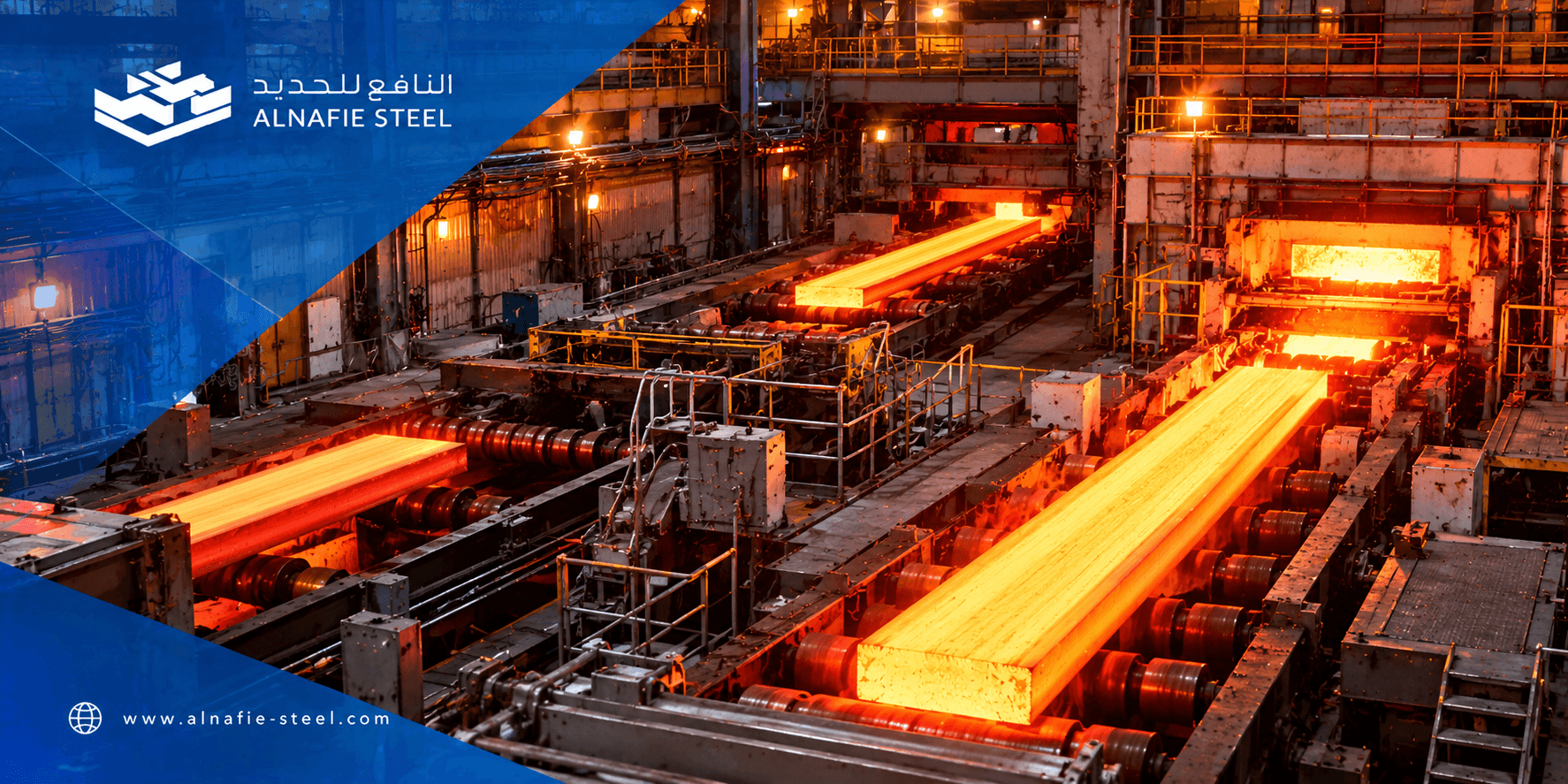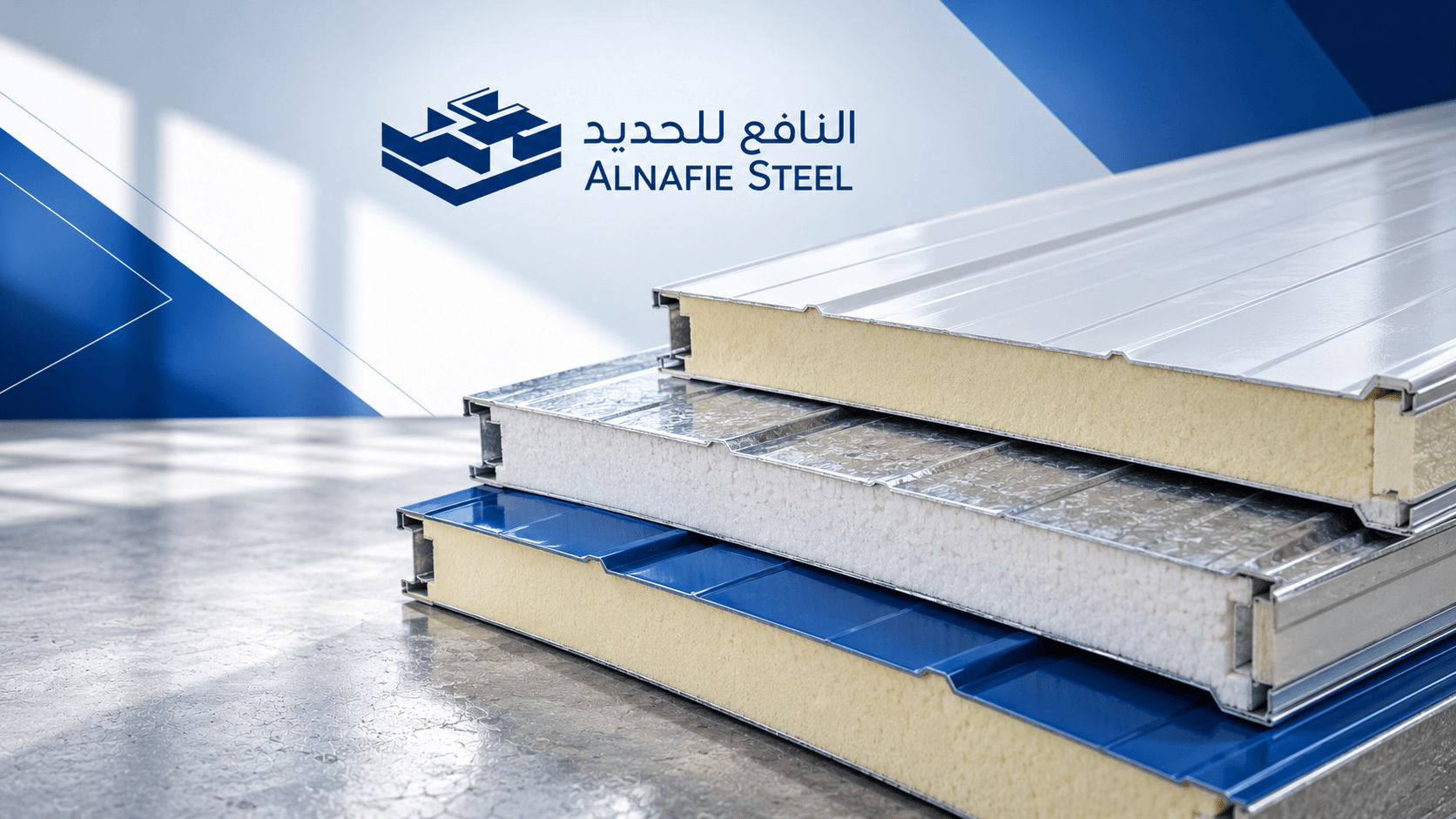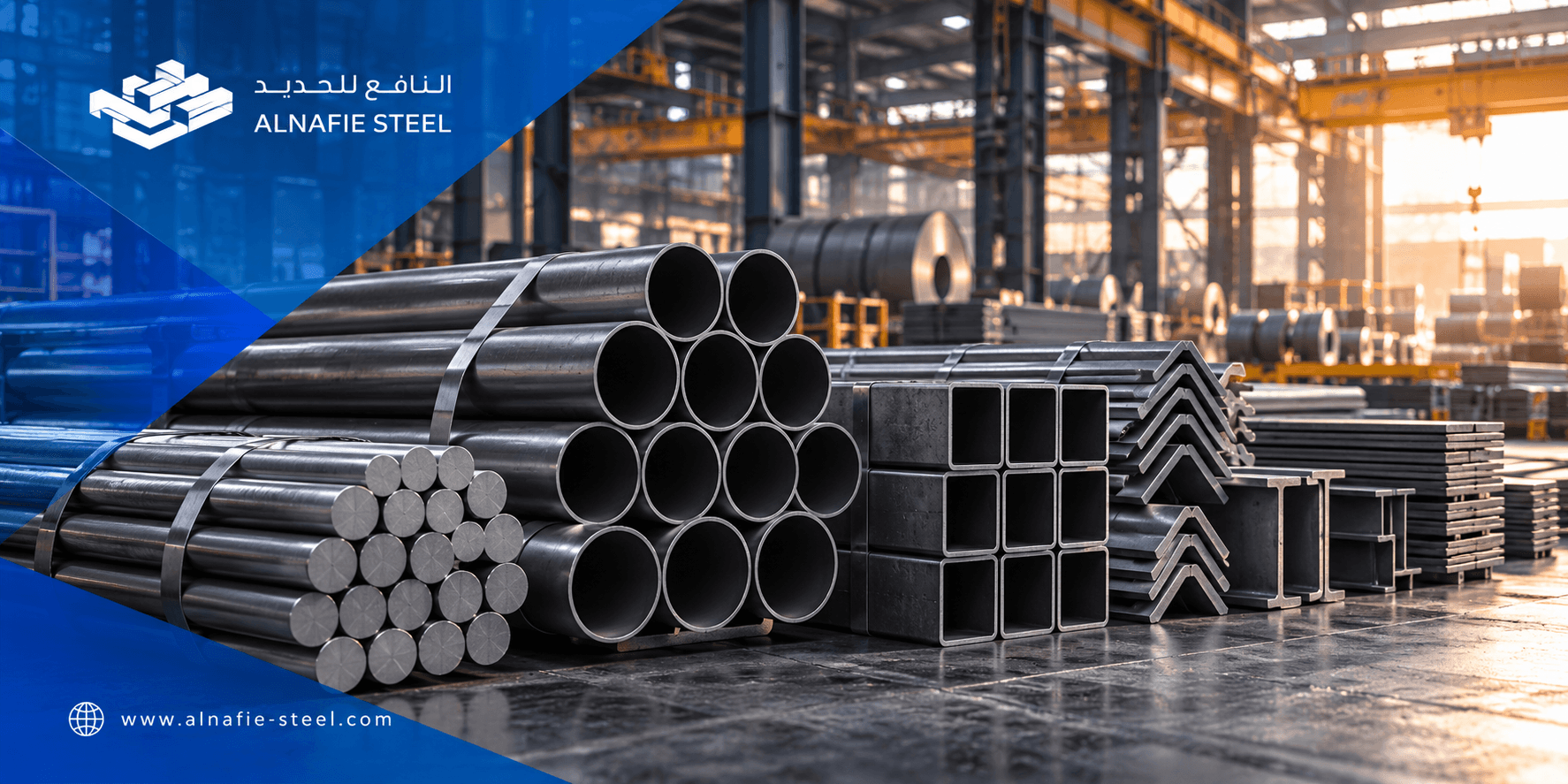
Carbon steel carries almost everything that gets built in the Kingdom, from the beams holding up warehouse roofs to the pipes moving water across industrial cities and the plates cut and folded in fabrication shops every day. Yet most buyers order it by thickness and price alone, and never look at the grade on the mill certificate, which is the line that actually decides whether a section carries its load or fails under it.
This guide covers carbon steel from the ground up, starting with the carbon content that defines it, then the three families it splits into, a grades chart showing the codes used side by side in the Saudi market, the properties that matter to an engineer and a buyer, and where each grade of carbon steel earns its place on site. We at Alnafie Steel import and supply most forms of this material, so what follows reflects what we handle daily rather than theory copied from a textbook.
What Is Carbon Steel
Carbon steel is an alloy of iron and carbon with no other elements added deliberately to change its behaviour. The carbon content runs from roughly 0.05% up to about 2.1%, and that upper figure is a real boundary. Anything carrying more carbon than that becomes cast iron, which is hard but brittle and cracks instead of bending.
Carbon is the whole story. Every increase in it adds hardness and tensile strength while taking away ductility and weldability in exchange. That trade is why no single grade of carbon steel is better than the rest. There is only a grade that suits a given load, a given forming method, and a given environment, which makes grade selection an engineering decision rather than a purchasing one.
You will also see the term mild steel used in the market, often loosely. Mild steel is not a separate material but the common name for low carbon steel, and the two terms point at the same thing in practice.
Carbon Steel vs Alloy Steel vs Stainless Steel
Three families sit next to each other in any steel catalogue, and the difference between them comes down to what else is in the mix besides iron and carbon.
Carbon steel contains no deliberate alloying additions. Alloy steel adds elements such as chromium, nickel, molybdenum or vanadium in measured amounts to buy a specific property, whether that is toughness at low temperature, resistance to creep at high temperature, or deeper hardening through thick sections. The additions cost money, so alloy grades are specified where carbon steel genuinely cannot do the job.
Stainless steel is the special case worth understanding properly. It carries at least 10.5% chromium, which forms a thin oxide layer on the surface that repairs itself when scratched. That layer is why stainless resists corrosion without any coating, and it is also why stainless steel sheet and plates cost several times what the equivalent carbon steel costs.
The practical comparison is simpler than the metallurgy. Carbon steel is cheaper, stronger per riyal, easier to weld and easier to form, and it needs protection from moisture. Stainless needs no protection and handles food contact and chemical exposure, and you pay for that. For structural work in a dry inland environment, carbon steel wins on every count that matters.
Low, Medium and High Carbon Steel
The carbon steel family divides into three bands by carbon content, and each band behaves differently once it reaches the shop floor.
Low Carbon Steel
Below 0.3% carbon, low carbon steel dominates the market by a wide margin. It welds with any ordinary process without preheat, it bends and cuts without cracking, and its tensile strength is moderate but sufficient for most structural work. Sheet, coil and structural sections in this range cover warehouses, hangars, building frames and general fabrication, and commercial steel products sit squarely here.
If parts will be welded on site by crews working at speed, low carbon steel is the answer without much further analysis.
Medium Carbon Steel
Between 0.3% and 0.6% carbon, medium carbon steel trades some weldability for strength. It is stronger and harder than low carbon steel, and it responds well to heat treatment, which is how shafts and gears reach their working hardness. Welding it needs preheat and controlled cooling or the weld zone cracks, so it belongs in machined and fabricated components rather than site-welded frames. High-strength reinforcement bar also falls in this range.
High Carbon Steel
Above 0.6% carbon, and reaching past 1% in some grades, this band is hard and highly resistant to wear. High carbon steel holds a cutting edge and survives constant abrasion, which is why springs, blades, discs and cutting tools are made from it. The cost is brittleness and poor weldability, and joining it reliably takes procedures most fabrication shops would rather avoid.
Past this point the material leaves the carbon steel family altogether and becomes special steel, where deliberate additions take over from carbon as the way to reach a target property.
Carbon Steel Grades Chart
Grade codes confuse buyers more than anything else in the specification, and the reason is that three numbering systems circulate in the Saudi market at the same time. The American AISI and SAE system gives a four-digit number such as 1018, where the last two digits indicate carbon content in hundredths of a percent. The ASTM system gives a code such as A36 tied to a product and an application. The European EN system gives a letter and a number, as in S355, where the number is the minimum yield strength in megapascals.
The chart below puts the most widely traded carbon steel grades together so the codes can be read against each other.
| Grade | System | Carbon content | Yield strength (MPa) | Typical use |
|---|---|---|---|---|
| 1008 | AISI and SAE | up to 0.10% | 170 to 200 | Cold rolled sheet and deep drawing |
| S235JR | EN 10025 | up to 0.17% | 235 | General structural frames |
| 1018 | AISI and SAE | 0.15% to 0.20% | 220 to 370 | Shafts, pins and machined parts |
| A36 | ASTM | up to 0.29% | 250 | Structural plate and beams |
| S275JR | EN 10025 | up to 0.21% | 275 | Medium load structures |
| A53 Grade B | ASTM | up to 0.30% | 240 | Welded and seamless pipe |
| A106 Grade B | ASTM | up to 0.30% | 240 | Seamless pipe for high temperature |
| S355JR | EN 10025 | up to 0.24% | 355 | High load structures and long spans |
| A516 Grade 70 | ASTM | up to 0.31% | 260 | Pressure vessel plate |
| 1045 | AISI and SAE | 0.43% to 0.50% | 450 to 585 | Shafts, axles and gears |
| 1060 | AISI and SAE | 0.55% to 0.65% | 370 to 485 annealed | Springs, discs and wire |
| 1095 | AISI and SAE | 0.90% to 1.03% | 380 to 525 annealed | Blades and cutting tools |
One line in that chart looks wrong at first glance and is not. The high carbon grades 1060 and 1095 show lower yield strength than 1045, because those are annealed figures. High carbon steel earns its real hardness from heat treatment rather than from composition alone, so a quoted annealed number says little about how the finished part will perform. Treat every figure here as indicative, since values shift with thickness and delivery condition, and read the mill certificate that arrives with the shipment as the final word.
Carbon Steel Properties
The density of carbon steel is approximately 7.85 grams per cubic centimetre, and that figure holds across effectively every grade regardless of carbon content. It is the number used to turn dimensions into shipping weights, so it matters commercially as much as technically.
What does change with carbon content is a set of three linked properties. Yield strength and tensile strength both rise as carbon increases, surface hardness rises with them, and ductility falls away in return. Every gain in strength is paid for with a loss in how far the material stretches and bends before it breaks, and that is the single trade-off behind every grade decision.
Two further properties matter in the workshop. Thermal expansion sits at roughly twelve parts per million per degree Celsius and is near enough constant across grades, which is what expansion gaps in long spans are calculated from. Machinability peaks in the middle of the range, because very low carbon steel tends to smear and drag on the tool while very high carbon wears it down quickly.
Weldability is the property that decides the most on site. Up to 0.3% carbon, the material joins with any standard process. Between 0.3% and 0.5% it needs preheat and controlled cooling. Above that, procedures get specialised and sometimes impractical, and the detail behind that progression is set out on our page covering welding carbon steel.
The one permanent weakness is corrosion, which gets a section of its own further down.
Carbon Steel Uses and Applications
Most of the metal visible on a Saudi construction site is low or medium carbon steel, and what distinguishes one piece from the next is the shape it was rolled or formed into rather than the material itself.
In steel-framed buildings, vertical and lateral loads travel through beams and channels rolled from grades such as A36 and S275, while connections are reinforced and braced with equal and unequal angles cut to length on site. In reinforced concrete, the whole system depends on deformed bar, which is medium carbon steel cold-formed and ribbed to grip the concrete around it.
In distribution networks, water, gas and compressed air move through pipe in the A53 and A106 grades. In fabrication shops, carbon steel plate is cut, folded and welded into tanks, fencing, stairs and bespoke frames. In manufacturing, shafts and gears are machined from medium carbon steel and then heat treated to raise surface hardness while keeping a tougher core.
Demand for carbon steel across the Kingdom tracks construction activity closely, which means grade availability in local stock becomes a scheduling factor and not only a cost one. Waiting on an imported coil can hold up a pour or a frame erection by a fortnight.
Carbon Steel Plate and Sheet
Carbon steel plate and sheet arrive in two forms depending on how they were rolled, and that choice affects price, tolerance and finish together.
Hot rolled plates and coils are rolled above the recrystallisation temperature, so they come out in heavier thicknesses with a scaled surface and wider dimensional tolerances. They are the cheaper option and the right one for structural work, profile cutting and general fabrication, with thicknesses running from around one and a half millimetres up into the heavy plate range.
Cold rolled sheet and coils are rolled again at room temperature after the hot process, which gives a smoother surface, tighter tolerances and higher strength through work hardening. They suit anything where the finished surface shows or where thin and consistent gauge is required, and they cost more because of the extra processing stage.
The working rule is straightforward. If the piece will be coated, hidden inside a frame or buried in concrete, hot-rolled carbon steel is enough and saves money. If the surface stays visible or the part goes into precision forming, cold rolled is the correct call.
If you already know the grade and thickness your project needs, request a quote from our sales team and include the dimensions, quantity and delivery location. A specific enquiry comes back as a firm price the same day instead of a round of questions.
Carbon Steel Pipe
Carbon steel pipe is made two ways, and each has work it does better than the other.
ERW and seamless pipes differ in whether a weld seam exists. Electric resistance welded pipe is formed from strip, rolled round and welded along its length, which keeps cost down and dimensional consistency high, making it the practical choice for water mains, fire protection lines and structural use. Seamless pipe is produced by piercing and drawing a solid billet, so there is no seam to act as a weak line, and it is what high pressure, elevated temperature and steam service call for.
A third family is structural rather than fluid-carrying. Square and rectangular MSH sections are preferred for columns, trusses and exposed frames, because a closed section resists torsion far better than an open profile and looks cleaner where the steel stays visible.
Grade selection in pipe follows the service rather than the shape. A53 Grade B covers general utility lines, and A106 Grade B is the specification to insist on once operating temperature rises.
Does Carbon Steel Rust
Yes, carbon steel rusts, and there is no useful way around that fact. Carbon steel contains no chromium to form a protective oxide layer, so the surface reacts with oxygen and moisture and converts progressively into flaking iron oxide, losing section thickness as it goes.
The problem sharpens in coastal cities such as Jeddah, Jazan and Dammam, where airborne salinity accelerates the reaction substantially compared with dry inland sites. A specification that lasts twenty years in Riyadh can fail in a fraction of that time on the Red Sea coast.
Protection is a solved problem, with three options rising in cost. Paint systems with a primer and topcoat are cheapest and need recoating every few years. Hot dip galvanising immerses the part in molten zinc and gives decades of protection, and galvanized sheet and coils come ready-protected from the mill. Where mechanical abrasion rather than moisture is the enemy, wear resistance plates with high surface hardness are the answer instead.
If exposure is severe and permanent, or contact with food or chemicals is involved, the right move is not protecting carbon steel but replacing it with stainless, which carries its corrosion resistance in the alloy itself and needs no external layer at all.
How to Choose the Right Carbon Steel Grade
Carbon steel grade selection becomes simple once three questions are answered in order.
First, what kind of load? Static loads in a building frame are satisfied by a grade such as A36 or S275. Moving or repeated loads in machinery need a medium carbon grade that resists fatigue, since a section that handles a static load fine can fail under cycling.
Second, will the piece be welded? If yes, stay below 0.3% carbon and avoid a long list of site problems. If a higher grade is unavoidable, budget the preheat and inspection from the start rather than discovering the cost mid-project.
Third, what is the environment? Coastal means galvanising or a higher-specification paint system. Dry inland tolerates simpler protection.
A worked example ties the three together. A storage hangar in Riyadh with static loads, site welding and a dry interior calls for A36 or S275 hot rolled with ordinary paint, which is the cheapest sound answer. The same hangar in Jazan keeps the grade and swaps paint for galvanising. Add a crane runway beam and the load becomes cyclic, which pushes the specification up to S355. Cost enters last, and tracking the steel price per ton shows why. The price gap between adjacent grades is far smaller than most buyers assume, so moving up a grade is usually cheaper than repairing a failure.
From the Right Grade to Your Site
Choosing the grade is half the job. The other half is finding it in stock, in the size you need, with a mill certificate, on the date the schedule demands.
In Alnafie Steel, We supply plate, coil, structural sections, pipe, angles and beams to projects in Jeddah, Riyadh, Dammam, Tabuk, Qassim, Khamis Mushait, Najran, Jazan, and Dubai, and every order arrives with its certification and conformity documents. Explore our steel product range in Saudi Arabia to see what fits your project, or send your specification across, and the technical team will come back with the closest available grade.
Need Any Steel Advice For Your Project? Talk to Us Today
We serve project sites across Saudi Arabia.
Frequently Asked Questions
Is carbon steel stronger than stainless steel?
In most grade-for-grade comparisons, carbon steel reaches higher strength per unit cost, and high carbon grades exceed common austenitic stainless grades outright in hardness. Stainless wins on corrosion resistance, not on raw strength, which is why structural work uses carbon steel and wet or hygienic environments use stainless.
Does carbon steel rust?
Yes, it rusts when exposed to moisture and oxygen, because it lacks the chromium needed to form a self-repairing protective layer. Paint, hot dip galvanising or cladding all prevent it, and the choice depends on design life and how aggressive the environment is.
What is the density of carbon steel?
The density of carbon steel is about 7.85 grams per cubic centimetre, or 7850 kilograms per cubic metre. The figure stays effectively constant across all grades, so it is reliable for calculating weights from dimensions.
What is the difference between mild steel and carbon steel?
Mild steel is a subset of carbon steel rather than a different material, referring specifically to low carbon grades below roughly 0.3% carbon. Every mild steel is a carbon steel, but medium and high carbon grades are not mild steel.
Which carbon steel grade is best for structural work?
A36 and S275JR cover the majority of general structural work, with S355JR used where loads or spans increase. All three weld without preheat and are widely stocked, which is why they dominate structural specifications in the region.
Can high carbon steel be welded?
It can be welded with preheat, post-weld heat treatment and slow controlled cooling, but the procedure is demanding and cracking risk stays high. In most practical cases it is better to use mechanical fasteners or to specify a lower carbon grade from the outset.
Does Alnafie Steel supply carbon steel in Saudi Arabia?
Yes, we supply hot rolled and cold rolled plate and coil, structural sections, pipe and angles in carbon steel with mill certificates, delivered to projects from our branches across the Kingdom. Send through your specification and quantity and a firm offer comes back against it.
Carbon Decides Everything That Follows
Everything in this guide traces back to one number, the carbon content. It determines whether a section welds on site or needs a furnace, whether it bends or snaps, and whether it yields at 250 megapascals or 355.
Which is why the first question when buying is not the price per ton but the grade. The right grade on a simple project saves real money, and the wrong grade on a critical one costs several times whatever was saved. Once the number is settled, the rest of the decision is supply and timing, and those are problems with straightforward answers.