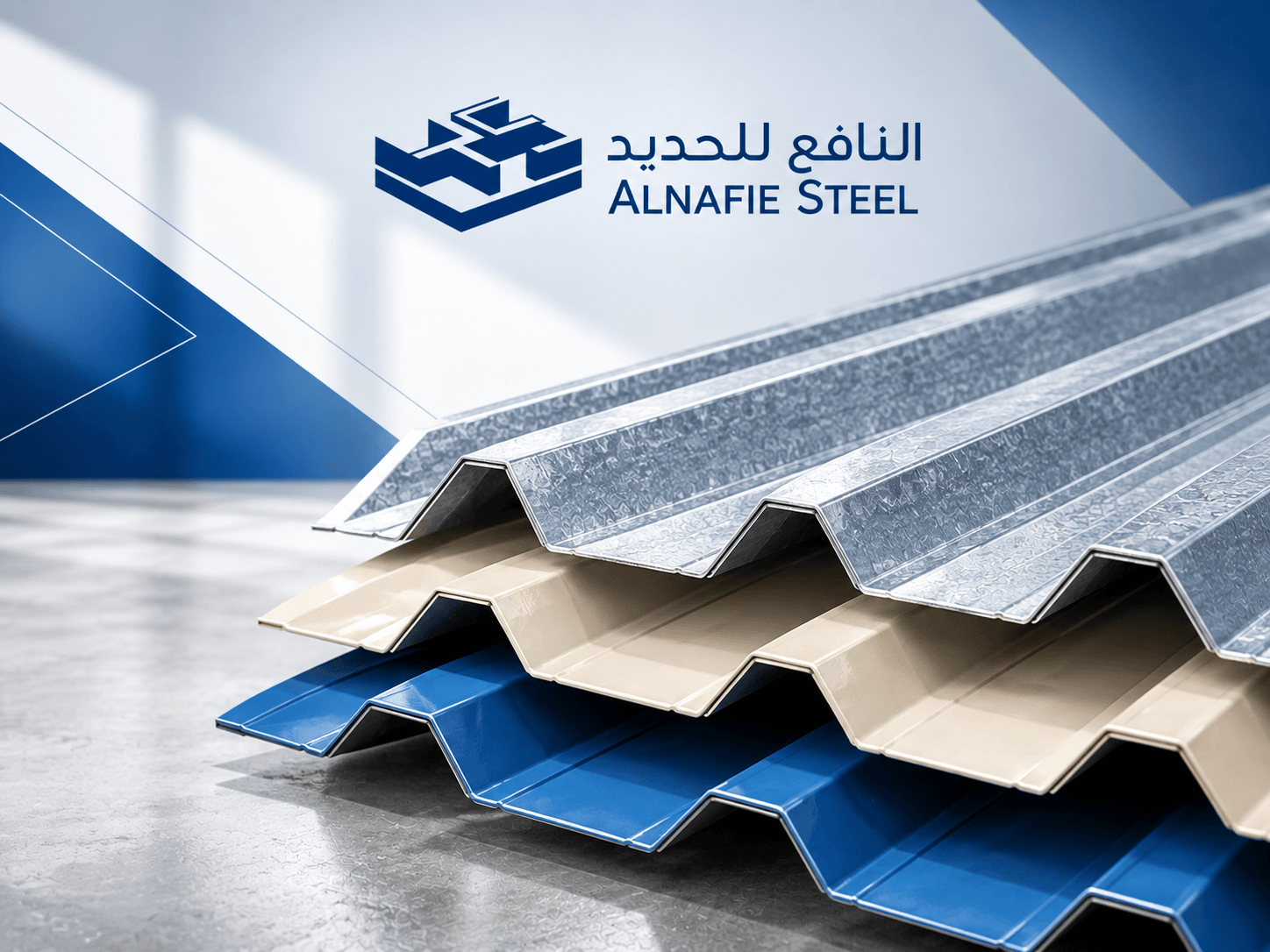
A corrugated sheet is a thin metal panel rolled into repeating waves or ribs, used to cover roofs, car shades, fencing and warehouses across Saudi Arabia. On site you will hear it called shinko, the local name that stuck after Japanese suppliers first brought these panels into the Kingdom decades ago. This guide from Al-Nafie Steel explains what corrugated sheets are made of, which types exist, how to pick the right thickness, and what really drives the price before you request a quote.
Three things are worth knowing up front. The base material is almost always galvanized or pre-painted steel, the corrugation is what makes a thin panel rigid, and the most commonly specified thickness sits between 0.35 mm and 0.5 mm.
What Is a Corrugated Sheet?
Press rollers shape a flat coil into a wave or trapezoidal profile. That geometry multiplies stiffness several times over compared with a flat panel of identical thickness, which is why a corrugated sheet resists wind load, dust weight and rainwater without buckling.
Two profile families dominate the Saudi market. The rounded wave is the traditional look, common on fencing and small shades. The trapezoidal profile, with squared ribs, carries more load across a longer span and is now the default for warehouses and industrial roofs.
Because shinko is a regional nickname rather than a technical designation, it appears in no international standard. When dealing with mills or overseas traders, always say corrugated sheet, or roofing sheet when the application is specifically a roof.
What Corrugated Sheets Are Made Of
Quality starts with the coil, long before the profile is rolled. The mill feeds thin coil through forming rollers, then cuts each panel to the ordered length. Coil grade and protective coating determine how long a corrugated sheet lasts far more than the profile shape does.
Galvanized steel
Most corrugated sheets start as galvanized sheet, steel coated with zinc to hold off corrosion. The mill certificate states coating mass as a code such as Z120 or Z275, where the number is grams of zinc per square metre. A higher number buys more years of service, and that difference becomes decisive near the coast.
Pre-painted (colour-coated) steel
Colour-coated panels begin as cold-rolled steel sheet, galvanized and then painted at the mill with a polyester coat. The paint adds a second barrier above the zinc and allows white, beige, green or red finishes. A light colour also reflects part of the solar load, which matters on a roof in Riyadh in July.
Aluminium
In Jeddah, Dammam and Khobar, humidity and airborne salt shorten the life of steel. Some specifiers switch to a corrugated sheet formed from aluminium instead. Aluminium does not rust and weighs less, but it costs more and dents more easily under impact.
Types of Corrugated Sheet
Corrugated sheets differ by profile, surface finish and whether insulation is bonded to them.
- Plain galvanized sheets are silver and uncoated, the lowest-cost option, suited to warehouses, workshops and temporary site structures.
- Colour-coated sheets are the same panel with a factory paint finish. They look cleaner and last longer, which is why homeowners pick them for shades and fencing.
- Tile-effect sheets are pressed to imitate clay roof tiles, used on pitched villa roofs. They give the look of tiles with the weight and speed of steel.
- PVC sheets cannot corrode at all, which suits chemical environments and farms, though they are weaker against impact than metal.
Polycarbonate Corrugated Sheet for Natural Light
A translucent corrugated sheet is made from polycarbonate or PVC rather than steel, and its job is to bring daylight inside without cutting openings into the structure.
The standard approach is to run one or two translucent strips between the steel panels in a warehouse roof, which cuts daytime lighting costs noticeably. Specify a UV-stabilised grade, because without it the sheet yellows and turns brittle within a few years under Saudi sun.
When You Actually Need Insulated Roof Panels
An insulated panel combines an outer steel skin with a bonded insulation layer, and in the full version an inner skin as well. The insulation slows heat transfer, dampens rain noise and prevents condensation forming underneath the roof.
The rule is simple. If people will sit under the roof, or heat-sensitive goods will be stored beneath it, insulation is not optional in a Saudi summer. An open-sided car shade, by contrast, performs perfectly well with a plain or colour-coated corrugated sheet.
Three insulation cores are common. Polyurethane foam delivers the best thermal performance per millimetre and dominates the market. Rock wool is specified where fire resistance is required, typically in factories under stricter safety rules. EPS foam is cheapest and weakest thermally. Core thickness usually runs from 50 mm to 100 mm.
Corrugated Sheet Thickness and Sizes
Thickness is the specification that matters most, because it sets both the load a corrugated sheet carries and the maximum purlin spacing allowed beneath it. The values below are typical market figures and should be checked against the manufacturer’s catalogue before ordering.
| Specification | Typical value | Notes |
|---|---|---|
| Corrugated sheet thickness | 0.28 mm to 0.7 mm | 0.35 mm to 0.5 mm most requested |
| Insulation core thickness | 50 mm to 100 mm | Depends on thermal performance required |
| Effective cover width | Roughly 1,000 mm to 1,050 mm | Varies with profile |
| Length | Cut to order | One panel per slope avoids end laps |
| Zinc coating | Z120 to Z275 | Z275 for coastal sites |
As a practical rule, anything under 0.35 mm belongs on temporary structures only. Permanent roofs and shades in exposed, windy locations need 0.4 mm or more.
Corrugated Sheet vs Sandwich Panel
A sandwich panel is built from two steel skins with insulation bonded between them at the factory. The difference is straightforward. A single-skin corrugated sheet is thin, light and inexpensive. A sandwich panel is thick, insulates well and works for walls and roofs alike, but it costs more, weighs more and demands a stronger frame.
| Comparison | Corrugated sheet | Sandwich panel |
|---|---|---|
| Thermal insulation | Poor | High |
| Weight | Very light | Heavier |
| Cost | Lowest | Clearly higher |
| Best suited to | Shades, stores, fencing | Rooms, offices, cold stores |
Metal Roofing Sheets for Warehouses and Hangars
Metal roofing sheets are the fastest way to close in a warehouse, workshop or extension. The panels are light enough to lift by hand and fix onto a simple steel frame within days. A square metre of 0.4 mm corrugated sheet weighs around 3.5 kg, a fraction of what a concrete slab imposes.
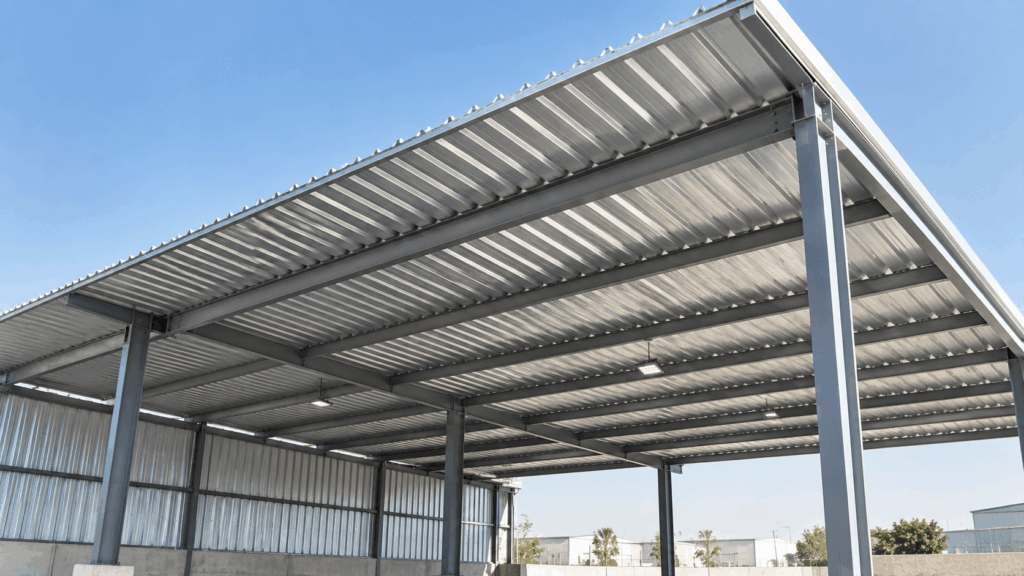
In larger hangars the roof load travels through a frame of steel beams and channels and columns, with purlins spanning between them to receive the panels. At this scale the frame matters more than the corrugated sheet itself, since an error there surfaces later as a leak or a sagging roof line.
Roofing Sheets for Car Parking Shades
Car parking shades are the most visible residential application in the Kingdom. The structure is a set of steel columns and purlins carrying colour-coated or insulated roofing sheets above the parking bay.
Three details are worth getting right, starting with clearance high enough for a tall vehicle. The second is a slope that drains rainwater away from the house entrance rather than across it, and the third is a light-coloured finish. An insulated corrugated sheet makes a measurable difference to cabin temperature after a car has stood in the sun for hours.
Cladding Sheet for Walls and Site Fencing
The same profiles work vertically as a cladding sheet, raising boundary wall height, screening a yard from view, or enclosing a construction site. Colour-coated panels are preferred here because the surface stays permanently in public view.
Remember that a vertical screen takes wind pressure head-on rather than at a shallow angle, so it sees higher loads than a roof of the same area. Set posts in adequate concrete footings and resist the temptation to save money on corrugated sheet thickness.
Installing Corrugated Roofing Sheets
Most leaks trace back to an error in one of these five stages.
- Frame preparation comes first, setting columns and purlins to the correct level and slope before lifting a single corrugated sheet.
- Working direction matters, so start from the end opposite the prevailing wind, where gusts cannot catch an exposed edge and lift it.
- Laps should overlap each panel onto its neighbour by at least one full corrugation, with a minimum end lap of 150 mm at any joint.
- Fixing means fastening every panel at the correct positions on each purlin.
- Finishing covers flashings, ridge caps and gutters, followed by sweeping away swarf and drill filings immediately.
The steel frame underneath
Shades and small rooms are typically framed with square and rectangular hollow sections for columns and purlins, stiffened with steel angles. The quality of the steel welding at each connection governs how the structure handles wind, and every weld should receive an anti-corrosion primer as soon as it cools.
Minimum roof slope
A flat installation is a false economy. Water ponds on the surface, works through laps and fastener holes, and corrosion begins on the underside of the corrugated sheet. Most manufacturers recommend a minimum slope of roughly five degrees for trapezoidal profiles and more for wave profiles, but the catalogue for your specific profile is the authority.
Choosing the Right Roofing Screws
The correct fastener is a self-drilling, self-tapping screw with a hexagonal head and a metal washer backed by an EPDM rubber seal. That seal closes the hole and keeps water out, which is why an ordinary screw is never an acceptable substitute.
- Fix through the crest of the corrugation on roofs so water never runs across the penetration.
- Do not over-tighten, because a crushed washer deforms and starts leaking within months.
- Use galvanized or coated screws so the fastener does not fail before the corrugated sheet does.
- Plan on four to six fasteners per panel per purlin, depending on cover width and wind exposure.
Corrugated Sheet Price in Saudi Arabia
There is no single corrugated sheet price. The figure moves with thickness, coating, insulation, project size and city, and it tracks the steel price per ton on global and local markets. The ranges below are approximate, gathered from installation contractors quoting in the Saudi market, and are indicative only rather than contractual.
| Type | Approximate range (SAR per square metre) |
|---|---|
| Plain corrugated sheet, supplied and installed | 60 to 90 |
| Fencing, supplied and installed | 50 to 75 |
| Insulated panel, supplied and installed | 90 to 180 |
| Corrugated sheet supplied only, no installation | 18 to 40 |
An installed rate covers the panel, the steel frame, fasteners, labour and transport, so it rises with heavier sections, taller columns or a complex shade geometry. The rate per square metre usually falls as the area grows, because mobilisation spreads across more square metres.
A supply-only corrugated sheet price covers the panel alone and is driven by thickness, zinc coating mass and paint. The gap between a 0.3 mm panel and a 0.5 mm one can approach a factor of two, so always compare quotes at identical thickness and coating mass. Otherwise you are comparing two different products.
How to Choose the Right Corrugated Sheet
Answer these six questions before requesting a quote.
- Will anyone sit beneath the roof? If yes, specify an insulated panel from the start.
- Is the site near the sea? Ask for Z275 coating, a painted finish, or aluminium.
- How exposed is the location? In open, windy areas do not go below 0.4 mm.
- Do you need daylight inside? Add translucent strips distributed across the roof.
- Can the supplier produce a mill certificate? It should state thickness and coating mass as numbers.
- What is the purlin spacing? Confirm it suits the chosen thickness per the load table.
Need Any Steel Advice for Your Project? Talk to Us Today
We serve project sites across every region of Saudi Arabia.
Frequently Asked Questions
What is a corrugated sheet?
It is a thin steel panel rolled into repeating waves or ribs, usually galvanized or painted, used to cover roofs, shades, fencing and hangars. The corrugation is what gives a very thin panel its rigidity.
Is shinko the same as a corrugated sheet?
Yes. Shinko is the everyday Saudi and Gulf name for the same product. The technical term is corrugated sheet, or roofing sheet when discussing roofs, and that is what to use with international suppliers.
How long does a corrugated metal roof last?
Service life depends on zinc coating mass, paint and environment. A good galvanized corrugated sheet inland can last 15 to 25 years, longer with paint and maintenance, and less on the coast if coating mass is light.
Does a corrugated sheet keep heat out?
A single-skin corrugated sheet does not. Thin metal conducts heat quickly. For thermal performance you need an insulated panel, or a separate insulation layer below the roofing, plus a light colour to reflect part of the solar gain.
Does a corrugated sheet rust?
The zinc layer protects the steel, but corrosion starts at scratches, cut edges and fastener holes if neglected. Galvanized fasteners, prompt removal of drilling swarf, and drainage that prevents ponding all extend service life considerably.
How much does a corrugated sheet cost per square metre in Saudi Arabia?
Supplied and installed, a plain corrugated sheet typically runs 60 to 90 SAR per square metre, rising to roughly 90 to 180 SAR for insulated panels depending on core, thickness and area. Treat these as indicative figures that move with the market.
What is the difference between a corrugated sheet and a zinc sheet?
They are usually the same thing. Zinc refers to the protective coating on the steel, not to the metal of the panel itself. The base material in most corrugated sheets on the Saudi market is steel.
What can be used instead of zinc and corrugated sheets?
The alternative depends on what the plain panel lacks. When heat is the problem, a sandwich panel is the answer. When corrosion on a coastal site is the concern, aluminium takes over. When a villa needs a better appearance, metal or clay roof tiles fit. When daylight is wanted inside, polycarbonate panels do the job. For permanent buildings that need a longer life and real sound insulation, a concrete roof still wins despite its cost and build time.
The Roof Starts With the Frame
A corrugated sheet remains the fastest, most economical way to cover a roof, a shade, a fence line or a warehouse, provided you match thickness and coating to the site and install it on a sound steel frame with adequate fall. The life of any such roof begins with the quality of the structure carrying it, not with the corrugated sheet alone.
Al-Nafie Steel does not supply formed corrugated sheets or installation services. What we do supply are the raw materials and sections every project of this kind is built from, from galvanized coils through the full range of commercial steel sections, with branches in Jeddah, Riyadh and Dammam serving most regions of the Kingdom. If you are looking for a trusted steel supplier in Saudi Arabia for a shade, hangar or warehouse project, contact our sales team for a quotation on structural materials.