This guide breaks down the steel price per ton in Saudi Arabia, covering the rebar price by size and grade, the factors that move the market, the difference between price per ton and price per kilo, and how to calculate the steel cost for your project.
Steel Price Per Ton in Saudi Arabia Today: Current Rebar Rates by Size
The steel price per ton in the Saudi market moves within a fairly predictable band, but it is never a single fixed number for every buyer. Three things explain most of the gap between the figures quoted around the market: whether the price is ex-works or delivered to site, whether it includes 15% VAT, and whether the order is wholesale or retail.
That is why we publish a range rather than one figure. A contractor ordering 300 tons in a single lot does not pay what a homeowner buying 8 tons pays. Before comparing quotes, it helps to review the grades and diameters available on our reinforcement bar page.
Based on approximate market averages in September 2026, use the following ranges as a reference:
| Pricing basis | Approximate range per ton | Notes |
|---|---|---|
| Wholesale / ex-works (before VAT) | SAR 2,450 – 2,700 | Large volumes and direct contracts |
| Retail including 15% VAT | SAR 2,850 – 3,300 | Varies by city and diameter |
| General market average | SAR 2,500 – 2,600 | Before VAT and delivery |
Across diameters the differences look small, but they compound quickly on a large project:
| Diameter | Approximate Steel price per ton (SAR) |
|---|---|
| 8 mm | 2,400 – 2,500 |
| 10 mm | 2,450 – 2,550 |
| 12 mm | 2,450 – 2,550 |
| 16 mm | 2,500 – 2,600 |
| 20 mm | 2,550 – 2,650 |
| 25 mm | 2,600 – 2,700 |
| 32 mm | 2,600 – 2,700 |
Every figure above is approximate and indicative, representing market averages rather than a formal quotation. Steel prices in Riyadh differ from steel prices in Jeddah or Dammam by the cost of freight alone. For available grades and sizes, see our reinforcement bar range at Al Nafie Steel.
Want to discuss your project or ask anything about steel? Call us now.
Trading and importing steel in the Saudi market since 1979
Jeddah • Riyadh • Dammam
What Affects the Steel Price Per Ton in Saudi Arabia? Iron Ore, Scrap and Energy
Steel pricing is the end of a long chain that starts at the mine and finishes at your site gate. Understanding that chain lets you read where the market is heading instead of simply reacting to the final number.
Global iron ore prices
Iron ore is the first input into any steel mill. When ore rises on international markets, production costs rise automatically and the effect reaches Saudi steel prices within a few weeks. Tracking global ore indices gives you an early signal on local direction, and you can follow market developments through our news and insights section.
Scrap prices
A large share of regional rebar output comes from electric arc furnaces that run on scrap as their primary feedstock. Any increase in imported scrap prices feeds straight into the cost per ton, and the reverse holds true as well.
Energy costs
Steelmaking is among the most energy-intensive industries there is. Electricity and gas represent a meaningful portion of the cost of a single ton, which is why any change in energy tariffs shows up in local steel prices soon after.
Freight and transport costs
Steel is heavy, and moving it is priced by the ton-kilometre. A project in the Eastern Province may be quoted differently from one in Riyadh for identical specifications, purely because of haulage distance. Bulkier products such as ERW and seamless pipes and hot rolled plates and coils also carry a larger freight share per ton than bar does. Rising sea freight or diesel costs push the delivered cost up for every buyer.
The dollar and currency movements
Most ore, scrap and imported product transactions settle in dollars. Although the riyal is pegged to the dollar, movements in other currencies such as the euro and the yuan still affect the cost of importing from European and Asian mills.
Supply and demand in the Saudi market
The volume of active construction across the Kingdom is the single biggest driver of demand. Building season, the pace of the mega projects, and the rate at which new residential schemes are released all lift demand and carry prices with them. During slower periods or long holidays, prices tend to flatten or ease. Timing therefore matters a great deal to your final cost, and buying at the peak of the season is a different exercise from buying in a quiet stretch.
Mill and supplier price lists
Every mill issues its own list based on capacity, inventory and input costs. The gap between two mills for the same diameter can run to tens of riyals per ton, which is why comparing offers before committing is essential. Understanding the difference between rebar, commercial steel and special steel will tell you whether two quotes are even comparable.
Storage and supply costs
A supplier holding warehouse stock can fix your price and deliver quickly, but that storage carries a cost that sits inside the price. Buying direct from a mill may be cheaper, yet it demands large volumes and a longer wait. Our services cover supply, storage and cut-to-size processing, alongside alloy steel and industrial products.
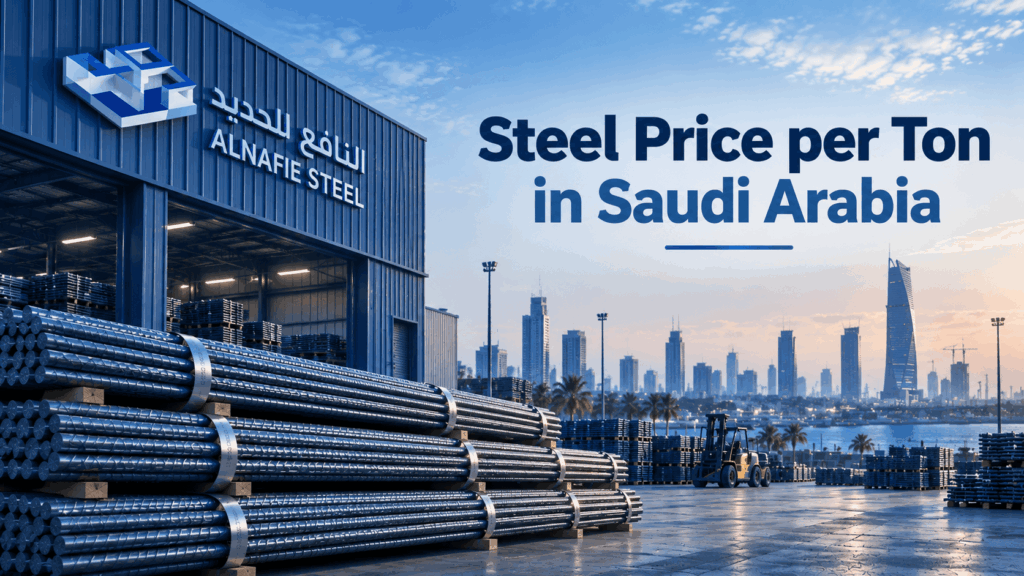
steel price per ton in Saudi Arabia
Why Does the Steel Price Per Ton Differ Between Steel Suppliers in Saudi Arabia?
Buyers are often surprised to collect three quotes and receive three different numbers for the same ton. The variation is normal, and it has clear causes:
- Order volume: the larger the quantity, the lower the steel price per ton. Five tons is priced very differently from five hundred.
- Steel type: rebar is priced differently from commercial steel or special steel in both cost and application.
- Diameter: smaller diameters need more rolling passes, larger ones face different demand, and both feed into price.
- Specification: steel grade and yield strength set the price. Higher-strength specifications cost more.
- The steel price per ton can fluctuate based on changes in raw material costs, global steel markets, and local supply and demand.
- Country of origin: domestic product differs from imported material in cost, duties and lead time.
- Stock availability: ready inventory means faster delivery, while a shortage in one diameter lifts its price temporarily.
- Delivery point: ex-warehouse is not the same as delivered to site.
- Freight: calculated by distance, number of trips and truck capacity.
- Payment terms: cash settlement usually earns a better price than credit.
- Project size: long-term contracts allow the price to be fixed for an agreed period.
For this reason, the most accurate answer to what the steel price per ton is today comes from a quote built on your own specification, not from a general table.
Want to discuss your project or ask anything about steel? Call us now.
Trading and importing steel in the Saudi market since 1979
Jeddah • Riyadh • Dammam
Steel Prices by Type: Rebar, Commercial Steel and Galvanized Steel
Rebar is rarely the only steel a project needs. Each product has its own market and cost base, and knowing the differences helps you allocate the budget properly. The table below compares steel price per ton levels across the most commonly ordered types:
| Steel type | Approximate price level | Typical use |
|---|---|---|
| Reinforcement bar | The reference baseline | Reinforced concrete, foundations, columns |
| Commercial steel | Close to rebar, varies by section | Warehouses and general structural work |
| Galvanized sheet and coils | Higher, due to the zinc coating | Humid environments and exterior projects |
| Special steel | Highest, depending on grade | Industrial applications and heavy loads |
| Square and rectangular hollow sections | Priced per ton or per linear metre | Steel frames and canopies |
If your project calls for structural sections, also review equal and unequal angles and hot rolled plates and coils, since these are priced on a different basis from rebar.
Construction Steel Prices Today in Riyadh, Jeddah and Dammam
Buyers frequently ask about the steel price today in Riyadh or the steel price in Jeddah, expecting a wide gap between cities. In reality, the ex-mill price is broadly similar, while the final steel price per ton can vary based on three main factors:
- Haulage distance: the further the site sits from a distribution centre or port, the higher the freight loaded onto each ton.
- Regional stock availability: a shortage of one diameter in a given city lifts its local price until the next shipment lands.
- Local demand intensity: cities with active mega projects see stronger demand and therefore leave less room to negotiate.
| City | Pricing notes |
|---|---|
| Riyadh | Strong demand from residential and commercial projects, plus inland haulage from mills and ports. |
| Jeddah | Port proximity lowers import cost, with solid demand from west coast projects. |
| Dammam | Close to industrial centres, with strong competition among Eastern Province suppliers. |
Al Nafie Steel supplies through its main centres in Jeddah, Riyadh and Dammam, which means lower freight and faster delivery to your site. To get the confirmed steel price per ton for your specific city, tell us the delivery location and we will quote it inclusive of transport.
How to Calculate Steel Cost and Rebar Quantity for Your Project
The calculation is simpler than most people expect, and it rests on a single formula:
Steel cost = quantity in tons × steel price per ton
Worked example: if your project needs 50 tons of rebar at an approximate price of SAR 2,600 per ton:
50 tons × SAR 2,600 = SAR 130,000 in base steel cost
The final figure usually carries additional items that belong in the budget from the outset:
- 15% VAT, where the quoted price excludes it.
- Freight from the warehouse to the project site.
- Cutting and bending services, where required.
- Offloading and handling on site.
- A wastage allowance, typically between 2% and 5% depending on execution accuracy.
For a fuller picture, here is an indicative model for a 50-ton project at an approximate SAR 2,600 per ton:
| Item | Calculation | Approximate value (SAR) |
|---|---|---|
| Base steel cost | 50 × 2,600 | 130,000 |
| Wastage allowance 3% | 130,000 × 3% | 3,900 |
| Freight | By distance | Set in the quote |
| VAT 15% | On the total | Added to the invoice |
| Subtotal before freight and VAT | — | 133,900 |
A practical tip: take your quantity from the bar bending schedules in the structural drawings, add the wastage allowance, then multiply by the steel price per ton. That gives you a realistic budget instead of a rough guess. If your project includes structural framing, review beams and channels for the remaining line items, and see our welding steel guide if fabrication is involved.
Price Per Ton or Steel Price Per Kg? How to Convert Between Them
The market trades in tons, but many buyers search for the steel price per kg, particularly on small projects and renovations. The conversion is straightforward:
1 ton = 1,000 kilograms
Price per kg = price per ton ÷ 1000
| Approximate steel price per ton (SAR) | Approximate steel price per kg (SAR) |
|---|---|
| 2,500 | 2.50 |
| 2,600 | 2.60 |
| 2,800 | 2.80 |
| 3,000 | 3.00 |
Note that buying by the kilo or by the bar at retail outlets is always dearer than buying by the ton, because the retail price absorbs the shop’s margin and handling. If your project runs into tons, buying directly from a specialist supplier saves real money.
Are Steel Prices in Saudi Arabia Rising or Falling?
The answer depends on the timeframe you are asking about. Over the short term, movement in the rebar price is usually contained within a narrow band. Over several months, the shifts become far more visible.
| Direction | When it happens |
|---|---|
| Rising | Global ore and scrap climb, demand builds with the construction season, energy or freight costs increase, or one diameter runs short. |
| Falling | Ore prices retreat, project activity slows, mill output increases, or freight costs ease. |
| Stable | Supply and demand are balanced, production inputs hold steady, and supply chains stay free of shocks. |
The current picture in the Saudi market leans toward relative stability with a mild upward bias, supported by demand from the mega projects and by broadly steady production inputs. To follow the latest market movements, keep an eye on our blog section.
Steel Price Forecast in Saudi Arabia for 2026
No one can offer a definitive forecast, because the market responds to global forces outside anyone’s control. Reading the indicators, however, gives a reasonable sense of the likely direction:
- Domestic demand: continued mega project delivery and urban expansion sustain a strong demand base, which supports prices.
- Global iron ore: ore holding within its usual range implies relatively stable production costs.
- Energy and freight: any sharp move here transmits into prices within weeks.
- Geopolitical factors: supply chain disruption tends to lift prices faster than it lowers them.
The most likely outcome is stability with a limited upward bias rather than sharp swings. In practice, the best move for a contractor or developer is to fix the price through a supply contract on large volumes instead of buying piecemeal, which protects the budget from sudden shifts. If you are planning ahead, you can also browse the available steel services and agree stock allocation in advance.
Steel Price Per Ton History in Saudi Arabia Over Recent Months
The table below shows approximate monthly averages, which are more useful for reading the trend than any single day’s figure:
| Month | Approximate average steel price per ton (SAR) | Direction |
|---|---|---|
| September 2026 (current) | 2,450 – 2,700 | Stable |
| August 2026 | 2,430 – 2,680 | Slight rise |
| July 2026 | 2,400 – 2,650 | Stable |
| June 2026 | 2,420 – 2,660 | Modest easing |
These are approximate pre-VAT market averages intended to show direction, not to be used for contracting. The contract price is issued as a formal quotation based on specification, quantity and delivery location.
Buying Steel From Al Nafie Steel: A Trusted Steel Supplier in Saudi Arabia
Now that you understand the steel price per ton and what moves it, the next step is choosing a supplier who offers a fair price, ready stock, and delivery on schedule.
Al Nafie is a Jeddah steel factory that has traded and imported steel in the Saudi market since 1979, serving contractors, factories, and developers through main centres in Jeddah, Riyadh, and Dammam.
What we offer:
- A broad product range: rebar, structural sections, plates and coils, and hollow sections across all common sizes.
- Certified specifications: products conforming to recognised international standards, with mill certificates.
- Flexible quantities: we serve small orders and large contracts alike.
- Supply and storage: ready stock plus cutting and processing to order.
- Nationwide coverage: delivery to project sites across the Kingdom.
- Fast quotations: send the specification and quantity, and we come back with a clear price.
To learn more about our history and expertise in the market, visit the about Al Nafie Steel page.
Your real price is not in a table. It is in a phone call.
Tables give you an average. Our team gives you a number based on your diameter, your quantity, and your site. We deliver to project locations across the Kingdom.
A leading steel supplier in the Saudi market since 1979
Jeddah • Riyadh • Dammam
Frequently Asked Questions About Steel and Rebar Prices
What is the steel price per ton in Saudi Arabia today?
The steel price per ton currently sits at roughly SAR 2,450 to 2,700 wholesale before VAT, and can reach SAR 3,300 at retail including 15% VAT. The exact figure depends on diameter, quantity, and delivery location, and is confirmed through a formal quotation.
What is the rebar price per ton today?
The rebar price in Saudi Arabia moves within the same band, with differences by diameter; sizes from 8 to 12 mm typically sit slightly below larger diameters such as 25 and 32 mm.
What is the steel price per kg today?
Steel Price per kg equals Steel price per ton divided by 1,000. At an approximate SAR 2,600 per ton, the price per kg is around SAR 2.60 before VAT and freight.
Why do steel prices differ between suppliers?
Because of differences in quantity, specification, diameter, country of origin, available stock, delivery point, and payment terms, on top of freight cost and project size.
Are steel prices going up or down?
Short-term movement is limited, and the current trend leans toward relative stability with a mild upward bias, supported by demand from the mega projects.
What factors affect the price of steel?
The main ones are global iron ore and scrap prices, energy costs, freight and transport, currency movements, local supply and demand, mill price lists, and storage and supply costs.
How do I get a steel price for my project?
Send us the specification, diameters, quantity in tons, and delivery location, and our sales team will return a formal quotation. You can also call 920006420 directly.
Does the steel price include delivery?
It depends on the terms of the quote. Some offers are ex-warehouse, and others are delivered to site, so it is best to confirm the delivery location from the outset so the price is complete and unambiguous.