Alloy steel is what engineers reach for when plain carbon steel runs out of capability — when a shaft carries reversing torque, when a gear tooth must survive contact fatigue, or when a pressure component has to hold strength at temperature. Controlled additions of chromium, molybdenum, nickel, manganese, vanadium and silicon change how the material responds to heat treatment, and with it the hardness, toughness and wear resistance available to the designer.
For procurement teams in the Kingdom the questions are narrower: which grade, in which condition, at which section size, and from which mill. This guide covers how these steels are classified, how the main grades differ, and how to specify them without over-paying or under-designing. Where the grade is settled, the specialists at this steel supplier in Saudi Arabia can move straight to availability.
What Is Alloy Steel?
Alloy steel is steel in which one or more elements have been deliberately added beyond the residual levels found in plain carbon steel, to achieve a defined mechanical outcome. The base remains iron and carbon; what changes is how the material transforms during quenching and tempering.
All steel contains trace elements, so the distinction is intent and quantity. When chromium, nickel or molybdenum is present at a level set by the standard and controlled by the mill, the material is classified as alloyed steel and ordered against that specification rather than by carbon content alone.
The most important consequence is hardenability: the depth to which a section hardens during quenching. A plain carbon bar of 100 mm diameter hardens at the surface and stays comparatively soft at the core. An equivalent alloy grade develops useful properties much deeper into the section, which is why it dominates in heavy shafts, forgings and thick-walled parts.
What Are Alloy Steels Made Of?
Each alloying element does a specific job, and knowing which does what makes grade selection more logical than memorising designations.
| Element | Primary effect |
|---|---|
| Chromium (Cr) | Raises hardenability and wear resistance; improves oxidation resistance; forms hard carbides |
| Molybdenum (Mo) | Increases high-temperature strength and creep resistance; reduces temper embrittlement |
| Nickel (Ni) | Raises toughness, especially at low temperature; improves through-hardening in thick sections |
| Manganese (Mn) | Improves hardenability and strength; assists deoxidation and sulphur control |
| Vanadium (V) | Refines grain size; raises strength and fatigue resistance via fine carbide precipitation |
| Silicon (Si) | Deoxidiser; raises strength and elastic limit, relevant in spring steels |
| Carbon (C) | Governs achievable hardness and tensile strength; higher carbon reduces weldability |
Carbon content remains the primary driver of attainable hardness. The alloying elements determine whether that hardness can be achieved uniformly, retained at temperature, and combined with adequate toughness.
Alloy Steel Properties
These properties form a balance, and improving one usually costs something elsewhere.
- Tensile and yield strength — quenched and tempered grades reach levels well beyond structural carbon steel, set by grade, section and tempering.
- Hardness — controlled through tempering; higher hardness improves wear performance but reduces impact toughness.
- Toughness — improved substantially by nickel, which is why nickel-bearing grades suit shock loading and low-temperature service.
- Wear resistance — driven by hardness and by hard carbide formation from chromium and vanadium.
- Fatigue resistance — critical for rotating shafts and gears; improved by clean steel and fine grain.
- Machinability — falls as strength rises, so many components are machined annealed and heat treated afterwards.
- Weldability — reduces as carbon and alloy content increase; higher-alloy grades typically need preheat and post-weld heat treatment.
- Corrosion resistance — limited. These are strength materials, not corrosion materials. Where corrosion governs, stainless steel sheets and plates or a coated product is the correct route.
Types of Alloy Steel
The conventional division is by total alloying content, and it carries real engineering meaning.
Low Alloy Steel
Low alloy steel contains a modest total of additions — typically below roughly 5% by weight — while keeping the general character and cost profile of carbon steel. Low alloy steel material is the workhorse category: chromium-molybdenum and nickel-chromium-molybdenum grades used for shafts, gears, axles, couplings, fasteners and pressure components. They are supplied annealed, normalised, or quenched and tempered depending on downstream processing. Low alloy carbon steel is sometimes used loosely for grades at the boundary — moderate carbon with small deliberate additions of manganese, chromium or molybdenum.
High Alloy Steel
High alloy steel carries a substantially greater total of alloying elements, typically above 5% and often far higher. The category covers tool steels, heat-resistant grades and, in the broadest classification, stainless steels. These are specified where service is severe: elevated temperature, aggressive wear, or corrosive exposure. They cost more and are harder to machine and weld, justified by service life rather than purchase price. Our special steel range covers both the low alloy engineering grades and the higher-alloy tool and heat-resistant families.
Low alloy steel and high alloy steel are best read as a spectrum of cost against capability, not two unrelated materials.
High Strength Low Alloy Steel (HSLA)
High strength low alloy steel takes a different route. Rather than heavy alloying and quenching, HSLA grades use very small additions of niobium, vanadium or titanium with controlled rolling to refine grain structure, giving high yield strength at low carbon content and preserving weldability.
HSLA is a structural material rather than a heat-treated engineering one, used in construction, bridges, transmission towers, cranes, pipelines and vehicle structures where the aim is to cut section weight without complicating fabrication. For plate in this category, our hot rolled plates and coils are the usual starting point.
Alloy Steel Grades and Material Codes
An alloy steel material code is not arbitrary. Each standard encodes composition in its own way, and reading it correctly prevents costly substitution errors.
- EN / DIN — descriptive. In 42CrMo4, the leading number is carbon in hundredths of a percent (0.42% C), followed by the main alloying elements in order of significance.
- AISI / SAE — four digits. The first two identify the family (41xx = chromium-molybdenum, 43xx = nickel-chromium-molybdenum), the last two give carbon in hundredths of a percent.
- W. Nr. — a numeric material number used alongside EN designations, common on European mill certificates.
- ASTM — generally application-led, specifying product form and property requirements rather than composition alone.
Two designations that look equivalent on a datasheet are not always interchangeable: composition ranges, permitted residuals and testing requirements differ between standards, and the mill test certificate settles it.
Low Alloy Steel Grades Chart
| Grade (EN) | Approx. AISI | Family | Character | Common applications |
|---|---|---|---|---|
| 42CrMo4 | 4140 | Cr-Mo | Strong balance of strength and cost, good hardenability | Shafts, gears, couplings, mining and cement equipment |
| 34CrNiMo6 | 4340 | Ni-Cr-Mo | Higher strength with strong toughness in heavy sections | Aerospace parts, oil and gas components, power generation |
| 16MnCr5 | 5115 | Mn-Cr case hardening | Tough core, hard carburised surface | Gears, pinions, transmission components |
| 17CrNiMo6 | — | Ni-Cr-Mo case hardening | Higher core strength than 16MnCr5 | Heavy-duty gearing, drive components |
| C45 | 1045 | Plain carbon (reference) | Medium carbon, limited hardenability | General shafts, keys, light-duty parts |
These cover the majority of general engineering demand in the region. Alnafie Steel stocks a broader engineering programme including case hardening, free-cutting and tool steel families alongside commercial steel products.
42CrMo4 vs 34CrNiMo6
These two account for a large share of enquiries in Saudi industry, and the choice is often made on habit rather than analysis.
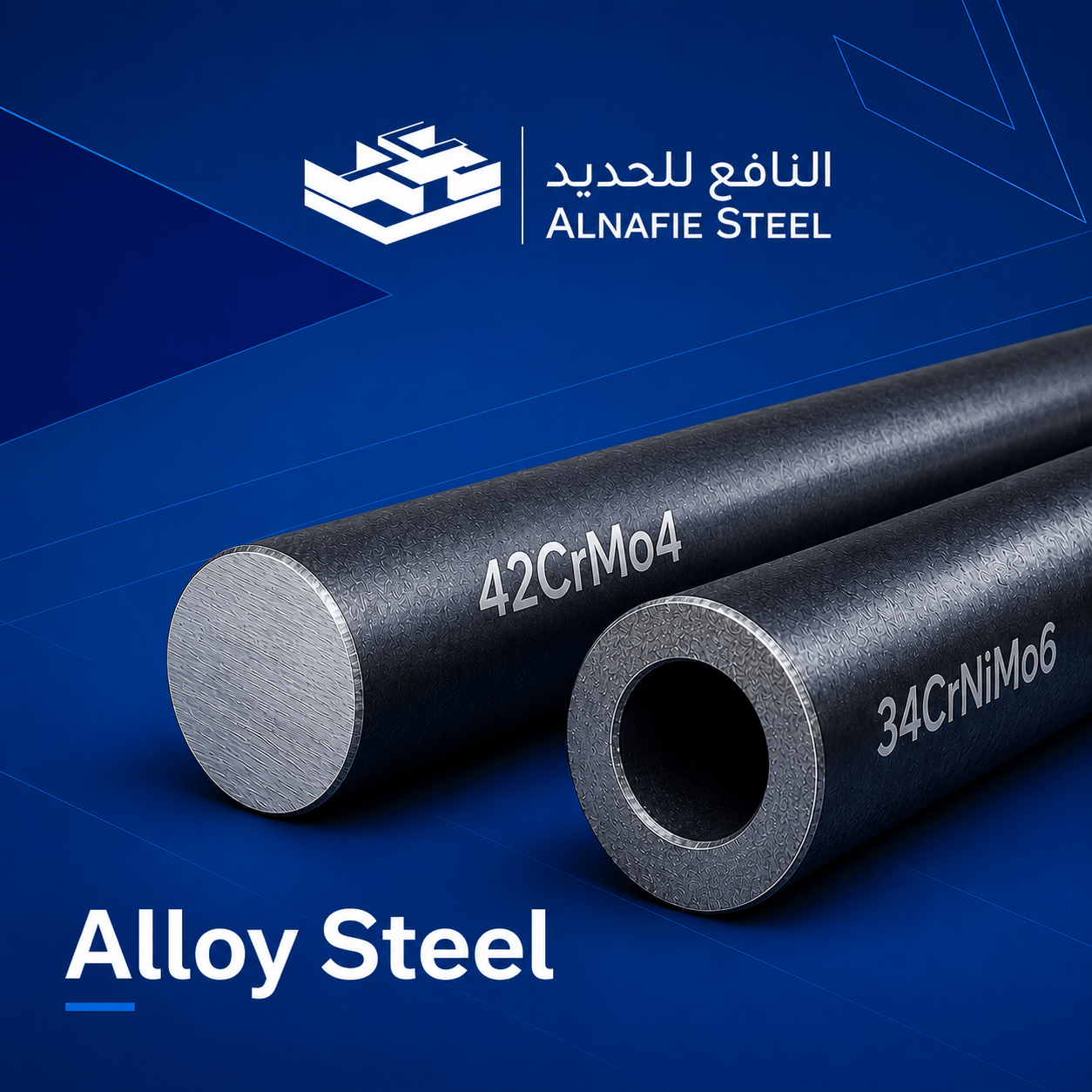
42CrMo4 (AISI 4140) is a chromium-molybdenum grade. Chromium provides hardenability and wear resistance; molybdenum supports strength at elevated temperature and reduces temper embrittlement. Quenched and tempered, it typically delivers tensile strength in the region of 900–1100 MPa depending on section size and tempering, machines predictably, and responds well to induction hardening and nitriding.
34CrNiMo6 (AISI 4340) adds significant nickel to the same chromium-molybdenum base. Nickel raises toughness and improves through-hardening, so large sections develop core properties closer to surface values. Quenched and tempered, it typically reaches around 1000–1200 MPa with better impact performance at equivalent strength.
| Consideration | 42CrMo4 | 34CrNiMo6 |
|---|---|---|
| Main additions | Chromium, molybdenum | Nickel, chromium, molybdenum |
| Typical Q&T tensile strength | ~900–1100 MPa | ~1000–1200 MPa |
| Toughness | Good | Superior, especially under impact |
| Through-hardening in heavy sections | Moderate | Strong |
| Relative cost | Lower | Higher |
| Availability | Very wide | More specialised |
42CrMo4 is usually right for general drive shafts, gearbox components, couplings and moderate section sizes, where loading is well understood and cost efficiency matters. 34CrNiMo6 earns its premium on large-diameter forged shafts where core properties are critical, components under impact or reversing loads, and safety-critical parts where failure cost far exceeds material cost.
A common and expensive error is ordering 34CrNiMo6 for a component 42CrMo4 would serve comfortably — and the reverse, specifying 42CrMo4 for a 300 mm forging and being disappointed by core hardness.
Heat Treatment and PWHT Considerations
These properties are created by heat treatment, not composition alone: annealing for machinability, normalising for uniformity, quenching and tempering for the strength-toughness balance, and case hardening for a hard surface over a tough core.
Welded components frequently require post-weld heat treatment, which relieves residual stress, tempers hard heat-affected zones and reduces hydrogen cracking risk. The correct PWHT temperature for alloy steel depends on grade, section thickness and the governing fabrication code — chromium-molybdenum grades are stress-relieved at substantially higher temperatures than plain carbon steels. The code and the material certificate, not a general table, must set the figure for any given job. Consumable selection matters equally; see our welding steel guidance.
Alloy Steel vs Carbon Steel
Carbon steel derives its properties almost entirely from carbon content. Alloyed grades add deliberate elements that change behaviour under heat treatment and in service.
| Factor | Carbon steel | Alloy steel |
|---|---|---|
| Composition | Iron, carbon, residual elements | Intentional Cr, Ni, Mo, Mn, V additions |
| Hardenability | Limited; thin sections only | High; effective in heavy sections |
| Strength range | Moderate | Wide, adjustable by heat treatment |
| Toughness | Adequate to moderate | Higher, especially nickel grades |
| High-temperature performance | Poor | Good in Cr-Mo grades |
| Weldability | Generally easier | Often requires preheat and PWHT |
| Cost | Lower | Higher |
Low alloy steel vs carbon steel is therefore not a question of which is better, but of whether the application needs depth of hardening, elevated-temperature capability or impact toughness.
Alloy Steel vs Stainless Steel
Stainless steel is an alloy of iron and chromium, with a minimum chromium content of roughly 10.5% and frequently nickel and molybdenum. That chromium forms a passive oxide film which regenerates when damaged, and that film delivers the corrosion resistance.
Stainless technically sits within the high alloy family, so alloy vs stainless steel is a question of which property governs:
- Choose alloy steel when mechanical performance governs — high strength, fatigue and wear resistance, heavy sections — and the environment is dry, protected or coated.
- Choose stainless steel when the environment governs — humidity, chlorides, chemicals, hygiene requirements, coastal exposure.
Saudi coastal and petrochemical conditions make this consequential — components in Jeddah, Dammam and Jubail see chloride exposure that low-alloy grades will not tolerate unprotected. Our stainless steel round, flat and angle bars cover the standard austenitic and ferritic grades for these environments.
Alloy Steel vs Aluminum
Alloy steel vs aluminum comes down to strength against weight, and to service environment.
- Density — aluminium is roughly one third the weight, decisive in transport and lifting applications.
- Strength and stiffness — steel is substantially higher; aluminium alloys cannot match heat-treated steel alloys in load-bearing capacity per unit area.
- Corrosion — aluminium forms a stable natural oxide and resists atmospheric corrosion well without coating.
- Temperature — aluminium loses strength at moderate temperatures where Cr-Mo grades remain serviceable.
- Cost — generally dearer per kilogram and cheaper per unit volume than steel.
There is no true aluminium steel alloy as a single homogeneous structural material; the two are separate families combined through coating or mechanical joining rather than alloying. For lightweight panels and non-structural work, aluminium plain sheets and coils are the appropriate product.
Aluminum Zinc Alloy Coated Steel: Where It Fits
Aluminum zinc alloy coated steel — sold as Galvalume or Aluzinc — is a carbon steel substrate coated with an aluminium-zinc alloy, typically around 55% aluminium and 45% zinc. It is a coated product, not an alloy steel, and the distinction matters when specifying.
The aluminium fraction provides a durable barrier and heat reflectivity; the zinc fraction contributes sacrificial protection at cut edges. The combination generally outperforms pure zinc galvanising in atmospheric exposure, which is why it is common in roofing and cladding across the Gulf. Where a zinc-coated product suits the application, galvanized sheet and coils remain the standard and more economical choice.
Alloy Steel Uses and Applications
Alloy steel uses cluster around components where failure is expensive and loading is demanding.
- Oil and gas — drill collars, valve bodies, wellhead components, flanges and fittings, often alongside ERW and seamless pipes.
- Mining and cement — crusher shafts, mill pinions and heavy gearing, frequently paired with wear resistant plates in high-abrasion zones.
- Power generation — turbine components, generator shafts, fasteners for elevated-temperature service.
- Manufacturing and machinery — gearboxes, spindles, dies, tooling, hydraulic components.
- Automotive and heavy transport — crankshafts, connecting rods, axles, transmission gears, suspension parts.
- Construction and infrastructure — HSLA sections in bridges, towers and long-span structures; high-strength fasteners and anchor systems.
- Marine and defence — components needing toughness under shock loading in demanding environments.
These sectors underpin much of Saudi Arabia’s industrial expansion, and reliable access to correctly certified material is a practical constraint on project delivery — one reason a well-stocked steel company with multi-city coverage matters to contractors and fabricators.
What Affects Alloy Steel Price?
Alloy steel price is quoted per tonne but set by several factors, and buyers comparing quotations should confirm the scope is equivalent.
- Alloy content — nickel, molybdenum and vanadium cost considerably more than iron, so nickel-bearing grades carry a structural premium.
- Raw material and energy markets — iron ore, scrap, ferroalloy and energy prices flow through to mill pricing.
- Heat treatment condition — quenched and tempered material costs more than as-rolled or annealed stock.
- Section size and product form — large-diameter forged bar and specialised profiles cost more per tonne than standard rolled sizes.
- Testing and documentation — additional mechanical testing, ultrasonic examination or third-party inspection adds cost.
- Origin and logistics — mill of origin, freight, customs duty and lead time all affect landed cost in the Kingdom.
The cheapest quotation is rarely the lowest total cost: material supplied without a proper mill certificate, or in the wrong heat treatment condition, transfers cost into rework and inspection.
Choosing the Right Alloy Steel Grade
A structured approach avoids the two common failures, over-specification and under-specification.
- Define the loading. Static, cyclic, impact or a combination. Fatigue and shock push toward nickel-bearing grades.
- Check the section size. Hardenability requirements scale with thickness; a grade adequate at 60 mm may be inadequate at 250 mm.
- Establish the service temperature. Elevated temperature favours molybdenum-bearing grades; low temperature favours nickel.
- Assess the environment. If corrosion governs rather than strength, move to stainless or a coated product.
- Confirm the delivery condition. Specify whether material is required annealed for machining, or already quenched and tempered.
- Plan fabrication early. Welding and machining requirements should influence selection, not be discovered afterwards.
- Insist on documentation. Request the mill test certificate with chemical analysis and mechanical results before acceptance.
Ordering by hardness figure alone, ignoring section size, and accepting delivery without chemical analysis are the errors that most often surface later as field failures.
Why Industrial Buyers Work With Alnafie Steel
Founded in 1979 and headquartered in Jeddah, Alnafie Steel has spent more than four decades supplying ferrous and non-ferrous metals to the Saudi market, with operations across Jeddah, Riyadh, Dammam and Dubai. Material is sourced from established global manufacturers and supplied to engineering, construction and manufacturing customers across the Kingdom and the wider MENA region.
Buyers with engineering steel requirements typically work with us for three reasons:
- Breadth of range. Engineering grades including 42CrMo4 and 34CrNiMo6, case hardening grades such as 16MnCr5 and 17CrNiMo6, tool steels, stainless grades, special alloys and non-ferrous products from one supplier rather than several.
- Technical input at enquiry stage. Grade selection, delivery condition and equivalence questions are handled before the order is placed.
- Coverage across the Kingdom. A multi-city presence supports projects in the western, central and eastern regions.
Frequently Asked Questions About Alloy Steel
What are the alloy steels?
Steels containing deliberate additions of chromium, nickel, molybdenum, manganese, vanadium or silicon, specified to improve hardenability, strength, toughness, wear resistance or high-temperature performance beyond plain carbon steel.
Is alloy steel good quality?
It is a high-performance category, but quality depends on the grade suiting the application, the heat treatment being appropriate, and the material arriving with a valid mill test certificate. A mis-specified grade is a liability regardless of its datasheet.
What is alloy steel used for?
Shafts, gears, axles, crankshafts, fasteners, valve and wellhead components, crusher and mill parts, turbine components, dies and tooling, and structural members in HSLA form.
Is alloy steel the same as steel?
No. All of it is steel, but not all steel is alloyed. Steel is the broad family of iron-carbon materials; this is the subset containing intentional alloying additions at specified levels.
What is the difference between alloy steel and stainless steel?
Alloy steel is optimised for mechanical performance and has limited corrosion resistance. Stainless contains at least roughly 10.5% chromium, forming a passive film that resists corrosion. Stainless is technically high-alloy, but the two answer different governing conditions.
What is the difference between alloy steel and carbon steel?
Carbon steel relies on carbon content alone; alloyed grades add elements that improve hardenability, toughness and elevated-temperature strength. They perform better in heavy sections but cost more and are generally harder to weld.
What are the main alloy steel grades?
In general engineering, 42CrMo4 (4140) and 34CrNiMo6 (4340) dominate, with 16MnCr5 and 17CrNiMo6 common in case-hardened gearing. Tool steel and heat-resistant grades cover more specialised requirements.
What are the properties of alloy steel?
High tensile and yield strength, controllable hardness and toughness, strong fatigue and wear resistance, good hardenability in thick sections, and retained strength at elevated temperature in molybdenum grades. Corrosion resistance is limited in low-alloy grades.
How is alloy steel used in industrial applications?
It is machined or forged into components, heat treated to the required strength-toughness balance, and installed in drivetrains, pressure systems, crushing and grinding equipment and turbines.
What affects alloy steel price?
Alloy content — particularly nickel and molybdenum — plus raw material and energy markets, heat treatment condition, section size, order quantity, testing and certification requirements, and origin and freight.
Is “alloy wheels vs steel wheels” related to this topic? No. That comparison refers to automotive wheels made from cast aluminium alloy against pressed carbon steel, and is a separate subject from industrial engineering grades.
Specify With Confidence
Alloy steel rewards precise specification. The right grade, in the right condition, at the right section size gives decades of service; the wrong one gives an unplanned shutdown. The decision rests on the loading, the section, the environment and the fabrication route — settled before the purchase order is issued.
Our technical and sales teams work with engineers, contractors, fabricators and procurement departments across Saudi Arabia to match requirements to available material. Send your drawings, specification or grade equivalence question and we will advise on suitable options and current availability.
Contact Alnafie Steel to discuss your alloy steel requirements, request product information, or get assistance selecting the right grade. As an established Saudi steel supplier, we are ready to support your next project.