Cast Iron: Types, Uses, and Its Relationship with Engineering Steel
In any industrial or construction project, the decision that determines success comes long before execution: which metal belongs in each part? Cast iron sits at the front of that decision — one of the oldest engineering materials still in daily use across factories and infrastructure, and one of the most misunderstood at the specification stage.
Getting it wrong is expensive. A casting placed where high tensile strength is required can fail without warning. This guide explains what cast iron is, how it relates to engineering steel and carbon steel, and when it is the right call — backed by the experience of Alnafie Steel in supplying the Kingdom’s industrial sector.
What Is Cast Iron?
Cast iron is an iron-carbon alloy with a carbon content above 2% — typically 2% to 4% — along with 1% to 3% silicon. That high carbon level is the key to the entire material.
The excess carbon does not dissolve completely into the metallic structure. Part of it separates as free graphite during solidification, and the shape of that graphite — flake or spheroidal — governs how the finished part behaves. The result:
- A lower melting point than steel, making casting easier and less energy-intensive.
- High fluidity when molten, allowing geometries that are difficult to forge or roll.
- Excellent compressive strength, far above the tensile strength of the same material.
- High vibration damping, decisive in machine bases and machining accuracy.
- Good machinability, since the graphite acts as a natural lubricant.
- Strong wear resistance under continuous friction.
- Good dimensional stability in parts requiring tight tolerances.
The trade-off is brittleness: little deformation before fracture, and welding that demands special procedures. That balance is why technical consultation before purchase is core to how Alnafie Steel works with clients.
The Most Widely Used Types of Cast Iron
| Type | Defining Property | Typical Application |
|---|---|---|
| Grey iron | Flake graphite, very high damping | Machine bases and engine blocks |
| Ductile (nodular) iron | Spheroidal graphite, higher ductility | Pipes, fittings, manhole covers |
| White iron | Extremely high hardness | Mill liners and wear parts |
| Malleable iron | Heat treated, improved toughness | Pipe fittings and small tooling |
Choosing the type is no minor detail: grey versus ductile can halve or double impact resistance in the same component. That is why Alnafie Steel begins every enquiry by defining operating conditions, before any discussion of grade or price.
What Is the Relationship Between Cast Iron and Engineering Steel?
Engineering steel describes the steel grades designed for machine components — shafts, gears, dies, transmission arms. They are selected on tensile strength, hardness, and response to heat treatment, and often contain alloying elements such as chromium, molybdenum, and nickel. The cast alloy belongs to the same ferrous family but sits at the opposite end of the carbon scale.
The relationship is complementary rather than competitive. Inside one machine you find a cast base providing stability, mass, and damping, while the rotating parts exposed to tensile and impact loads are made from heat-treated alloy grades — each material placed where it performs best.
The practical rule is simple:
- Static, compressive load, complex shape → casting is the better route.
- Moving parts under tension, bending, or repeated impact → alloy grades.
- Both requirements in one assembly → split the design into two materials instead of compromising.
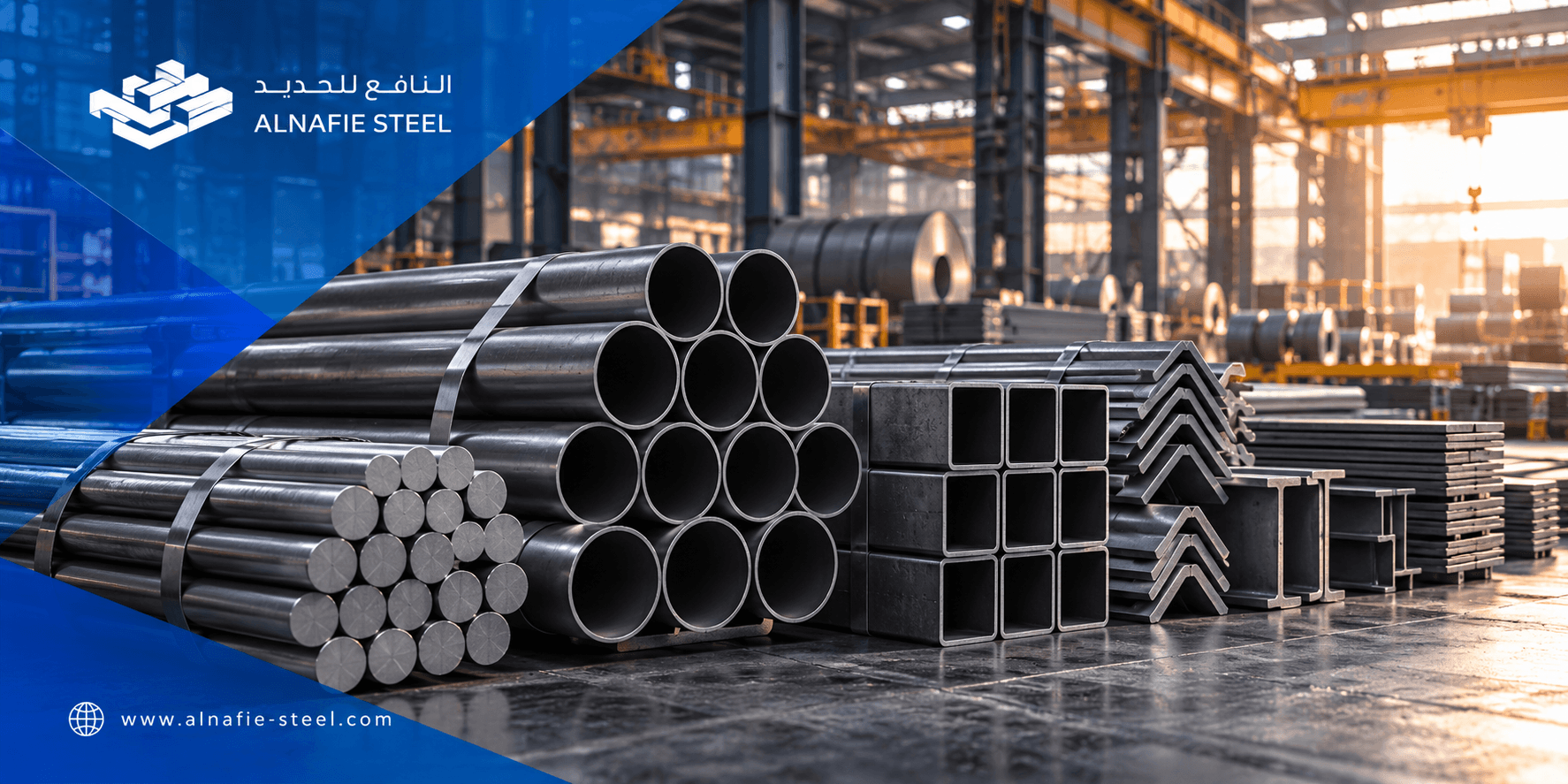
This is why Alnafie Steel supplies a broad range of special steel in multiple forms: round, hollow, hexagonal, and square bars alongside plates and flats.
The Relationship Between Cast Iron and Carbon Steel
One line separates the two materials: carbon content. Carbon steel stays below roughly 2.1%, while the cast alloy always crosses that threshold. Small on paper, yet it changes material behaviour completely.
In carbon steel, carbon stays dissolved within the structure, so the material keeps its ductility and its suitability for forging, rolling, and welding. In cast iron, part of the carbon separates as graphite, raising hardness, wear resistance, and damping while lowering ductility. The first is shaped by rolling, the second by pouring into moulds.
Quick Comparison Between the Two Materials
| Criterion | Cast Iron | Carbon Steel |
|---|---|---|
| Carbon content | 2% – 4% | Below 2.1% |
| Forming method | Casting in moulds | Rolling, forging, drawing |
| Tensile strength | Low to moderate | High |
| Compressive and wear resistance | Excellent | Moderate |
| Weldability | Difficult, needs preheating | Good to excellent |
| Vibration damping | Very high | Low |
The takeaway: castings for static, geometrically complex bodies; rolled sections for structures and parts exposed to tension and site welding. In mature projects the decision is rarely either/or, but a smart distribution of both across the design — and the Alnafie Steel team helps map it from the drawing stage.
Cast Iron Applications in the Saudi Market
You will find it where no alternative performs quite as well:
- Water and drainage infrastructure: pipes, fittings, manhole covers, drainage grates.
- Machine bases and housings: where vibration drops and accuracy holds steady.
- Energy and process industries: pump bodies, valve bodies, equipment enclosures.
- Wear-facing components: mill liners and mixer parts in cement and mining plants.
- Thermal applications: furnace and burner parts under repeated heating cycles.
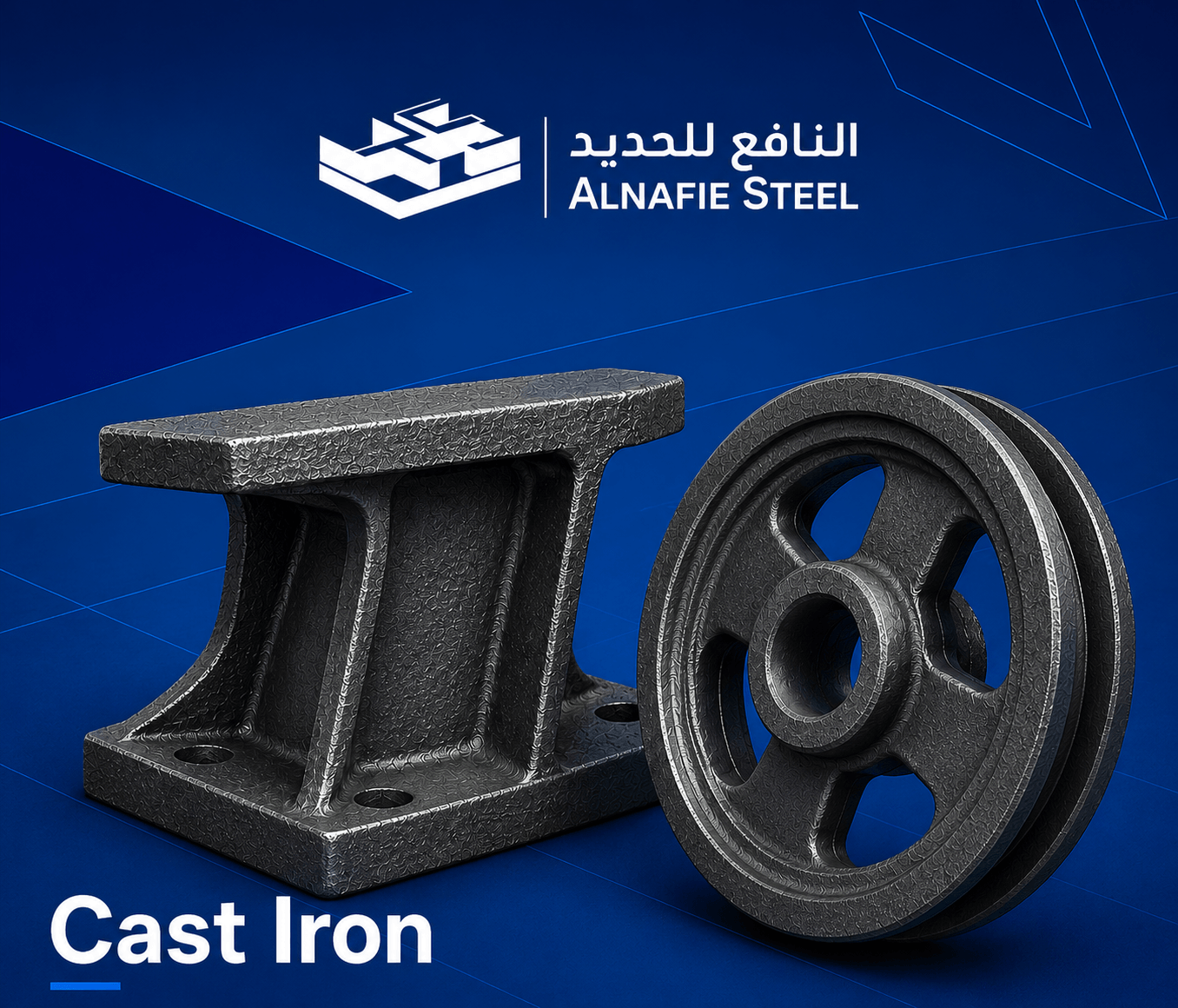
- Industrial spare parts: pulleys, brackets, and gear covers on production lines.
- Architectural work: gates, columns, and decorative elements.
As industrial projects expand under Vision 2030, demand for locally available castings has risen, and shorter lead times are now a direct competitive advantage. Alnafie Steel supports these sectors with the materials and sections behind mould tooling and fixing systems.
How to Choose the Right Cast Iron Grade
The right choice never rests on which material is stronger, but on load type, operating environment, and manufacturing method. In the Saudi context — high summer temperatures and salt-laden humidity in coastal zones such as Jubail, Yanbu, and Dammam — these criteria matter even more:
- Load type: steady compression points to grey iron; impact and cyclic loads point to ductile iron or engineering steel grades.
- Geometric complexity: hollow forms and compound curves cost less to cast than to machine.
- Operating environment: salt and moisture call for protective coatings or internal lining.
- Temperature: thermal cycling requires grades that tolerate expansion without cracking.
- Maintenance and spares: local availability of a replacement reduces downtime.
- Documentation: mill certificates and chemical analysis are mandatory on major projects.
This is where a supplier becomes a technical partner rather than a vendor. Alnafie Steel engineers match the required grade to the correct standard — ASTM, EN, or SASO — and provide certificates and inspection reports for every shipment, while our cutting and processing services reduce waste and shorten the fabrication cycle.
Products That Complement Cast Iron in Your Projects
Castings rarely work alone on site; they arrive within a wider material package, and Alnafie Steel supplies the rest under one roof:
- Reinforcement bar for the concrete foundations that carry machinery and heavy equipment.
- Commercial steel sections, angles, and plates for workshops and installation work.
- Hot rolled plates and coils for platforms, walkways, and fabricated structures.
- Wear resistance plates for hoppers, conveying systems, and material handling.
A single source keeps documentation and specifications consistent across the package.
Frequently Asked Questions
What is the main difference between cast iron and carbon steel? Carbon content and forming method. The first holds more than 2% carbon and is produced by casting; the second holds less than 2.1%, is rolled or forged, and welds easily.
Is cast iron stronger than steel? It is stronger in compression and wear, weaker in tension and impact. That is why it suits bases and static bodies, while steel suits load-bearing and moving parts.
What is the difference between cast iron and engineering steel? Engineering steel refers to grades built for machine components, with high tensile strength and response to heat treatment. The cast alloy is a high-carbon material known for damping, compressive strength, and complex shapes.
Can cast iron be welded? Yes, but under conditions: preheating, slow cooling, and specialised nickel electrodes to avoid cracking. In practice, mechanical joints are preferable wherever the design allows.
Does cast iron rust? Yes — it is a ferrous metal and oxidises with moisture, though the surface oxide layer advances slowly. Painting, galvanising, or internal lining provides protection.
What is the carbon percentage in cast iron? Typically between 2% and 4%, with silicon at 1% to 3%, which supports graphite formation during solidification.
How do I choose the right supplier? Look for accredited conformity certificates, chemical analysis for every batch, processing services, and technical support at the design stage — the criteria behind how Alnafie Steel works with industrial and construction clients.
Decades of Experience in the Steel Sector
Alnafie Steel is a steel company in Saudi Arabia and one of the top steel companies in Riyadh, Dammam, and Jeddah. It has traded steel and metals since 1979, from its headquarters in Jeddah with principal centres in Riyadh, Dammam and Dubai. Four decades in this market means understanding what contractors and fabricators actually need on the grating line item, not simply holding a size list.
Final Thoughts
Cast iron is not an outdated option the industry has moved past; it holds a permanent place in every plant and infrastructure project. It leads when the priority is stability, hardness, damping, and complex geometry, and steps back when high tensile strength or fast site welding is required. Understanding that dividing line is what saves a project from avoidable rework — and it is what Alnafie Steel builds with clients from the design stage.
Planning an industrial or construction project and need the right grade matched to the correct specification? Follow our news and insights for technical updates, or contact the Alnafie Steel team for advice and a quotation built around your requirements.