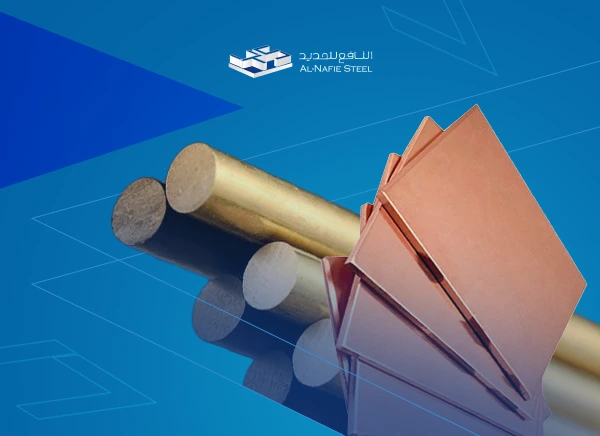
Brass sheet is one of the most widely used non-ferrous materials in factories, machine shops and engineering projects. Brass machines easily, resists corrosion, and conducts heat and electricity well, so it shows up in valves, fittings, electrical terminals, heat exchangers, and many other parts that have to perform reliably for years.
At Al Nafie Steel, we help industrial buyers across Saudi Arabia and the GCC choose the right brass sheet and copper sheet grade, thickness and size for their application, and prepare accurate quotations for project requirements.
What Is Brass?
Brass is a copper-based alloy with zinc added in different proportions. Changing the zinc content changes the alloy’s strength, color and formability. That’s why brass isn’t really a single material. It’s a whole family of alloys, and each one suits a particular job.
Brass has a golden-yellow color. It is easier to machine than pure copper, and it is stronger and harder too, while still holding up well against corrosion. That combination makes it a go-to material for valves, fittings and precision mechanical components.
What Is Brass Made Of?
Brass Composition
Brass is made mainly of:
- Copper: typically 55% to 90%
- Zinc: roughly 10% to 45%
- Small alloying additions: lead for better machinability, tin for seawater corrosion resistance, or aluminum and manganese for extra strength
More zinc makes the alloy stronger, cheaper and paler in color. More copper improves ductility, corrosion resistance and cold formability.
Brass Properties
| Property | Typical Value |
|---|---|
| Density | 8.4 – 8.7 g/cm³ depending on the alloy |
| Melting point | approx. 900 – 940 °C |
| Electrical conductivity | 25% – 40% IACS |
| Thermal conductivity | Good, but lower than copper |
| Magnetic | No |
| Machinability | Excellent, especially leaded grades |
| Corrosion resistance | Good in air, fresh water and most industrial environments |
| Friction | Low, well suited to moving parts and bearings |
For a manufacturer, brass offers a useful balance: it is stronger than copper, much easier to machine than steel, and cheaper than pure copper.
Brass vs Copper: What’s the Difference?
Engineers and procurement teams make this comparison all the time before they specify a material:
| Criteria | Brass | Copper |
|---|---|---|
| Composition | Copper + zinc alloy | ~99.9% pure copper |
| Color | Golden yellow | Reddish orange |
| Density | 8.4 – 8.7 g/cm³ | 8.96 g/cm³ |
| Melting point | 900 – 940 °C | ~1,085 °C |
| Electrical conductivity | Moderate | Highest after silver (~100% IACS) |
| Strength & hardness | Higher | Lower, more ductile |
| Machinability | Excellent | Fair (gummy when cutting) |
| Price | Usually lower | Usually higher |
| Best for | Valves, fittings, machined parts, terminals | Cables, busbars, HVAC tubing |
Bottom line: if electrical or thermal conductivity comes first, choose copper. If machinability, strength and cost matter more, choose brass.
Brass vs Bronze
Brass and bronze look alike, so people often confuse them, but the main alloying element is different. Brass is copper plus zinc. Bronze is mainly copper plus tin, sometimes with aluminum or phosphorus added.
- Bronze offers better corrosion and wear resistance, so it is preferred for bushings, gears and heavy-duty marine parts, but it costs more.
- Brass is easier to machine and more economical, which makes it the better fit for high-volume precision parts and fittings.
Types of Brass and Common Brass Grades
Copper alloys are classified under the Unified Numbering System (UNS), much like alloy steel grades are, with each number defining the chemical composition and properties. These are the most common grades in industry:
Popular Brass Alloys
| Grade | Common Name | Approx. Composition | Typical Use |
|---|---|---|---|
| C260 | Cartridge Brass (70/30) | 70% Cu – 30% Zn | Brass sheet, deep drawing, electrical terminals |
| C272 | Yellow Brass (63/37) | 63% Cu – 37% Zn | Sheet, strip, general fabrication |
| C280 | Muntz Metal (60/40) | 60% Cu – 40% Zn | Thick plate, hot forming |
| C360 | Free-Cutting Brass | Cu + Zn + ~3% Pb | Rods and CNC-machined parts |
| C464 | Naval Brass | Cu + Zn + ~0.75% Sn | Marine hardware, heat exchangers |
High-Purity Copper Grades
| Grade | Description | Typical Use |
|---|---|---|
| C110 (ETP) | 99.9% pure, high conductivity | Busbars, electrical panels |
| C122 (DHP) | Phosphorus-deoxidized copper | HVAC and refrigeration tubing, brazing |
| C101 (OFE) | Oxygen-free electronic copper | Electronics and high-vacuum applications |
Brass sheet and plate are generally produced to ASTM B36, copper sheet to ASTM B152, free-cutting brass rod to ASTM B16, and European supply to EN 1652. Putting the grade and standard on the purchase order is the best way to keep quality consistent from one delivery to the next.
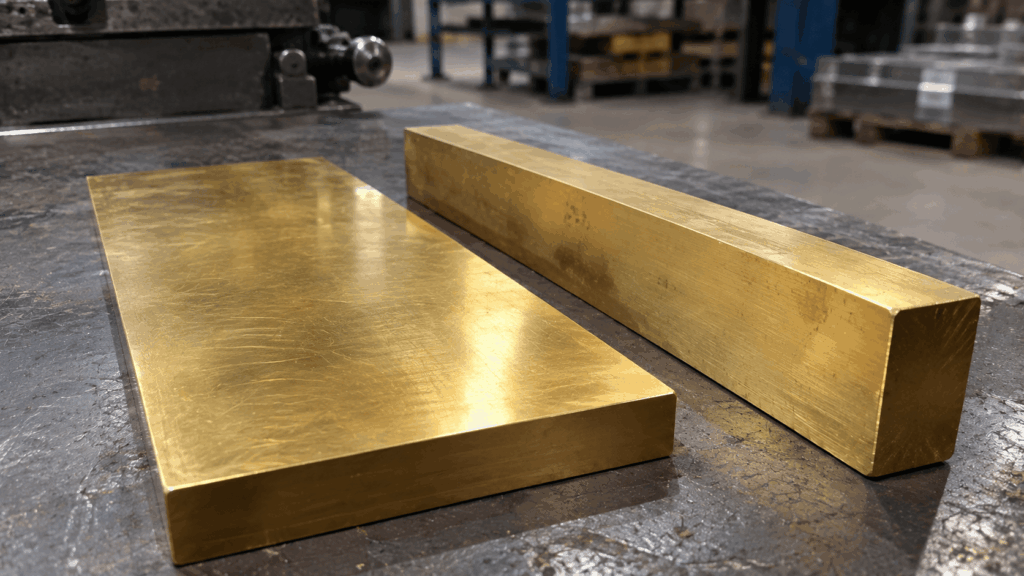
Brass Sheet, Plate, Strip and Rod
Brass sheet is only one of several product forms, and the right one depends on how the part will be made.
Brass Sheet
Flat brass sheet is produced by rolling, usually cold rolling, which gives a smooth surface and tight thickness tolerances, just like cold rolled sheet and coils in steel. Brass sheets are used for cutting, bending, forming and general fabrication, and come in soft, half-hard and hard tempers depending on how much forming the part needs.
Brass Plate
Brass plate is the thicker version of brass sheet. It is used for large machined components, fixture bases and machine parts cut from a single block.
Brass Strip and Coil
Thin brass strip and coil, slit from wide brass sheet, feed continuous production lines. Typical products are stamped electrical terminals, connectors and heat exchanger parts.
Brass Rod and Bar
Round, hex, square and flat bars are mostly supplied in C360 free-cutting brass for high-speed CNC turning of fittings, nuts, screws and valve parts. Where better acid or chloride resistance is needed, compare them with stainless steel round, flat and angle bars.
Brass Sheet Sizes, Thickness and Weight
Standard Brass Sheet Sizes
| Item | Common Range |
|---|---|
| Brass sheet thickness | 0.3 mm – 6 mm |
| Brass plate thickness | 6 mm and above, on request |
| Sheet dimensions | 1000 × 2000 mm – 1220 × 2440 mm (4 × 8 ft) – 1250 × 2500 mm |
| Strip and coil width | approx. 10 mm – 1000 mm |
| Cut to size | Available to project drawings |
Brass Sheet Weight Calculator
Brass sheet is priced by weight, so working out the weight is the first step in estimating cost. Use this formula:
Weight (kg) = Length (m) × Width (m) × Thickness (mm) × 8.5
(For copper sheet, use 8.96 instead of 8.5.)
Example: a 4 × 8 ft brass sheet (1.22 × 2.44 m), 2 mm thick: 1.22 × 2.44 × 2 × 8.5 ≈ 50.6 kg
Uses of Brass in Industry
Brass is used across many industrial and engineering sectors. The main ones are:
Valves, Fittings and Fluid Handling
Brass is the first-choice material for valves, taps, compression fittings and meter bodies because it resists corrosion and takes precise threads. Brass fittings are commonly installed on industrial piping such as ERW and seamless pipes in water, gas and compressed air systems.
Electrical Components
Brass is used for terminals, sockets, connectors, grounding hardware and switchgear parts. It conducts electricity well enough for these jobs and is strong enough to handle repeated tightening.
CNC Machining and Mechanical Parts
C360 is the industry benchmark for machinability. It is used to mass-produce nuts, screws, bushings, light gears and precision parts with minimal tool wear.
HVAC and Heat Exchangers
Brass alloys go into tube sheets, condensers and heat exchangers because they transfer heat well and resist corrosion.
Marine and Desalination
Naval brass is used for pump shafts, marine fittings and desalination plant components. In highly saline or acidic environments, stainless steel sheet and plates are worth comparing.
Safety-Critical Equipment
Brass is non-magnetic and much less prone to sparking than steel, so it is used in some equipment components at refineries and oil and gas facilities.
Architectural Finishes
Decorative brass sheet is used for cladding, stair nosings, floor dividers and signage in commercial projects. It has a premium metallic look and lasts a long time.
Advantages of Brass
- Corrosion resistance: brass doesn’t rust like iron, and it develops a protective surface layer over time
- Excellent machinability: higher cutting speeds, longer tool life and greater output
- Formability: brass sheet is easy to bend, draw and stamp cold, and high-zinc grades can be hot formed
- Good electrical and thermal conductivity, with more strength than pure copper
- Non-magnetic and low-sparking
- Low friction, well suited to sliding and moving parts
- Antimicrobial: brass sheet surfaces inhibit bacteria thanks to their copper content, which is useful in healthcare and food facilities
- Fully recyclable without losing its properties
Brass Price in Saudi Arabia: How Is It Calculated?
The price an industrial buyer pays for brass sheet is very different from the scrap price or the raw copper price on the exchange. It helps to understand the cost layers before you compare brass sheet quotes.
What Makes Up the Brass Price per kg
- Copper price (LME): the main benchmark, which changes daily on the London Metal Exchange.
- Zinc price and content: zinc is cheaper than copper, so the more zinc an alloy contains, the lower its cost.
- Conversion cost: melting, rolling, drawing, annealing and finishing. This is higher for thin brass sheet and precision rod.
- Freight, customs and insurance to the local warehouse.
- Supplier margin and value-added services: stocking, cut-to-size and mill test certificates.
Why Are Copper Prices Rising?
Copper makes up most of the alloy, so any rise in the copper price feeds straight into the brass sheet price. The main drivers are:
- Growing demand from the power sector: grids, data centers and urban expansion
- The energy transition and electric vehicles, which use far more copper than conventional technology
- Tight supply: falling ore grades at major mines and long lead times for new projects
- Energy costs and the US dollar, the currency metals are priced in
For current brass sheet pricing on a specific grade and thickness, contact our sales team for a detailed quotation.
Need help for your project? Call us today.
How to Choose the Right Brass Grade
- Manufacturing method: CNC machining calls for C360 rod, while deep drawing and stamping call for C260 brass sheet.
- Operating environment: marine and desalination service needs C464 brass sheet or dezincification-resistant (DZR) brass.
- Conductivity: if electrical conductivity is the top priority, C110 copper beats any brass alloy.
- Joining method: leaded brass is not suitable for welding, so use mechanical fastening or brazing instead. The requirements are quite different from conventional steel welding.
- Weight and cost: if saving weight matters and good corrosion resistance is still required, aluminum plain sheet and coils may be a more economical alternative.
Tip: in damp environments, don’t let brass touch carbon steel or aluminum directly unless an insulating barrier is in place. This prevents galvanic corrosion.
Brass and Copper Sheet Supply in Saudi Arabia
As an established steel company in Saudi Arabia with long experience in ferrous and non-ferrous metals, Al Nafie Steel supports industrial customers with material selection and sourcing across its special steel range, alongside its commercial steel products, and delivers through its branches in Jeddah, Riyadh, and Dammam.
Our team can help you with:
- Selecting the right brass sheet or copper sheet grade for your application
- Matching ASTM and EN specifications, with mill test certificates on request
- Defining brass sheet thicknesses, dimensions and cut-to-size requirements
- Scheduled deliveries for industrial and contracting projects
- Technical support as part of our services
Trusted Since 1979
Al Nafie Steel has been in the metals business since 1979 and has become a trusted steel supplier in Saudi Arabia for factories and contractors. As a steel supplier in Riyadh, as well as Jeddah and Dammam, our team gives practical technical advice to help you choose the right brass sheet or metal for every industrial application.
Talk to Us Today
Our team is ready to support your project from start to finish, serving project sites across every region of Saudi Arabia.
Frequently Asked Questions
What is brass made of?
Brass is an alloy of copper and zinc. Copper typically makes up 55% to 90% and zinc the rest. Small amounts of lead or tin are sometimes added to improve machinability or corrosion resistance.
What is brass used for?
Brass is used for valves, fittings and plumbing hardware, brass sheet fabrication, electrical terminals and connectors, CNC-machined parts, heat exchangers, marine and desalination equipment, and architectural finishes.
Which is more expensive, brass or copper?
Copper sheet is usually more expensive than brass sheet because copper is about 99.9% pure, while brass contains cheaper zinc. The final price of a brass sheet also depends on thickness, grade and processing cost.
How can I tell if something is brass?
A brass sheet is golden yellow, while copper is reddish orange. Brass is not attracted to a magnet, and its density is about 8.4–8.7 g/cm³. To confirm the exact grade, check the mill test certificate or use an XRF analyzer.
Is brass magnetic?
No. Brass and copper are both non-magnetic. If a piece sticks to a magnet, it either contains iron or is steel with a brass or copper plating.
What is the most expensive type of copper?
Among industrial coppers, oxygen-free electronic copper (C101) and beryllium copper alloys are some of the most expensive, because they are complex to produce and their alloying elements are scarce.
Why is the price of copper going up?
Demand is rising from power grids, renewable energy and electric vehicles, while mine supply is limited. Energy costs and the US dollar also move the price, and all of these feed into brass prices too.
Does brass rust?
Brass doesn’t rust the way iron does, but it can tarnish and darken over time. In seawater it can suffer dezincification, so naval brass (C464) or DZR brass is used for marine service.
What is the difference between brass and bronze?
Brass is copper plus zinc, and it is easier to machine and more economical. Bronze is copper plus tin, with better corrosion and wear resistance, and it is used for bushings, gears and heavy-duty marine parts.